


 Francais
 Deutsch
 Italiano

Refine Your Search
+"United States USA" +1945 stock footage and images
- Showing 193 to 198 of 404 results more
 Hide
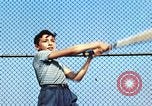
American people honor sailors of the U.S. Navy; views of towns, cities, people in the United States right after World War 2.
A film intended for U.S. Navy personnel about the return to civilian life after World War 2 and the better life of Americans in the United States as a result of their service. Film created immediately after the end of World War 2. A boy practices baseball, hitting the ball and running. View of the baseball diamond with a New York City bridge in the background. Women with children walk around in a park. A man greets a sailor of the U.S. Navy, shakes his hand and thanks him for his service. A mother talks to a child that is sitting on her lap as they read a book. Fishermen raise up fishing nets at a dock and process a catch of crabs. A man works in a laboratory. Dignitaries salute as soldiers march carrying the American flag. Two boys walk directly behind two U.S. Navy sailors and try to copy exactly how the sailors are walking. An elderly woman prays, kneeling in a church. People stand in a baseball stadium as the U.S. National Anthem begins to play. A sailor raises the American flag as other sailors stand at attention. Aerial view of a field in the U.S. Cattle graze on field. A man rides a bicycle in a small town, and tips his hat to a woman leaving a house. A boy with a manual push lawn mower cuts grass in the background. Automobile traffic in a small American town of the 1940s. Aerial view of the skyscrapers of a city. View of the U.S. Declaration of Independence. Houses or businesses and small boats and docks along a waterfront in Essex Connecticut. A board reads 'Here was built the Oliver Cromwell Connecticut warship in the Revolution 1776."

James Vincent Forrestal speaks in honor of U.S. navy personnel and welcomes them on behalf of citizens in the United States (WW2)
A World War II film about contribution of the U.S. Navy personnel for better life of Americans in the United States. United States Secretary of the Navy James Vincent Forrestal speaks in honor of men who served in Navy. He states that Navy men will adjust in civilian life as they were in World War II. He welcomes the Navy men on behalf of all civilians.
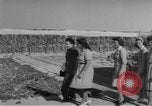
Madame Chiang Kai-shek with American Red Cross girls, boards C-54 Skymaster and leaves for Chongqing, China.
Soong Mei-ling or Madame Chiang Kai-shek, wife of Chairman of the Nationalist Government of China Generalissimo Chiang Kai-shek, leaves for Chongqing (Chungking), China from the United States. Madame Chiang with American Red Cross girls. She walks and speaks to the girls. Madame Chiang and the girls standing at the shore of a beach. Soong Mei-ling meets the U.S. officers and Generals. She is escorted by a Chinese official. Soong Mei-ling enters a car. She gets out of the car and climbs up a ladder. Soong Mei-ling boards C-54 Skymaster. The C-54 takes off for Chongqing. The aircraft in flight. A pilot and crew at controls. A crew member plotting a graph. The pilot at the controls talks. The crew members and the pilot talking.

Equipment is loaded and soldiers board railroad cars at railroad stations in the United States (WW2)
Role of U.S. railroads during World War II. Soldiers and officers walk carrying personal belongings in the United States. They enter a building. Railroad freight cars parked on a railroad station. Tanks and artillery parked. Transport and equipment loaded on flat cars moving along a track. Soldiers entrain for a war front. A railroad train carrying U.S. troops and cargo moves along a railway track, with the black locomotive approaching camera position.
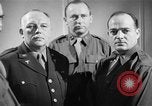
World War 2 Combat Exhaustion patients undergo personality tests, receive sleep therapy and various treatment in the U.S.
Treatment for combat exhaustion cases among U.S. soldiers following combat in World War II. U.S. officers talk about operation plan of a hospital and speak about three sections including admission, treatment and rehabilitation. A patient undergoes a physical examination. A dental survey and necessary laboratory studies. Doctors seated at table to perform an intelligence tests and mental examination. Psychiatric and other personality tests and intelligence test are administered including Rorschach test and Kohs block design test. The doctors check the psychiatric and physical report of the patient by looking at an X-ray. Patients receive sleep therapy: A nurse and an army doctor give narcosis therapy (continuous sleep treatment), by administering barbituates that keep a patient asleep for 18-20 hours per day for several days. Insulin is used on "loss of weight" cases: Combat exhausted soldiers lying on beds and receiving insulin before breakfast by nurses to stimulate their appetite. A nurse checks the weight of a patient during treatment. A nurse checks the diet which will be given to the patients in a kitchen. A patient receives an electric shock therapy treatment. A doctor injects a medicine into a patient. The patients go through physical exercises to maintain physical fitness. The patients are reeducated to know the causes of diseases. (Note: Clips deals with treatment for Combat Exhaustion, also later termed Post-traumatic Stress Disorder or PTSD.)
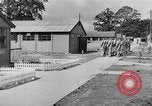
Combat Exhaustion patients receive military training at a center after the completion of treatment in the United States.
Reenactment of combat exhaustion treatment for U.S. soldiers from World War 2 combat. Patients receive military training at a training center after the completion of treatment. The patients march during the training. Rehabilitated patients pitch tents and drill. The patients receive training of sensible occupation therapy project, constructive and field projects, sports for physical coordination and team spirit. (Note: Clips deals with treatment for Combat Exahaustion, also later termed Post-traumatic Stress Disorder or PTSD)