


 Francais
 Deutsch
 Italiano
Refine Your Search
+"United States USA" +1945 stock footage and images
- Showing 343 to 348 of 405 results more
more Hide
Hide
A technician points to glowing LEDs and women work on machines including a printer in Pennsylvania, United States.
People work in the Moore School of Electrical Engineering in Pennsylvania, United States. Wires come out of a control panel. Numbered Light Emitting Diodes (LEDs) of the control panel glow. Technicians point to the glowing LEDs. A woman technician looks at a machine. A woman near a printing machine. She detaches a paper and takes it away.
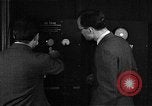
John Mauchly and J. Presper Eckert with ENIAC at the Moore School, University of Pennsylvania, United States
Moore School of Electrical Engineering at the University of Pennsylvania, United States. John Mauchly and J. Presper Eckert stand and talk in front of the Electronic Numerical Integrator And Computer, also known as ENIAC, their invention. A woman technician hands over paper results. Readings are taken from a meter on the control panel of the early computer (the first electronic, general purpose, programmable digital computer). A technician attaches equipment to a control panel. A woman works on a terminal interface while a man checks results using an abacus. Numbers are observed as they light on a display.
The U.S. Army Ninth Armored Division arrives in Camp Patrick Henry, Virginia, to be deactivated following World War II
Troops coming home to America at the end of World War 2. An Army Sergeant just returned from Europe, at the end of World War 2, stands on a pier, beside the troop ship USS General J. C. Breckinridge (AP-176). With him is a woman who wearing a jacket emblazoned with many emblems of U.S. military units. The sergeant places the insignia of the 10th Armored Division on her back. They hug and laugh. Scene shifts completely to 9th Armored Division soldiers at Camp Patrick Henry, Newport News, Virginia, holding the large sign originally placed on the Ludendorff bridge in Germany, by C Company of the 9th Armored Engineer Battalion during the war. It reads:"Cross the Rhine with dry feet, courtesy of 9th Arm'd Div." The soldiers carry the sign past a wooden building at the camp. Change of scene shows Ninth Armored Division troops arriving by train at Camp Patrick Henry. They march in loose order on train platform, with troop transport railroad train pulled into station. The happy soldiers march through a Victory Arch bearing words, "Welcome Home" at an entrance to the camp. More views of the troops marching into Camp Patrick Henry, where the 9th Division is to be deactivated. In the camp grounds, Sergeant reaches into his dufflebag and takes out a small puppy. ( Note: Vehicles: seen in this clip include: MB GPW, and CCKW)
Microscopic views of various bacteria.Surgeons combat bacteria by careful scrubbing prior to surgery
Surgical instruments in an operating theater.Microscopic views of bacteria, including those causing lockjaw and gangrene, respectively. Views of streptococus and staphylococus. Surgeons scrub before undertaking surgery. Cartoon animation of Bacteria and skin.
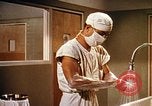
Illustrates danger of careless pre-surgical scrubbing. Partly animated clip includes cartoon showing bacteria.
Surgeon is seen scrubbing hands and arms for five minutes before performing surgery. When finished, he sneezes, but does not return to scrub and clean his hands again. Animated cartoon shows bacteria surviving the scrub brush bristles and remaining in place. Animation shows additional streptococcus bacteria descending onto surgeon's hands after doctor sneezes. The bacteria present through the scrubbing, and the new streptococcus bacteria talk to one another (voiced by Mel Blanc). The bacteria are isolated by surgeons rubber gloves before he begins patient surgery operation.

Illustration of carelessness and accidental contamination in surgical theater
Surgical theater. Patient brought in. A patient to be operated upon. Doctor with contaminated hands accidentally spills instruments and cuts his rubber glove. Discards only one instrument although unsure which one actually caused the cut glove. A contaminated instrument remains and is used in the surgery.