


 Francais
 Deutsch
 Italiano
Refine Your Search
+"United States USA" +1945 stock footage and images
- Showing 37 to 42 of 405 results more
more Hide
Hide
USAF Lieutenant General Ira Eaker speaks about his experiences in the U.S. Air Force in the United States.
An interview of United States Air Force Lieutenant General Ira Eaker conducted by Dr. Maurer in the United States. Dr Maurer and General Eaker seated at a desk. Dr Maurer talks about the work and the contribution of General Eaker in the U.S. Air Force. He says that General Eaker was the Commander of the 8th Air Force. In 1944, he became the Commander in Chief of the Mediterranean Allied Air Force. Then from 1945 until his retirement in 1947, he was the deputy commander of the Army Air Forces and chief of the Air Staff. General Eaker talks about his experiences. He talks about the first airplane flight he saw. He further speaks that he was sent to a training camp in 1917. A man came in the camp looking for some fliers. He was already selected for an examination of regular army. He says that in November 1917, he was on a parade grounds. An airplane was in flight overhead. The aircraft landed and he looked at the engine of the aircraft.
Contributions of African Americans in various fields in the United States.
(See also clip 65675078146 from different film transfer). Famous African American men and women citizens in the United States. Clip opens with of Booker T. Washington at Tuskegee University. Scene in a laboratory with African American scientist and inventor George Washington Carver, as an elderly man, working with another scientist in the laboratory. African American judge of New York city court. African American explorer Matthew Henson is seen looking at a globe (he was with Admiral Peary planting the American flag at the North Pole in 1909), and an unnamed African American surgeon at work in an operating room in New York. Next scene shows famous "father of the blues" musician and composer W.C. Handy (William Christoper Handy) smiling. Next is seen the financier and publisher of the Amsterdam News, Dr. C.B. Powell (Clilan Powell) greeting three uniformed African American women during a World War 2 war bond drive, and handing them a check (close up is shown) for 25,000 dollars, dated January 4, 1942, for the war bond drive. It is from the account of the Victory Mutual Life Insurance Company which Dr. Powell also owned. The check is signed by C.B Powell and Philip M.H. Savory (Dr. Savory was co-owner of the New York Amsterdam News). The next scene shows Elise Johnson McDougald, better known as Gertrude Elise Ayer, who was the first black full-time public school principal after the consolidation of New York City schools in 1898. She was also a noted woman writer during the Harlem Renaissance. She is seated in her office at her desk, likely in P.S. 119 in Harlem, since this is approximately year 1945 and she was at P.S 119 at that time. Her name plaque is visible on the front center of the desk. Principal Ayer smiles as a woman delivers a document to her. Next is seen the African American historian, author, and professor, Lawrence D. Reddick, serving in his role as the curator of the Schomburg Collection of African American Literature. In an art studio is seen the famous African American sculptor and painter Charles Alston, at work on a sculpture. Next scene shows the famous African American contralto singer, Marian Anderson, receiving a bouquet of flowers and smiling after a performance. This transitions to a view of African American orchestra conductor Dean Dixon leading an orchestra in a performance of Beethoven's 9th Symphony. Several views of different sections of the orchestra performing under Dixon's direction. Clip closes with brief shots of campuses of several historically black colleges and universities in the United States like Howard University, Hampton, Tuskegee, Fisk, Prairie View. An American college football game underway at the stadium of one of the colleges.
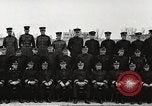
Naval officers photographed at The Naval Operating Base, Hampton Roads, Virginia in 1925.
The Naval Operating Base, Hampton Roads, in 1925 (re-designated "U.S. Naval Station Norfolk," in 1945). Opening scene shows Senior Naval officers (mostly captains plus a couple of rear admirals) seated in front row, and two rows of others officers standing behind them. At one point, they all remove their caps. Behind them is a concrete wall. But tops of some some buildings can be seen behind in the background. Closeup of a seated young rear admiral flanked by captains. In change of scene, all the officers are seen standing at attention, side-by-side on a gravel waterfront area, with a river and numerous buildings on the opposite shore visible in background. The camera pans across the assembled officers. Next, officers are seen on the waterfront, marching in white hats and carrying swords. (In these scenes, the motion is too fast, due to lack of compensation for low hand cranking speed of source camera.) The officers stop and stand in formation, and then march away.
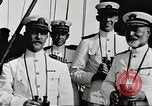
Chief of Naval Operation, Vice Admiral Edward W. Eberle at The Naval Operating Base, Hampton Roads, Virginia in 1925.
Vice Admiral Edward W. Eberle at Naval Operating Base, Hampton Roads in 1925. (The base was re-designated "U.S. Naval Station Norfolk," in 1945). Opening scene shows Admiral Eberle, Chief of Naval Operation, standing on deck of a ship with a captain, a Commander, and a Lieutenant Commander. They are pointing and peering through binoculars at objects (likely aircraft) passing overhead. Next, a Navy launch is seen entering a channel and moving toward the camera. It arrives at a dock is made secure by sailors. Vice Admiral Eberle then steps to the dock, followed by a Captain, a Commander, and several other naval officers, who line up on the dock They exchange salutes with the Admiral, who then ascends stairs followed by his retinue. The last scene is reconstituted and re-filmed. This time, naval staff officers are lined up beside the launch. They salute as Admiral Eberle steps from the launch, followed only by a staff Lieutenant Commander. The admiral then proceeds up steps, followed by officers on his staff. Another scene shows Admiral Eberle, standing on the dock with senior members of his staff behind him.
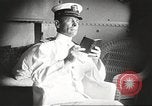
Scenes of Naval Operating Base, Hampton Roads, Virginia in 1925
Naval Operating Base, Hampton Roads, Virginia (renamed U.S. Naval Station Norfolk, in 1945 ). U.S. Navy Commander seated in a chair aboard a ship. A large group of civilian businessmen and officials pose on board a ship with several American Navy officers and one British Naval officer, for a photograph. Some of them stand and some are seated. One civilian stands in front of the group and poses with an American Navy Captain. Change of scene shows Admiral Way on the Navy Base, containing mansions and other structures from the 1907 Jamestown Exposition. It is a very windy day and several civilians are seen on a sidewalk and entering a large building on Admiral Way. Numerous Navy personnel in uniform are seen in the area, including a number of Naval officers entering that building and others heading there along a sidewalk. Residential mansions are seen in the vicinity along Admiral Way.
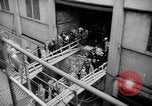
A large number of visitors board the USS Wasp at the Puget Sound Navy Yard, Bremerton, Washington
Visitors board and crowd the deck of the USS Wasp (CV-18) in June, 1945, near the end of world War II. The Wasp is about to depart again, for the Western Pacific, following repairs at Puget Sound Navy Yard, Bremerton, Washington. Two U.S. marines are escorting two women, and showing them an F4U Corsair airplane on the deck. Some of the visitors look up toward the camera. The aircraft on deck have been arranged for this static display. visitors are seen departing across a gangplank. Views from deck of the Wasp, of Navy personnel on the pier, below. Camera pans across the pier where spectators still stand. A few people stand on the water side of a building. A large group of visitors coming up from the hangar deck. Civilians and sailors wave at the camera. Visitors leaving the carrier on the gangplank.