


 Francais
 Deutsch
 Italiano
Refine Your Search
+"United States USA" +1946 stock footage and images
- Showing 7 to 12 of 184 results more
more Hide
Hide
The United States demobilizes following World War II
Opening illustrated slate shows reduction of Amercan Armed forces personnel from more than 12 million in 1945 to only a little over 1 and a half million in 1947. U.S. Navy submarines are seen docked in storage. Men work spraying protective coatings over guns on Navy ships as they are placed in storage in the "Mothball Fleet." A lone sailor is seen on the deck of a ship with vast number of mothballed Navy destroyers in the background. A B-24 Liberator bomber being dismantled and a B-17 parked with engines removed, seen through stack of propellers in foreground. Airman sets a demolition charge. Views of several bomber aircraft being blown up as junk. Stacks of junked and scrapped American war materiel rusting. View inside a mill where molten metal is being processed (ostensibly recycled from junked war materiel). Narrator speaks of beating guns into plow shares. Several views of molten metal being poured into and from ladles. Views inside post-war factories returning to peace-time production, where industrial heavy equipment, railroad wheels, kitchen appliances, home appliances, rubber tires, and new 1946 Ford automobiles are assembled (looking exactly like the 1942 models).

Launching of NATIV missile under Project MX770 in California United States.
A scientist makes a presentation of Project MX770 showing coverage of model and various phases of missile development from 1946-1951. Development of NATIV (NORTH AMERICAN TEST INSTRUMENTATION VEHICLE) missile is between 1946-47 while NAVAHO is developed between 1948-49.The presentation shows the pulling of test vehicle under launching tower and its vertical position. A technician ties guide wires near the top of the missile.The missile is fired. Graphical presentation shows the parabolic pathway of missile showing altitude of 400mt and speed of mach8 (2722.32m/s). The firing range of Navaho is 3000mt from surface to surface.The missile uses Ramjet engines. Models of three missiles are also shown.
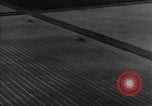
Views of the United States. Farms, cities, highways, and beaches. Destruction in Japan by atomic bomb. U.S. infantry in combat
Farmers harvesting grain and corn with machinery on American farms with a narrow tractor harvester. Steel mills and heavy industry and cargo railroads in the United States. Industrial views with smokestacks releasing much smoke and smog (also pollution scenes). Scenes of New York City with busy streets filled with cars, buses, and truck traffic, together with pedestrians. Many varied 1940s and 1950s cars on the roads. Elevated and also aerial views of U.S. highway networks busy with 1940s and 1950s cars. Views of Jones Beach, on Long Island, New York. Scenes of destruction in Japan from the atomic bomb, with sweeping views of destroyed city in Hiroshima or Nagasaki circa 1945 or 1946. U.S. Army infantrymen engaged in house-to-house fighting in Europe during World War II, firing rifles and moving between points of cover in a city filled with rubble.
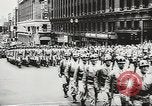
Work and achievements of Harry S. Truman during his first Presidential term in the United States
President Harry S. Truman marches with veteran soldiers of U.S. Army Company D (129th Field Artillery) with whom he served as an officer in World War 1. Wide view of men lined up on White House lawn. Disabled veteran soldiers of World War 2 greet the President. Narrator discusses problem of lack of housing for veterans and their families after World War 2. Aerial view of trailer homes or recreational vehicle (RV) camper units lined up in open space, serving as temporary housing for veterans. Truman sitting at desk while he signs the Veterans Emergency Housing Act of 1946. Views of long lines of new homes being built, and construction workers hammering to build frames of new houses in the United States. During a time of price inflation, scene shows grocer changing price signs on eggs, meats, cheeses to show increasing prices. Truman ata work in his office reviewing paperwork at his desk. Narrator mentions Taft Hartley Labor Act that Truman vetoed. View of car on road with sign on side that reads, "Veto Hartley Taft Slave Labor Bill." President Truman reading at his desk. Close up view of cover page of report entitled "To Secure These Rights. The Report of The President's Committee on Civil Rights. View of Episcopal church Bishop Henry Knox Sherrill seated at a desk. Bishop Sherrill is talking to another man. Narrator states that Truman acted on a civil rights program recommended by Bishop Sherrill, head of the Civil Rights Commission. Car pulling up to portico of White House and view of President Truman shaking hands with visiting President of Mexico, Miguel Alemán. President Truman being presented a sacred Torah by Israeli President Weizmann. Discusses foreign policy matters with Secretary of State George Marshall and comes up with Truman doctrine, Marshall plan and European recovery program. View of Truman signing Economic Cooperation Act of 1948 on April 3, 1948 (of which the Marshall Plan was a part).
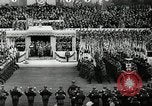
From Labor Department documentary. Montage of World War II scenes from start to finish,including American home front.
Opening scene shows Adolf Hitler reviewing German troops on parade. German paratroopers jumping from Junkers Ju-52 aircraft. View from the ground of paratroopers descending from three Ju-52s. The Japanese attack on Pearl harbor, December 7, 1941. Heavy smoke rising from the leaning USS Arizona after she is hit by bombs. Newspaper headline reading "Pearl Harbor Bombed!" American soldiers leaving Camp Stoneman, are seen assembled on a pier at the Pittsburg California waterfront to board one of the ferries that would take them to Piers 15 and 45 on the Embarcadero in San Francisco. A sign at pier reading:"Through these portals pass the best damned soldiers in the West." Glimpses of soldiers firing howitzers in World War 2. Glimpses of the civilians supporting the war effort. Auto factory workers walking near a war production plant during shift change. A new army truck leaves a factory. War production workers assembling the turret on a Sherman tank. Guns and turrets being manufactured. Factory floor filled with new pursuit airplanes. A B-25 Mitchell bomber aircraft taking off. Aerial view from bomber of its bombs exploding over enemy target below. Freight trains carrying United States military supplies. Supplies being loaded aboard a ship for the U.S. and Allies. The American battleship USS New Mexico firing a gun, and firing guns from triple turrets. Workers assembling aircraft engines in a war plant. A woman at work in a war materiel production plant. Gun camera images from warplane strafing a ground target. World War 2 Victory parade along 5th Avenue, New York City, in 1946. Washington Square triumphal arch in background. Various views of the parade. Laid off war plant workers looking for new jobs. Troops welcomed home: Ship carrying returning United States soldiers back home after the end of World War 2. Disabled soldiers and sailors, such as some who were wounded in battle and lost limbs like arms or legs, making their war to a Military Air Transport Service C-54 aircraft. More views of the disabled veterans who were injured during World War II.
Some U.S. Army soldiers focusing on leisure after World War 2, and some attend Army extension classes in the United States.
A post-war U.S. Army film (after World War 2) in 1945-1946 contrasts dice and pool playing soldiers with the soldiers who take Army extension classes to prepare for jobs in civilian life following demobilization and discharge from the Army. Group of U.S. Army soldiers in a room as they play pool at a billiards table. Soldiers in a barracks room seated on a bed and on the floor throwing dice in a game of craps. The soldiers play cards and smoke. Contrast is shown with U.S. Army students seated in a class. An officer takes lessons. A soldier takes notes. A young teacher or professor explains a concept with the help of a blackboard. View of the Hôtel Miramar in Biarritz, France (built in 1927 and demolished in 1978). Aerial view of a building with interconnected corridors. Street level view of the University of Calcutta Senate Hall in Calcutta (Kolkata), India (hall designed by Walter Granville; one time home to the Asutosh Museum of Indian Art; demolished in 1960). People walking in front of the Senate Hall as a car and a pulled rickshaw go by. In next scene, a sign reads 'Fox-Hole Campus'. An officer holds a mechanical model and explains a concept to students. A soldier works with equipment and an African American soldier stitches clothes at a sewing machine. A sign "Learn today; Earn tomorrow" as soldiers learn skills to help them in the civilian sector after separation from the armed forces. A solder works on a model. Pamphlets on a desk with the names of different subjects written on them that U.S. Army students can study to learn skills and jobs, including Automobile Repair Shop, Retail Bakery, Service Station, Grocery Store, Metal Working Shop, Shoe Repair Business, Small Sawmill Business, Beauty Shop.