


 Francais
 Deutsch
 Italiano
Refine Your Search
+"United States USA" +1953 stock footage and images
- Showing 7 to 12 of 205 results more
more Hide
Hide
U.S. Army Infantry in action. Taking prisoners. Negotiating a truce. Operating a tactical nuclear weapon atomic cannon.
U.S. Army troops moving through an enemy town on foot and in vehicles and tanks. U.S. Army infantry taking prisoners during the Korean War. A sign at Prison camp reads: "POW Camp #1, Utilities, Carpenter Shop." American troops process prisoners of war. Each is registered and given a POW identification to be worn at all times. Korean truce being signed at Panmunjom, in 1953. Amphibious assault forces underway at sea and troops wading ashore. A field headquarters in combat zone, where U.S. Army commanders are being briefed by an Intelligence (G2) officer. U.S. Army troops in camouflaged positions. U.S. tanks firing their guns and moving in a line. U.S. Army atomic cannon or nuclear cannon (e.g., M65 or Atomic Annie) firing tactical nuclear explosive shells. Various sized atomic bomb or nuclear bomb explosions from the shells. Army technician monitoring radiation readings on a tank exposed to tactical nuclear weapon effects. An airman hosing down an airplane exposed to radioactivity.
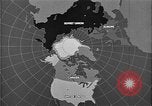
Cold War scenes: Soviet military on parade in Red Square; U.S. Army placing gun batteries in U.S. residential areas
Opening scene shows animated map of northern part of the earth, centered on the North Pole. It depicts the shortened flight paths between various parts of the Soviet Union, and the United States via polar routing, representing bombing threats. The Soviet Red flag flying on a flag pole. A large number of Soviet Tupolev Tu-2 bomber aircraft parked at an airfield. (They are equipped with four-bladed AV-9VF-21K variable pitch propellers.) Aerial view of several Russian Tu-2 aircraft in flight. Closeup of aircraft's twin tail showing dihedral angle between them, as viewed from tail of the aircraft. View of military parade in Red Square, Moscow. Numerous open army trucks, filled with Soviet troops, drive in formation. In a closeup, the Soviet State Museum building dominates the background. Closeup of Georgi Malenkov (who was named premier and first secretary of the Communist Party of the Soviet Union, upon the death of Joseph Stalin, in March 1953). He reviews the parade from the Kremlin. Soviet Secret Police Chief, Lavrentiy Beria, stands beside him. Army motorcycle troops pass in formation. Lenin Mausoleum and Kremlin Walls in background. Closeup of Soviet military veterans in civilian clothes, with medals, watching the parade. More troops in open trucks. They pass large posters of Lenin and Stalin. Closeups of Soviet civilians including women and children. A group of Asian persons watching the parade. View from a high point overlooking Red Square showing lines of army trucks snaking around both sides of St. Basil's Cathedral, as they leave the square, past Lenin's Tomb. Closeup of Soviet soldiers saluting with rifles as they pass reviewing stand. Their truck is towing a field howitzer equipped with two tires on each axle. Closeups of several towed howitzers. Scene shifts to Elizabeth, New Jersey, United States, where army jeeps and artillery pieces maneuver on the city streets, in preparedness exercises during the Cold War. A woman hanging laundry out to dry on a line. Artillery being placed in a vacant lot near a residential neighborhood. A woman looks out her apartment window at the gun being placed in the lot. Soldiers uncover it, revealing a 120 mm M1 anti-aircraft gun. Young boys watch the activity from a backyard, where clothes are on a line to dry. The soldiers erect a radar antenna on a fire control trailer. Two women watch the activity from their apartment window. Closeup of the gun installed and ready. A radar antenna rotating in the field. A battery of several antiaircraft guns installed in the field. Cars and pedestrians on busy streets and sidewalks in the city. Children playing on monkey bars in a park. Distant view of military temporary buildings and guns installed near apartment buildings. An alarm clock. A rotating radar antenna. A civilian asleep in his bed. A soldier steps from his unit's orderly room and blows a whistle. The disturbed civilian in bed looks at his clock reading 5:30 AM and expresses disgust. He is next seen with friends, registering a complaint with an Army Captain in his office, who agrees to resolve the matter. An Army Officer is seen standing at a large chalk board explaining how and why anti aircraft guns are being installed across the area, as civilians watch and listen to his explanation

Chief Justice of Supreme Court, Earl Warren and other judges pose in the United States.
U.S. Supreme Court Justices of the 1953 session. Group showing Felix Frankfurter, Hugo Black, Chief Justice Earl Warren, Stanley F. Reed, William O. Douglas, Tom C. Clark, Robert H. Jackson, Harold H. Burton and Sherman Minton, posing for the camera. Views of them as they talk.
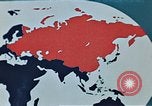
American Information Agency film showing that people in friendly countries also hold misconceptions about America and Americans
From a U.S. Information Agency film about the role of that agency. Colored map shows Soviet- controlled area in red and other areas in blue. Expressing concern about false impressions among Allies, regarding America and Americans, a chart is shown depicting results of a public opinion poll conducted in January 1953. In this poll French respondents expressed the view that Americans have poor taste; are overgrown children; and are only interested in money. and no family life. Narrator adds that many French also believe most Americans live in skyscrapers and have no family life.
USIA film describing the ways it conducts its world-wide operations
Segment of U.S. Information Agency film describing its world-wide operations. Map shows 217 overseas posts in 17 countries, of the USIA (also known abroad, as the U.S. Information Service). Animated map zooms in on one post, in Rio de Janeiro, Brazil. Aerial view of Sugar Loaf Mountain overlooking the harbor and city. Street scene in Rio. USIA Public Affairs Officer, William A. Wieland, is seen walking along a sidewalk in the city. Next he is seen in the office of Ambassador James S. Kemper, briefing him about USIA activities. View of the Brazilian Foreign Office building. Mr. Wieland meets with the Chief of the Cultural Division there. Book stacks in the USIA Thomas Jefferson Library in Rio de Janeiro. Mr. Wieland conferring with a librarian. He is also seen at the USIA broadcast facility in the U.S. Embassy. Film shifts to street scene in Cebu, the Philippines. A building displaying American and Philippine flags, is labeled: " United States Information Service." Inside, and American and a Filipino worker give bundles of literature to local workers for distribution. One, a bus driver, carries his bundle onto his open-sided bus, displaying the name, "Cebu, Autobus." He waves as he drives away. The USIA Public Affairs Officer is seen visiting the Mayor of Cebu City, Vincente S. del Rosario; giving a news release to the editor of a newspaper; broadcasting on local radio;and socializing with local editors. USIA drive a mobile movie van into a remote village where many children are playing. They set up a screen and projector. Almost everyone in town attends the showing. Scene shifts to USIA headquarters building at 1778 Pennsylvanis Avenue,in Washington, DC. Director Theodore Streibert holds a staff meeting. View of President Eisenhower addressing U.S. public media leaders about confronting the Soviet Union with truthful information about the U.S. and the West, on April 16, 1953,in Washington, DC. A USIA technician transmitting text of the speech to its public affairs officers around the world. Views of newspapers carrying the story in Paraquay, Ireland,Algeria, and Burma. The President's speech was printed in a pamphlet entitled "The Peace We Seek," ahd sent abroad where it was translated into Arabic,Japanese, Persian, and 20 other languages. Four million copies were distributed. Posters about the speech were also distributed.
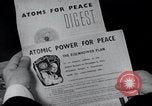
Voice of America broadcasts President's speech and USIS "Atoms for Peace" exhibits are presented worldwide
President Eisenhower of the United States addresses United Nations on December 8, 1953 about atomic bomb and atomic weapon dilemma in the nuclear age (part of Atoms for Peace initiative). Operators in radio transmission control rooms note down readings. View of time clocks of various places in the world including Honolulu, New York, London, Moscow, Calcutta, Bangkok and Tokyo displayed. The Voice of America broadcasts program in different languages by announcers. Scene of a family sitting in a living room as they listen to the president's speech on a console radio. People work at typing, printing, and translating the speech. USIA motion pictures service prepare newsreel of president's speech. A man views air mail of USIA films. Exterior views of several different United States embassy buildings worldwide. A guard standing outside the building. A Public Affairs Officer at the U.S. embassy in Japan, in Tokyo, meets with U.S. Ambassador to Japan Robert Murphy. USIA members seated around table for meeting, and, in Washington DC, creating publications about the Atoms for Peace program. People seated in a USIA library in Brazil read books and various USIA materials. Architects design 30 foot high Atoms for Peace exhibits. An exhibit being setup in a foreign country (possibly in North Africa). Exterior and interior views of the West Berlin, Germany Atoms for Peace exhibit. Prime Minister Jawahar Lal Nehru in India is seen arriving in a jeep to view the Atoms for Peace exhibit in India. Prime Minister Nehru inside the exhibit hall watching a presentation. In Japan, a woman operates remote-controlled robotic hands to hold radioactive materials, at a demonstration for Japanese citizens. In a city in Italy, a view of a mobile van unit carrying an Atoms for Peace exhibit. Scenes from a film "A is for Atom" that was translated into 30 languages and shown all over the world. Wide view of the Kremlin in Moscow, Russia, Soviet Union. A Russian radio commentator speaking at a microphone. Propaganda dramatization showing the Russian announcer attacking American plans for Atoms for Peace.