


 Francais
 Deutsch
 Italiano
Refine Your Search
+"United States USA" +1954 stock footage and images
- Showing 7 to 12 of 145 results more
more Hide
Hide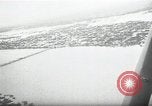
Aerial views of Rio Grande River flood resulting from Hurricane Alice. Water over International Bridge and surrounding areas
Aerial view of Rio Grande river flood in wake of Hurricane Alice, in 1954. International Bridge between Laredo, Texas and Nuevo Loredo, Mexico, is completely under water. Houses and fields inundated by flood waters. A soldier patrolling in the area. Store owners seen clearing mud from sidewalks by their establishments. Woman and boys wash mud from sidewalk.
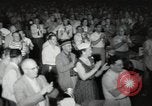
Former President Harry S Truman plays piano and James Petrillo, President of American Federation of Musicians, plays trumpet
Musician members of the American Federation of Musicians of the United States and Canada, at their annual convention, in 1954, applaud former President Harry S Truman as he stands with Union President, James Petrillo on stage. The play a short duet, Truman on piano, and Petrillo on the trumpet. They play a part of "Hail Hail the Gang's all here," to the delight of the audience.
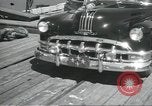
Admirals board the USS Nautilus for part of its sea trials
Opening scene shows a 1954 Pontiac VIP staff car, displaying 4-stars on its bumper plate. It is parked on a wharf next to the nuclear submarine, USS Nautilus (not seen).Admiral Robert B. Carney, Chief of Naval Operations, and Admiral William Fechteler, former CNO step from the car. Next, Admiral Carney is seen below decks on the Nautilus, making a selection on a juke box installed in one of the boat's compartments. Glimpse of officers standing on the foredeck as the Nautilus makes way on the surface. Admiral Fechteler, at the helm and Admiral Carney, seated next to him. The admirals and ships officers watching sailors at the helm. Momentary glimpse of Admiral Carney at the juke box. Crew members eating in the sailors mess. Officer briefing the admirals at the helmsman's station. Crew members, in cold weather gear, descending stairs inside the Nautilus. The boat making way in calm waters, with several crew standing on deck. A sailor wearing headphones and communications gear. The admirals saluting as they arrive on the Nautilus.
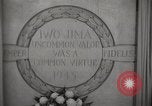
Dedication of Marine Corps War Memorial at Quantico Virginia, and sculptor Felix de Weldon working on sculpture for Arlington location.
The U.S. Marine Corps War Memorial original statue during its unveiling ceremony at the Marine Corps base in Quantico, Virginia on November 10, 1951 (This is after the statue had been moved from its original Constitution Avenue location in Washington DC in 1947, and subsequently renovated under sculptor de Weldon's supervision while it was in Quantico.). A sign on the memorial reads "Uncommon valor was a common virtue, 1945." Next scenes show sculptor Felix de Weldon as he works to build the larger Marine Corps War Memorial in Arlington, Virginia, which was dedicated in November 1954. Felix de Weldon measuring a model of the flag raising on Iwo Jima made by him. de Weldon and others on his team work to carve the large war memorial in plaster before it is cast in bronze. Views of the sculpted faces of the six Marines who raised the flag on Iwo Jima: Faces of John Bradley, Rene Gagnon, Ira Hayes, Franklin Sousley, Harlon Block and Michael Strank. Brief glimpse of the original flag raising scene on Mount Suribachi in February 1945. Next scene, circa 1954 or 1955, shows the completed Marine Corps War Memorial in bronze, in Arlington Virginia, with Washington Monument and Lincoln Memorial landmarks of Washington DC in the background. Close-up views of faces of a young boy, an elderly woman, and a middle aged man who removes his hat. American flag fluttering in the breeze atop the war memorial.
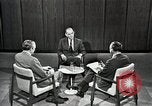
Senator J. William Fulbright talks about Russia and Viet Cong during television interview in United States.
Senator J.William Fulbright in United States.Television Interviewer asks Fulbright about Geneva convention in 1954. Fulbright said that President Lyndon B Johnson reached out for negotiation. Russia must also come to United Nations to resolve differences. He states that Britain had previously proposed to talk but Russia refused to the proposal. The Interviewer asks Fulbright about involvement of Viet Cong. Fulbright says that it is an army they have guns and they kill our people. Their representatives must be called for talk and negotiations must be done. He said it would be wise to divide them.
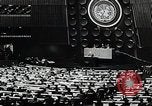
Atoms for Peace. UN approves formation of IAEA. Nuclear scientists gather in Geneva Switzerland
UN General Assembly seen meeting in 1954 as it approves an International Atomic Energy Agency (IAEA). U.S. Ambassador Henry Cabot Lodge II, and French ambassador, Henri Hoppenot, speaking. Finn Moe, of Norway, speaking. View of the city of Kjeller, Norway. Flags of Norway and the Netherlands at joint atomic laboratory. Scientists with various pieces of scientific equipment inside the facility. Indian ambassador, Krishna Menon, speaking at the United Nations. Atomic laboratory and a Government Teachers' Training College, in India. Indian scientists in a laboratory. Indian lecturer speaks to students. Brazil's Professor Ernesto Leme speaks at the UN. The city of Sao Paulo, Brazil. The University of Sao Paulo. Rio de Janeiro, Brazil. The Center for Physical Research. Clock tower of Brazil Central Station in Rio. Sutan Sjahrir,of Indonesia at the United Nations. An animated map shows nations interested in atomic energy. The UN Headquarters building on the East River in New York. A person looking through a microscope. Foreign scientists attending indoctrination courses at the U.S. Argonne National Laboratory. Diplomats sign agreement between the U.S. and Philippines on July 27, 1955, for the Philippines to lease uranium for a research nuclear reactor, and to receive technical assistance. Views of Geneva Switzerland in August 1955, including street views with pedestrians, and tram or streetcar on city streets. Exterior of Palace of Nations, then interior view with atomic science conference in progress. Indian nuclear physicist, Homi Jehangir Bhabha, presiding over conference of scientists and university representatives from 73 nations, including, inter alia, John Cockcroft, of Great Britain; Otto Hahn, of Germany; Willard Libby, of the U.S.A.; Vladimir Vexler of the Soviet Union; and Niels Bohr of Denmark. Views of exhibit hall at the conference, and displayed models of nuclear reactors, uranium ore refining exhibits, and accelerators. U.S. President Dwight Eisenhower views swimming pool reactor, while visiting the exhibit hall. Site work and construction underway in Meyrin, Geneva, Switzerland for a research laboratory for the European Organization for Nuclear Research (CERN - Conseil Européen pour la Recherche Nucléaire). Sitework seen for a facility of Euratom in Europe (European Atomic Energy Community). View of early sitework in Manila for an Asian nuclear center in the Philippines under the Colombo plan, for training personnel in nuclear science and technology.