


 Francais
 Deutsch
 Italiano
Refine Your Search
+"United States USA" +1963 stock footage and images
- Showing 1 to 6 of 193 results more
more Hide
Hide
Kennedy and Johnson speak about peaceful aims of the United States in 1963 during the Cold War.
"To keep the peace" about need for peace, during Cold War. Expansive farm field of wheat waving in breeze under a sunny to partly cloudy sky in the United States. Wide shot of ocean waters and sun breaking through low clouds near dawn or dusk. President John F Kennedy delivering a speech on peace and nuclear testing, on July 2, 1963, in Naples Italy at NATO headquarters. Kennedy says, "The purpose of our military strength is peace. The purpose of our partnership is peace. So our negotiations for an end to nuclear tests and our opposition to nuclear dispersal are fully consistent with our attention to defense--these are all complementary parts of a single strategy for peace." Shortly after President Kennedy's death, President Lyndon B Johnson addresses a joint session of Congress on November 27, 1963. Shows segment of speech where President Johnson says, "We have proved that we are a good and reliable friend to those who seek peace and freedom. We have shown that we can also be a formidable foe to those who reject the path of peace and those who seek to impose upon us or our allies the yoke of tyranny."
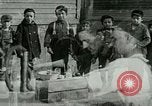
Montage of scenes regarding worker's rights, early labor disputes in the U.S., and the 1963 March on Washington for Jobs and Freedom
Clip opens with footage of factory workers in an American factory in the early 1900s operating machinery or assembly operations. Next scene shows American workers demonstrating for better working conditions during a time of labor strife circa decade of 1910. American workers hold a sign that says, "8 hours rest and 8 hours sleep." Next scene shows a family bundled in warm clothing on a cold day, riding on a sled in a winter outdoor area. Their faces look desperate and they appear to be cold. Next brief scene of only a few seconds shows two different bearded Jewish men being helped down or possible pushed down from a stand or stage (the context is not clear). Next scene briefly shows a couple kissing. Next scene shows scenes from the March on Washington for Jobs and Freedom, in August 1963. Camera shows crowd assembled on Washington Monument grounds, and also shows marchers with signs such as "We march for higher wages" as they are seen marching in the street. Close-up views of faces of various protestors and attendees, both white and African American, and young and old, as they listen to speeches delivered from the steps of the Lincoln Memorial during the event.
Retired veteran aviators share Luncheon at Bolling AFB celebrating Air Force record-setting flights in 1929 and 1963.
A large group of retired Air Force officers are seen seated at a number of tables during a luncheon celebrating the 35th anniversary of the 1929 endurance record setting flight of the Fokker C-2A aircraft named "Question Mark." The event is in the Bolling Air Force Base Officers' Club. Closeup of General Carl Spaatz, addressing the group from a podium. Colonel Harry Halverson and aviation mechanic, Sergeant Roy Hooe, who both flew on the Question Mark, are listening, along with Major Sidney J. Kubesch (who,in October 1963, was aircraft commander on the B-58 bomber that set a speed record, flying 8,028 miles from Tokyo to London in 8 hours, 35 minutes and 20.4 seconds). Lieutenant General Ira Eaker addresses the group next. Closeup of him and of General Spaatz tilting his head to hear. The audience applauding. Sergeant Roy Hooe then addresses the group. The clip ends as the luncheon ends and the participants socialize.
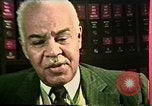
Roy Wilkins comments recalling the 1963 March on Washington in Washington DC
Civil Rights leader Roy Wilkins talks and reflects on the 1963 March on Washington for Jobs and Freedom . View of marchers carrying banners advocating equal rights. Clarence Mitchell talks about Roy Wilkins.

Winter storms and cold in United States, and Europe and far eastern regions during winter of 1963.
People walking wearing winter clothes in streets of Chicago, Illinois. Views of the frozen shore areas and ice on Lake Michigan in city of Chicago. Chicago River is jammed by ice. View of railway tracks covered with snow in Europe. Dripping ice on statues. People wearing gloves. Narrator describes snow events in Italy including Florence, Italy. Youth run and slide on ice on frozen river in Italy. Car passing on snowfield. Houses covered with snow and collapsed due to snowfall in Japan. Japanese men and women removing snow using spades and snow shovels. Japanese people shovel snow near homes. Men removing snow from around snowbound railroad trains where passengers had been trapped.
Luncheon at Bolling AFB celebrating the 1929 flight endurance record of Fokker airplane named Question Mark, and 1963 speed record of a B-58 bomber.
Opening scene shows large group of retired Air Force officers seated at a number of tables in the Bolling Air Force Base Officers' Club. Closeups of General Carl Spaatz, Lieutenant General Ira Eaker, Lieutenant General James Ferguson (Deputy chief of staff for research and development at Headquarters Air Force), and Major Sidney J. Kubesch (who, in October 1963, was aircraft commander of the B-58 bomber that set a speed record, flying 8,028 miles from Tokyo to London in 8 hours, 35 minutes and 20.4 seconds). Old time aviators, Colonel Harry Halverson and aviation mechanic, Sergeant Roy Hooe, who both flew on the Question Mark, are also seen. Closeup of a model B-58 Hustler bomber sitting on a luncheon table. Closeup of a model of the Fokker C-2A "Question Mark" next to old log book. ( This clip also shows two unidentified women participating in the luncheon.)