


 Francais
 Deutsch
 Italiano
Refine Your Search
+"United States USA" +1965 stock footage and images
- Showing 37 to 42 of 144 results more
more Hide
Hide
Pershing Guided Missile System of United States Army in United States.
Army vehicles move on road. Erected missile in field. A war head vehicle, a launcher, a programmer and test vehicle and a radio terminal vehicle in field. A soldier looks at the expanding disc of radio terminal. Automatic jacks move launcher. War head is locked to the dual motor. Soldiers get down from the launcher. A soldier, in programmer and test vehicle checks the missile. The missile is erected. Two men at the remote firing panel. Missile is fired. Animation of stage 1 and stage 2, of missile thrust and explosion of war head. The explosion of target is also animated. Howitzer in field. Number of simultaneous explosions in a field

U.S. Navy training film about escape from ditched modern jet fighters that sink faster than the old propeller airplanes
An F6F Hellcat ditches in the sea. It floats long enough to allow pilot to abandon it before sinking. Next an A-4 Skyhawk ditches. Narrator remarks about the short time for escape from such aircraft on the surface of the water. Views of tests conducted by the U.S. Navy to test the sink rates of jet aircraft from various heights and attitudes. A dummy is placed in the cockpit of a derelict F9F Panther, which is lifted by a crane and is dropped into water from a low height. It is seen floating. (Narrator states that even with no structural damage, it sinks in less than a minute.) Next an FJ-2 Fury is dropped from about 55 feet. Due to structural damage, narrator states such an aircraft may sink in a few seconds, and generally between zero to 55 seconds. View of crane operator and then of an airplane sinking rapidly. Scene shifts to James F. Roth of U.S. Navy Attack Squadron 42,(VA-42) the "Green Pawns," in the closed cockpit of a Navy jet airplane. Next, an F-4 phantom jet is seen being catapulted from an aircraft carrier. Animation shows that the airplane falling into the sea right after takeoff will sink ballistically and can descend as deep as 100 feet in 10 seconds.
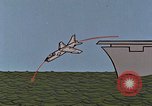
A pilot ejects from a test jet aircraft that has been plunged into water.
Animation shows method of escape from a jet when it submerges in water. It shows how the pilot has to come out from the cockpit in case of emergency. Pilot tests the method of escape from the jet in case of emergency. He takes the model of cockpit in the water reservoir made for the purpose. Then he ejects himself from the canopy, leaves the cockpit and ascends to the surface. Information given to the pilot: disconnect yourself, leave cockpit, ascend to the surface.
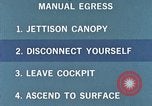
Pilot demonstrates three point disconnect for underwater escape.
Pilot in the cockpit. He stands to disconnect himself from the cockpit. There are three points which have to be disconnected. Cockpit submerged in water. Pilot disconnects himself.
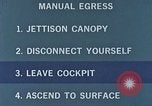
Aircraft pilot escapes from a jet cockpit immersed in water.
Pilot disconnects himself from the cockpit. Cameraman recording the whole process. Pilot ascends to the surface. Pilot moves forward and tries to leave the cockpit.
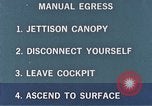
Explanation of importance of breathing out while ascending from a jet aircraft immersed in water
Pilot leaves the cockpit. He slowly ascends to the surface. Animation shows that if a person ascends without properly reducing lung pressure, he may develop lung problems. Mediastinal Emphysema, Air Embolism, Pneumothorax can be the major problems. The pilot goes beneath the water again. He wears an oxygen mask. He disconnects himself, leaves the cockpit and ascends to the surface.