


 Francais
 Deutsch
 Italiano
Refine Your Search
+"United States USA" +1966 stock footage and images
- Showing 85 to 90 of 142 results more
more Hide
Hide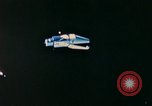
NASA Gemini spacecraft practicing docking and maneuvering with Agena vehicle.
A NASA backup Agena unmanned target vehicle, launched as a docking target for Gemini 9, is orbiting with a shroud still attached. Astronauts call it "the angry alligator." Brief closeup of the vehicle. Views from Gemini IX as it practices maneuvering close to the "angry alligator." Change of sequence shows another Agena target vehicle in orbit above an ocean on earth. A Gemini spacecraft docks to form a compound craft with the Agena, and its astronauts then command the Agena to start its rocket engine. Glow is seen from the rocket engine firing. Beautiful views of the Blue Planet, Earth, from a combined Gemini and Agena vehicle in orbit at 850 miles distance.
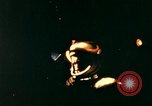
Views of Planet Earth taken from NASA Gemini spacecraft
Glimpse of astronaut in NASA Gemini spacecraft during orbit. Dramatic views of the Earth from outer space orbit. Eclipse of the sun photographed from Gemini XII. Two Gemini spacecraft (probably Gemini VI and VII) orbiting earth, in formation, close to one another.

Views of Planet Earth taken from earth orbit. NASA Gemini spacecraft maneuvering and Astronauts working outside them.
Views from NASA Gemini spacecraft maneuvering close to Agena vehicle in space. A dacron tether attaching a Gemini craft to the Agena space vehicle. The tether held taut by the differential gravitational pull on the two space vehicles (Agena being closer to earth). Astronaut Ed White, performing the first extra vehicular activity (space walk) during the Gemini IV mission in June 1965. His overglove is seen floating past him. He performs work in space using special tools. Views of other astronauts having difficulties during subsequent space walks. Astronaut Edwin "Buzz" Aldrin, pilot of Gemini XII, performs a series of tasks during a space walk test, proving the value of rest breaks, tethers, and handholds to facilitate such work in the weightlessness of space. He removes a hatch, that flies away. He tightens bolts.

Abandoned ghost town mining town in western United States
A trail on hilly terrain in the American West or Great Plains. Ruins of damaged wooden houses and wagons, and carts. Views of several wooden houses and shops of a small, abandoned "ghost town", perhaps a mining village, in the American frontier west. Interiors of a house and several empty caskets; perhaps the old shop of an undertaker.
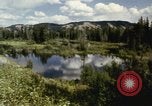
Paintings depicting a journey by mountain men to the animal fur-traders' rendezvous of 1837.
A film includes accounts of the Lewis and Clark Expedition (1803–1806) and a journey to animal fur-traders' rendezvous in the Green River Valley, Wyoming in 1837. The Missouri River Basin and the Rocky Mountains in the area. Interiors of a house showing beads, fur clothing, North West Indian guns of the Fur Trade Era. Drawing of a mountain man who roamed the North American rocky mountains. A painting by American painter Alfred Jacob Miller depicts a journey to the animal fur-traders' rendezvous in the Green River Valley, Wyoming in 1837. Paintings depict that the rendezvous was organized by American fur company and provided mountain men and Native American Indians with an opportunity to come together to exchange their furs for supplies that would sustain them through the winter. Paintings depicting buffalo hunts by men.
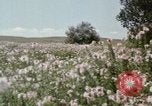
Great Plains and Independence Rock, part of the Oregon Trail in the United States. Views of Great Plains landscape and animals.
Panoramic views of the Oregon Trail which was one of the main overland migration routes on the North American continent, leading from locations on the Missouri River to the Oregon Territory from 1841 to 1869. The Great Plains or so called a the time "Great American Desert" with high plains. Elk at a river bank. Bison or buffalo herd feeding and fighting on the plains. View of a covered wagon of the period seen on the plains. Wagon wheel ruts in limestone rock on ground showing old path the wagons followed. Independence Rock on the Oregon Trail, with carved names of pioneers who carved their names on its surface between 1841 and 1869. View of Sweetwater River. The Missouri River leading to the Oregon territory. An abandoned old wagon wheel on the plains.