


 Francais
 Deutsch
 Italiano
Refine Your Search
+"United States USA" +1967 stock footage and images
- Showing 79 to 84 of 339 results more
more Hide
Hide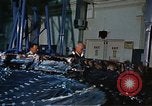
NASA officials and Astronauts Frank Borman and Michael Collins examine damaged bottom part of Apollo 1 command module
Apollo 204 review board at National Aeronautics and Space Administration (NASA) in United States. NASA officials and Astronauts Frank Borman and Michael Collins examine debris in lowest part of Apollo 1 command module, which has been separated from the upper part.
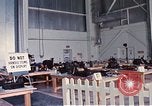
Technicians inspect the NASA officials examine pieces removed from damaged Apollo 1 command module and examine the module, too
Apollo 204 review board at National Aeronautics and Space Administration (NASA) in United States. Officials inspect burned and damaged parts of the Apollo 1 command module that have been removed and placed on tables. They take photographs, examine with flashlights, write on clipboards, and discuss the items. They also inspect the command module where it is resting on a stand in the back of the room.
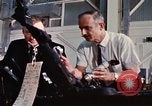
NASA investigators examine parts of the Apollo 1 command module
Apollo 204 review board at National Aeronautics and Space Administration (NASA) in United States. Investigators examine wrecked parts of the Apollo 1 command module using magnifying glass and lights. They hold intense discussions as they work.
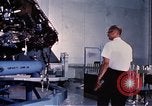
National Aeronautics and Space Administration (NASA). Investigators examine damaged Apollo 1 command module
Apollo 204 review board at National Aeronautics and Space Administration (NASA) in United States. Investigators examine damaged Apollo 1 command module that has been stripped to expose its interior components.
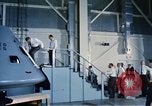
National Aeronautics and Space Administration (NASA) officials check features of new Apollo command module
Apollo 204 review board at National Aeronautics and Space Administration (NASA) in United States. Astronaut Frank Borman, member of the Apollo 204 Review Board, enters new Apollo command module. Technicians fit an outer door in place on the capsule and then remove it. Astronaut Michael Collins, who is also inside the capsule, then places an inner seal door in place and it is removed, again. Officials consult. Frank Borman exits the module. Collins discusses the outer door with technicians at the top of the stairs, emphasizing the need to be able to push the door open readily. Borman talks with group at bottom of stairs. All gather around and discuss inner seal door that is laid out on floor. Borman chews gum, in background. Group gathers around the capsule again and then disperses.

The anti war protests against the United States involvement in the Vietnam War.
Anti-war protests in the United States during the Vietnam War. Protesters march and demonstrate against the United States involvement in the Vietnam War from Central Park to the UN headquarters in New York City. Demonstrators in crowd holding protest signs. A number of African American marchers hold signs that read, "Black men should fight white racism, not Vietnamese freedom fighters." Another sign reads, "They are our brothers whom we kill." Masses of people including doctors, teachers, and businessmen on streets. People dressed in different costumes and 1960s hippie fashion as they protest. Young men participate in burning their draft cards while a crowd gathers around to watch the draft card burning. Pro-war counter protestors (sometimes called "Hawks") also demonstrating and arguing with anti-war activists. Pro-war banner reads, "End Hanoi Sanctuary. Let's bomb Hanoi to win the war and destroy the Communist conspiracy." Another Hawk sign reads, "Anarchy Cannot be Permitted in the USA. Fight Communism and Red Termites." African American civil rights activist Martin Luther King Jr. walks toward the United Nations building with other officials advocating peace. Policemen drag a protester. Scene changes to San Francisco: 50000 people carry banners as they protest the war in Vietnam and march to the Kezar Stadium (670 Kezar Dr, San Francisco, CA 94118, United States) for a mass assembly. People push each other during the protest as pro-war demonstrators clash with anti-war demonstrators and pacifists. A huge crowd gathered at a stadium.