


 Francais
 Deutsch
 Italiano
Refine Your Search
+"United States USA" +1971 stock footage and images
- Showing 19 to 24 of 50 results more
more Hide
Hide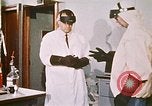
Scientists test fire fighting chemicals and fire fighters spray water to extinguish a fire during a drill in the U.S.
Rocket fuel fire fighting and rescue drills in the United States. A scientist gives a sample of a fire fighting chemical to another scientist. The scientist sprays the chemical on a test table. Flames rise as the chemical burns. A fire fighter sprays water to extinguish a fire near the Apollo Command Module. Men carry an injured on a stretcher. A spacecraft on a launch pad.
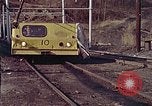
Glimpses of industrial and commercial activities in the United States
Miners arriving above ground on a rail car. Open coal cars filled with coal. A steel furnace. A commuter railroad train. A man operating a tracked crane at a city construction site. Workers and equipment at a road and tunnel project. Home builders starting on foundation of a new house in the suburbs, with view of a new suburban neighborhood being built in background. Views of various construction activities: a mobile home; a high rise building; a residential house. Factory workers on an automobile assembly line are seen assembling engine, transmission and other parts to chassis. Salesman showing a car to prospective woman customer a a new car dealership. Bushel baskets of vegetables, fruits, and assorted produce at a sidewalk market. Several shoppers seen on Connecticut Avenue, in Washington, DC. Businesses seen include: The Camalier & Buckley shop, Raleigh's haberdashery and the Mayflower hotel (in the background). New automobiles stored in a yard, including many station wagons, and a sedan car being offloaded from a truck. Man doing major bodywork repairs on a car. Doormen in red uniforms assist patrons in taxis at a hotel or apartment building.
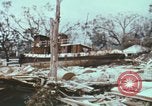
Large scale damage to life and property due to a tornado in the United States.
A documentary on occurrence of a tornado in the United States. Damage caused by the tornado. Rubble on the ground. Damaged buildings and houses. People searching for injured and dead in the rubble. A woman crying and talking about the tornado. A board outside a building reads: 'Disaster Assistance Center'. Men and women seated at desks inside the building. They work to help the victims. Help coming in from many places and many people like the Red Cross, the Salvation Army, engineers, rescue squads and several other volunteers come to help. A man smoking a cigar.
Characteristics and names by which tropical cyclones are known in different places is discussed in the United States.
A documentary in the United States on occurrence of tropical cyclones. A rubbled area after being hit by a tropical cyclone. Soldiers carrying a dead body on a stretcher. Cyclones are known by different names based on their geographical locations. Animation depicts names of cyclones in different areas with the help of a map. In the Western Pacific they are known as typhoons. They are known as Baguio in the Philippines. They are called cyclones in the Indian Ocean and the Bay of Bengal. In Australia they are called Willy-Willy. A cyclone is called a hurricane in the Eastern Pacific, the Gulf of Mexico and the Caribbean. Characteristics of tropical cyclones. Counter clockwise wind flow at the time of a cyclone. The pressure when the tropical cyclone approaches. The eye of the tropical cyclone may be very small or very large in diameter. The strongest winds around an eye average from 90-150 knots. The storm is divided into semicircles for orientation. The right semicircle is considered to be the most dangerous semicircle because of its stronger wind. The left is considered to be relatively less dangerous because of somewhat weaker winds. A demonstration is done by considering ships stuck in both the parts. The ship stuck in the right semicircle revolving in the area. The ship stuck in the left one arrives towards the end and comes out of the storm. Ships underway at sea during a storm. Clouds in the sky. Rain begins to fall. A man checking a parametric center. Animation shows a ship arriving towards the storm center. The ship's radar used to locate the ship's location.
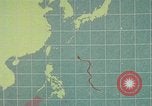
Animation in the United States shows the method of escape by a ship when stuck in a cyclone.
A documentary in the United States on occurrence of tropical cyclones. Animated map shows the passage of a typhoon. The way of evasion for ships from the cyclones is demonstrated. The ship stuck in a typhoon should always head towards the safer side of the cyclone. The ship should run for the less dangerous semicircle if caught in a typhoon. The course of the cyclone should be noticed.
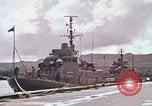
Crew working and undertaking preventive measures to face a typhoon in the United States.
A documentary in the United States on the occurrence of tropical cyclones. A ship anchored at a port. Preventive measures being undertaken by the ship's crew. Mooring lines are doubled and tied properly. Men working on the ship. A ship underway at sea. Men working on different instruments on the ship. Men filling tanks. Water tight security should be ensured. Measures to prevent flooding of the ship should be undertaken. Compartments should be checked. A ship underway at sea. It is stuck in a typhoon. Water breaks over its surface.