


 Francais
 Deutsch
 Italiano
Refine Your Search
+"United States USA" +1974 stock footage and images
- Showing 13 to 18 of 57 results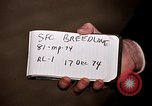
Color guard and awards presented during retirement ceremony for General Andrew J. Goodpaster in the United States
Combined services color guard march into position at the retirement ceremony of General Andrew J. Goodpaster at a gymnasium in United States. Troop commanders representing Army, Navy, Air Force, Marines and Coast Guard are seen. General Goodpaster accompanied by Secretary of Defense, James Schlesinger, Deputy Secretary of Defense William Clements, General George Brown, General David C. Jones, Admiral James Holloway, General Fredrick Weyand along with General Robert Cushman arrive and take positions in the review stand. General Goodpaster and Secretary Schlesinger troop the line and return to the review stand. Color guard marches to a position in front of the stand and General Goodpaster stands in front of the Color guard facing the stand. He saluted as the Color guard dipped colors. General Jones, Admiral Holloway and General Weyand, one by one are seen awarding medals to General Goodpaster.
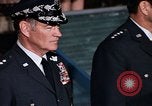
Retirement ceremony of General Andrew J. Goodpaster in United States
Combined services Color guard march into position at the retirement ceremony of General Andrew J. Goodpaster at a gymnasium in United States. General Goodpaster, Secretary of Defense James Schlesinger, Deputy Secretary of Defense, William Clements, General George Brown, General David C. Jones, Admiral James Holloway, General Fredrick Weyand and General Robert Cushman are there in the review stand. Secretary Schlesinger and General Goodpaster make speeches at the podium.

A Soviet agent tries out for position of the defector against American Air Force voice communication
A film titled 'With enemies like you who needs friends' explains scope of enemy effort against United States Air force voice communications. An enactment shows a Soviet agent invited by United States Air Force to tryout for position of defector. The agent receives intelligence information over the phone. Exposes Soviet techniques for intercepting voice communications.
Vulnerabilities of United States Air Force communication systems
United States Air Force retired Major General Barry Goldwater explains the role of voice communication and the importance of ensuring its security followed by a film titled ' The third man is listening' The film shows the vulnerabilities of United States communication systems. An Air Force officer explains enemy capabilities for acquiring intelligence through interception of these communications.
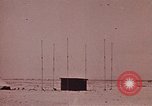
U.S. Air Force film about the threat of communications intelligence gathering by Communist nations
After showing several Russian signal intelligence sites, a map, centered on the North Pole, depicts numerous forms of communications facilities and antennas. An animated map depicts what it calls the world-wide communist communications intelligence (COMINT) threat, comprised of fixed sites, trawlers, airborne, submarine, and satellite platforms. Then several types of facilities are shown. The film narrator, a U.S. Air Force Colonel in short-sleeved summer uniform shirt, is then seen as he mentions diplomatic posts around the world that also serve as intelligence gathering sites. Aerial views, from overflying helicopter, of Washington, DC, and environs, including the Capitol, Federal buildings, and the Pentagon. Map showing Soviet Military Attache Office, Soviet school, Soviet Embassy, and the Pentagon, together with the telephone trunk lines serving them. Another map displays microwave links in the Washington area. View of the residence of the Russian Ambassador, at 1125 16th Street, NW, Washington, D.C. The radio antenna on the roof of the building. Images of "Krug" signal gathering sites, and map of their locations in the Soviet Union., Map of USSR communications intelligence threat in Asiatic-Alaskan area. Innocent-appearing fishing trawlers used by Soviets to intercept communications. A Soviet Tupolev Tu-95 aircraft, equipped for signal intelligence collection, is seen in flight. Closeup of the aircraft tail. Views from an aircraft flying around the Tu-95. Animated illustration of earth rotating in space and of satellites passing over it. Map of Cuban COMINT threat. Polar-centered map showing Chinese and North Korean communications intercept installations. U.S. intelligence aerial photograph of a site in China, across from Taiwan. Map of COMINT threat sites in Southeast Asia.
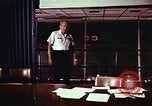
Officer shows enemy log book containing intelligence information obtained by intercepting American communication systems
United States Air Force officer shows pages from enemy log book containing intelligence information obtained by intercepting American communication system. A document aimed at establishment of operations to ensure communication security.