


 Francais
 Deutsch
 Italiano

Refine Your Search
+"United States USA" +1975 stock footage and images
- Showing 49 to 54 of 136 results more
 Hide
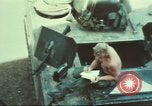
News report and informational programs are broadcast to a large majority of servicemen in the United States.
American servicemen are kept informed by American Forces Radio and Television Station facilities. A soldier listens to a radio and writes a letter. Another soldier in southeast Asia looks at a post with directional arrows showing distances thousands of miles away to cities like Seattle, San Francisco, and Denver. He sits on a bench and listens to the radio. Aerial view of the broadcasting station part of the American Forces Radio and Television Station. Power is supplied by portable generators housed in wooden shacks. View of radio studios, control rooms and administrative blocks. A man serving as Disc Jockey or DJ operates a control panel and a phonograph turntable to play a record. He turns dials on the control panel and works on a program schedule. View of a reel to reel tape machine running. News report and informational programs are broadcast to a large majority of servicemen. Military cooks working in a kitchen to prepare food. Army soldier standing at washroom sink and shaving, while listening to a portable radio. Two Army soldiers, one white and one African American, playing pool or billiards while listening to a portable radio. Soldiers on a rest break during a patrol in the Vietnam War listen to a radio.

Operation of an American Forces Radio and Television Station.
Work of members at a American Forces Radio and Television Station in the United States. A man examine 16mm motion picture film before a program telecast. Station technicians playback 2-inch Quad reel-to-reel videotapes. Closeup of a monitor displaying a sports event. Closeup of waveform monitor. Men undertake technical maintenance of the television broadcast station. Transmitter is adjusted by one technician. A maintenance man examines a transmission dish.

Special U.S. Air Force teams decontaminate crash site of aircraft carrying nuclear weapons.
'Nuclear might ready but safe.' About the safe use of nuclear weapons by the United States Air Force. A nuclear weapon strapped to a trailer, with two armed guards standing nearby. A missile raises up toward launch position. B-52 bombers on a flight line. A B-52 bomber,on ground alert, taxis out for takeoff. B-52 in flight during airborne alert. Remains of a crashed aircraft that carried a nuclear bomb (a "Broken Arrow" event). An Air Force team team looks at the wreckage of the crashed plane in a field as they work to decontaminate the area. The health concerns involve possible local contamination by scattered non-explosive radioactive materials.
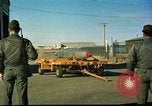
The mechanism of working of a nuclear device and the devices that ensure safety of nuclear weapons in the U.S.
Safe use of nuclear weapons by the United States Air Force. A nuclear bomb on a trailer. a C-119 aircraft takes off in background. An animation shows the nuclear material used in weapons. Fissionable material is surrounded by a layer of high explosives.. Detonators being fired simultaneously at the edges of the high explosives causes implosion that exerts pressure on the fissionable material, causing it to compress into a critical mass that results in nuclear explosion. In an event in which the high explosive, itself, is accidentally ignited, it will burn unevenly, and not provide the uniform circumferential pressure needed to cause the core of nuclear material to compress into a critical mass, even though it may be broken up and scattered.. Various safety features of a nuclear weapon. A battery which provides current, armed switch which controls the flow of current. Thermo fuses which ensure protection against fire. Various mechanical devices like safety pins and wires with seals also ensure safety of nuclear weapons and prevent untimely detonation.
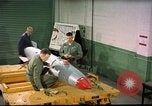
U.S. Air Force personnel handling nuclear weapons.Technicians being examined for reliability
Safe use of nuclear weapons by the United States Air Force. A Sergeant (E4) technician works on a nuclear bomb as a Technical Sergeant (E6) supervisor looks on. A Quality Assurance Evaluator takes notes. The technician reacts angrily after dropping a T304C Continuity Tester and his supervisor corrects him. The technician is then questioned by a doctor to ensure his reliability for a nuclear program. Men around an aircraft as a trailer carries a nuclear bomb near the aircraft. The bomb being attached under the fuselage of the plane. Men work in groups using the two men concept to assure that no individual is ever in a position to arm, launch, or detonate a nuclear weapon.
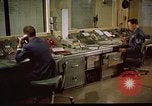
Air Force personnel receive and decode messages; sound an alert; deploy bomber aircraft during drill in the United States.
Nuclear weapon safety strategies employed by the United States Air Force during the Cold War. Shows aircraft alert training drills related to launch of nuclear weapons. U.S. Air Force personnel work on the controls in a control room of an air base. Men answer phone calls. An alert order being received in a coded language. An alarm being sounded and airmen scramble and run from their rooms and billiards table to the aircraft at the base. Crew members enter waiting bomber aircraft and put on their flight gear and breathing apparatus. Controllers decode the message separately and then compare it. Aircraft commanders being instructed. A cocoa alert being sounded and aircraft taxi along a runway. Scene shifts to aerial view of a U.S. Air Force B-52 bomber aircraft in flight, which narrator indicates is among aircraft that are airborne at all times and prepared to proceed to a target. View of pilot and copilot in the cockpit of the B-52 bomber aircraft. Aerial view of B-52 aircraft banking to right side. View of different crew members such as bombardier and navigator in B-52 aircraft as they separately confirm interpretation of an incoming message. View of Republic F-105 Thunderchief aircraft parked readying for takeoff on runway. Another fighter aircraft preparing for takeoff (F-11 ?). A surface missile being readied for launch. A missile being launched from an underground missile silo, taking off and emitting a fiery flare.