


 Francais
 Deutsch
 Italiano
Refine Your Search
+"United States USA" +1979 stock footage and images
- Showing 1 to 6 of 46 results
Safety measures and precautions which can be taken in the event of a tornado, in the United States.
A documentary on occurrence of a tornado in the United States. The aftermath of a tornado in Wichita Falls, Texas. A rubbled area. A man standing near the rubble. Dead bodies on the ground. Doctors treating wounded people. Red Cross workers and volunteers working to help the victims. Temporary housing facilities given to homeless people. Rebuilding work being undertaken. People standing outside a house. A doll on the ground. Disaster plans being worked upon. People discussing amongst themselves. Narrator outlines preventive measures, warnings, and emergency plans and Disaster Plans that should be in place to in the event of a tornado. Narrator discusses what to do, and what not to do in the event of a tornado. National Oceanic and Atmospheric Administration (NOAA) weather radio should be used. It gives warning about tornadoes. When a tornado hits people should take cover in basements. Weather clues should be noticed, warnings should not be ignored and people should not stay in mobile houses at the time of tornadoes. People can take shelter in a ditch. Matches should not be lit and people should not enter the disaster area. Views of the April 10, 1979 tornado in Wichita Falls, Texas as it hits the area.
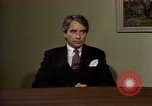
Richard Burt speaks about June North Atlantic Treaty Organization(NATO) foreign ministers conference in the United States.
Richard Burt, Assistant Secretary for European affairs in the United States. Richard Burt speaks about the June North Atlantic Treaty Organization (NATO) foreign ministers conference of Paris. He speaks about Soviet Union's disagreement about the 1979 decision and to negotiate with them. The other issues to be discussed include development and conditions in Poland.
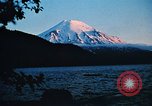
Volcanic eruptions of Mount St. Helens in Washington State, United States, in 1980
Film begins showing pristine snow-covered Mount St. Helens in Washington State, U.S.A. View on March 20, 1980, the mountain appears to have less snow on it. Camera pans over the Cascade mountains. Still picture (illustration) of Mount St. Helens erupting in the past. Several hikers are seen sitting on the peak of the mountain. Camera pans over the view, showing Spirit Lake below and, in the distance, Mount Rainier. Slate reads: "Camp Mehan 1959."View of Mount St. Helens overlooking the Y.M.C.A. Boys try rowing a boat with one oar lock unfastened to the gunnel. one boy sailing alone in a small sail boat. Boys playing volleyball. Boys diving from a dock. A camper speaking with a Forest Ranger in the Gifford Pinchot National Forest. Campers in the park at places such as Bear Cove, Cedar Brook, and Donnie Brook. Hikers with full back packs exploring the forest. Campers cooking over a charcoal grill. A man with a fishing rod casting into a lake. Interior of a lodge at the end of a trail. View of Mt. St. Helens in 1979. View of a seismograph recording a moderate earthquake of 4.1 on the Richter Scale, beneath the mountain on March 20, 1980. View of smoke and ash rising from the mountain on March 27, 1980. Forest service vehicles closing roads and access to the Gifford Pinchot National Forest. View from the air, of a newly opened crater on Mount St. Helens. Forest Service workers and cooperating scientists setting up their gear to study the phenomenon. Nearby Ranger stations, such as Pine Creek are seen after being evacuated by the Forest Service. On March 29th, a second crater is seen on the Mountain. Explosive eruptions seen on March 31st. Camera captures these. A bulge in the mountain at Goat Rocks, is show. Narrator states that it is moving at 5 ft. per day. Another view of smoke and ash rising from the mountain. Scientist David Johnson is seen as he describes how the symmetry of the mountain means that volcanic outflows would come down on all sides of Mount St. Helens. A helicopter lowers a large refuse bin to help Spirit Lake youth camp operators hauling out. Outdoor shops are seen hawking Mt. St. Helen souvenirs. On May 18, 1980, a Forest Service tree planting crew is seen at work in a field. Rumbling sounds. A mountain lion is seen running. Tree planters look up as Mt. St. Helens has a violent eruption, which is seen on film, as the field workers run to escape. Narrator states the cloud reached nearly 14 miles into the sky. The cloud and internal bolts of lightning are seen. View of daylight obscured in Eastern Washington. Policeman wearing a face mask, stops a car from proceeding eastward. A helicopter of the 304th Aerospace Rescue and Recovery Squadron depart their Portland Air Base, to search for Geologist David Johnson, who was manning a scientific lookout above Cold Water Creek. View from inside the helicopter in flight. Narrator notes they failed to find him.
People follow instructions broadcast by radio and TV during hurricane preparations in the United States.
Instructions being broadcasted on radio and TV during hurricane warning in the United States. Hurricane force winds arise. Couple stands at a beach. Wind with high speed blows and trees bending. High surf overtaking palm trees on shore and dock areas. Local recordings inform and instruct people via radio and television. Close up view of men speaking into microphones and radios to issue warnings and track storm progress. People seen reaching for battery powered portable radios, and buying alternate fuel sources like Sterno in a store. A person reaching for a flashlight and batteries in a drawer. Men and women in queue at gas stations and filling up 1970s era cars at gasoline or petrol pumps. A girl fills empty gallon jugs with water at a kitchen faucet. A bathroom tub being filled with water in case water becomes unavailable. Men carry plywood to cover windows and doors. Signs and debris blowing in high winds. Piece of metal roofing flying down the street in high wind. Men and women tie up boats to secure them at a dock. People gather in a Red Cross shelter area, and some stand in a line receiving food at the shelter. People boarding up windows. Aerial view of eye of a storm in a hurricane as seen from an aircraft. Dramatic scenes of hurricane force winds blowing through doors and windows, with debris flying toward camera position. View of storm surge and violent high waves crashing near land during hurricane. Neighors and officials knocking on doors to tell citizens to evacuate before a storm. Point of view shot from car in heavy storm, driving away, as an ambulance with siren running passes going the opposite direction. View of downed telephone poles and lines near ground from winds, as car avoids them and keeps driving. A 1950s Chevrolet car navigates through deep water as people try to escape rising flood.

People follow the broadcast evacuation instructions and help neighbors in evacuating during a hurricane in the United States.
Instructions are broadcasted on radio and television during a hurricane in the United States. The hurricane approaching and very high tides, high surf, and storm surge seen at a coastal area. High waves crash into docks. High speed wind blows. Signs : 'No Surfing, No Vehicle' and 'No Sleeping on Pier'. Local broacasters in a studio give emergency instructions over radio, to inform and instruct the people about evacuation via radio and television. People follow the instructions: They knock on neighbors doors and help them in evacuating. High waves seen from a hurricane or tropical storm with cyclone winds.
Psychedelic drug Lysergic acid diethylamide discovered by Dr. Albert Hofmann is used for mind control in the United states.
Documentary depicts development and administration of LSD (Lysergic acid diethylamide ) by the CIA (Central Intelligence Agency) as a tool for mind control (Project MKUltra). Scenes of swirling colors and lights meant to simulate the experience of someone being under influence of a hallucinogen. Prostitutes and late night city street scenes. A bull in a bull fighting ring that narrator says has electrodes implanted in its head to control it. A man sitting in a chair while under the influence of a drug speaks emotionally and cries. A close up of George White who worked on the CIA program. On September 21, 1977, Stansfield Turner, Director CIA, speaks about Mission Mind Control. Members are seated in a hall. News correspondent Paul Altmeyer stands in front of the Headquarters of OSS (Office of Strategic Services, and precursor to the CIA) in its original World War 2 era location in Washington DC. The first mind control work began from this Headquarters. The members who are the part of this mission are the shapers and molders of the OSS. Still photos of U.S. General, William Joseph Donovan, nicknamed 'Wild Bill', and Boston industrialist Stanley Lovell, who is the Head of OSS Research and Development efforts into mind control. Still images of OSS Captain George H. White, formerly of the Bureau of Narcotics. Correspondent shows and reads from the diary of George White and talks about his training and schooling. J. Michael Burke, President of Madison Square Garden Center is seen walking across the basketball court in the Center. He was a former colleague of Mr. White, and Burke talks about George White and his technical knowledge. Another colleague of White who is a narcotics officer talks about him. A close up of George White. A note written in White's diary. George White worked on a truth drug at St. Elizabeth's Hospital in Washington DC where experiments were conducted. View of exterior of Saint Elizabeth's psychiatric hospital in Washington DC. A 1952 CIA memo says the aim is "controlling an individual to the point where he will do our bidding against his will." Exterior views of the Sandoz Laboratory buildings in Basel, Switzerland where doctor Albert Hofmann believed that they had discovered and found a psychedelic drug and the discovery was LSD. Retired Chief Psychologist for CIA, John Gittinger, talks about the powerful drug and is being interviewed publicly. CIA's interest in LSD was intense but they were worried that the Russians would get hold of it. Commentator notes that mistaken intelligence reported that Sandoz Laboratory was going to put 100 million doses of LSD on the open market. Concerned, the United States was prepared to buy the entire supply. However, through information learned from Freedom of Information Act filings, John Marks, author of The Search for the Manchurian Candidate, tells the interviewer that this was mistaken information caused by a mixup when an American military attache confused milligrams versus kilograms, so there were in fact only 100 doses on the market. Brief footage of CIA chemist, Dr. Sydney Gottlieb.