


 Francais
 Deutsch
 Italiano
Refine Your Search
+"Vienna Austria" +1933 stock footage and images
- Showing 1 to 3 of 3 results
Forty thousand home guards gather to pledge the independence of their country at the Imperial Park in Vienna, Austria.
Forty thousand home guards gather to pledge the independence of their country in Vienna, Austria. Dignitaries and high government officials arrive. Home guards troops march in the Imperial Park. Home guard officers and dignitaries salute the marching troops. Marching troops in large numbers carry their national flags. Chancellor Engelbert Dollfuss looks at the procession and the ceremony.

Contributions to rocket research by German Professor Eugen Sänger in the 1930s
German Professor Eugen Sänger conceived of a rocket-propelled airplane in 1934. View of his sketches and notes.View of a workshop, close to his home, where Sänger developed his ideas. It is a nondescript building with wooden exterior and "Deutsche Raketenflug-Werft, Vien1934" (German Rocketflight shipyard, Vienna,1934) scrawled on its door. Professor Sänger and an assistant are seen in doorway of the workshop. Interior views of machinery. Blueprint cross-section of Sängers first Rocket motor (the S.R.1) from 1932. Drawing of test facility arrangement from 1932. Drawing of the S.R.2 rocket motor from 1933, with high pressure liquid oxygen cooling. Drawing of testing apparatus and arrangement from 1933, including Bosch fuel injection pump.
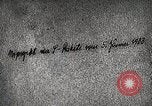
Drawings and hardware of Professor Eugen Sänger's S.R.6 and 7 rocket motors designed in 1934.
Drawing of "L-Rocket," dated January 5, 1933. Professor Eugen Sänger's S.R.6 Rocket motor from May 23, 1934, in which the combustion chamber is the same design as the slim nozzle of the L-Rocket. Actual parts of the S.R.6 motor. Plan of Rocket motor S.R.7 from May 21, 1934, with fuel inlet cooling by coiled pipe to the nozzle jacket. Second version of S.R.7 from June 5th, with cooling in the outer shell. Drawings of Versions three and four of the S.R.7. and scenes of the actual hardware held in Sänger's hand. He unscrews part and points out the features. He points out the cooling coils around the combustion chamber. Another version is similarily displayed after he removes its outer shell.