


 Francais
 Deutsch
 Italiano
Refine Your Search
+"Vietnam" +1965 stock footage and images
- Showing 445 to 450 of 562 results more
more Hide
Hide
Douglas A-4 Skyhawk takes off, crewmen attach rockets on aircraft on USS Hancock (Vietnam War)
United States Navy aircraft carrier in South China Sea during the Vietnam War. Essex-class USS Hancock (CV/CVA-19) aircraft carrier sailing in the South China Sea. A United States Navy Douglas A-4 Skyhawk takes off from the aircraft carrier. A man bends forward as Douglas A-4 Skyhawk takes off from catapult. A bending man signals as a Vought F-8 Crusader takes off. Sidewinder rockets are seen attached to a Vought F-8 Crusader taking off. An aircraft swiftly takes off. Crewmen transports a heavy rocket to a Douglas A-1H Skyraider. Men attach a rocket to a Douglas A-1H Skyraider.
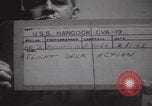
Pilot and plane captain talking, crew attach rocket on A-1H Skyraider onboard the USS Hancock aircraft carrier (Vietnam War)
United States Navy aircraft carrier in South China Sea during the Vietnam War. Essex-class USS Hancock (CV/CVA-19) aircraft carrier sailing in the South China Sea. A pilot (name: Rudy Miller) on a A-1H Skyraider and a plane captain talking to each other. Pilot gives "thumbs up". Plane captain hands over helmet to pilot. Pilot wears helmet. Two men transporting a large rocket on wheels. Crew men attach a large rocket underneath an A-1H Skyraider.
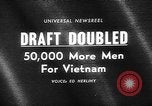
U.S. President Lyndon Johnson's speech on his decision to increase U.S. forces in Vietnam; in Washington DC, United States
U.S. President Lyndon Johnson's Washington Press Conference address on his new policy for Vietnam. President's wife Lady Bird Johnson and daughter Lynda Bird Johnson Robb in attendance. Members of the press seated in the room and take down notes. President Lyndon Johnson addresses the press. The President says that he wishes to convey to Communist powers in Vietnam that the United States cannot be defeated by 'force of arms or by superior power.' The President states that he has spoken to Commanding General Westmoreland has assured him that whatever his needs are, they will be met. He says that U.S. troop numbers in the Vietnam War will be increased from 75,000 to 125,000. Additional forces will be needed later which will be sent. Brief shots of young men recruits in the United States standing in line for the draft, taking tests, and taking the oath as soldiers. The President says that he welcomes the concerns of any nation.
During press conference, U.S. President Lyndon B. Johnson shares query received from a woman asking why the U.S. is fighting in Vietnam
Artist's sketch of U.S. Army field grade officer. Sketches of soldiers, arms, and equipment, including tanks, machine guns, missiles. President Lyndon B. Johnson, addressing the nation, relates receiving a letter from a woman who doesn't understand why America is fighting in Vietnam. Two U.S. Army captains in jungle fatigues, walk past a helmeted tank crewman, in Vietnam. Closeup of Vietnamese woman holding her crying baby. View of man on his haunches over a fire in destroyed building. (Vietnam War period).
U.S. Defense Secretary Robert McNamara addresses a news conference and reports on Vietnam in the United States.
U.S. Defense Secretary McNamara addresses a news conference in the United States. United States Secretary of Defense Robert McNamara addresses a news conference and reports on Vietnam. He points at the bombed out supply routes from the North Vietnam. He shows the Chinese machine gun. He points at the charts showing the air raid damaged bridges. Reporters note down the points. The Defense Secretary states presence of the regular North Vietnamese troops in the South. (Vietnam War period).
U.S. President Lyndon B Johnson addresses the Association of American Editorial Cartoonists on Vietnam in the United States.
President Johnson addresses the Association of American Editorial Cartoonists in the United States. View of the White House. Members of the Association of American Editorial Cartoonists gather during the conference. President of the United States Lyndon Baines Johnson addresses gathering. Members note down the points. President reaffirms U.S. policy in South Vietnam. He visualizes the prosperous Vietnam once the war ends. street and field scenes. Monuments and buildings. President continues his speech and talks about the Red China and North Vietnam.