


 Francais
 Deutsch
 Italiano
Refine Your Search
+"Vietnam" +1967 stock footage and images
- Showing 751 to 756 of 814 results more
more Hide
Hide
Major Mack talks about the duties of the 552nd Airborne Early Warning Control Wing Unit, at Ubon Air Base in Thailand.
Major Mack at Ubon Air Base in Thailand during College Eye airborne radar surveillance mission. He talks about the 552nd Airborne Early Warning Control Wing Unit. Major Mack speaks about individual duties and performances of the 18 member team. Radar technicians detect any airborne target in North Vietnam.
Continuous surveillance of the 552nd Airborne Early Warning Control Wing Unit, at Ubon Air Base in Thailand.
Major Mack at Ubon Air Base in Thailand during College Eye airborne radar surveillance mission. He talks about the 552nd Airborne Early Warning Control Wing Unit. Major Mack talks about maintaining continuous surveillance in North Vietnam. The Unit works with unity and professionalism.
Major Mack speaks about 552nd Airborne Early Warning Control Wing's assistance to friendly areas, at Ubon Air Base in Thailand.
Major Mack at Ubon Air Base in Thailand during College Eye airborne radar surveillance mission. He talks about the 552nd Airborne Early Warning Control Wing Unit. Major Mack talks about the strike force in North Vietnam. The Radar station transmits information of target heading any friendly areas. The unit also provides MIG warning, detect friendly aircraft and provide in flight refueling. He talks about the Unit providing rescue helicopters in case of any mishap.
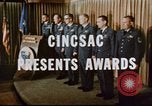
Crew of U.S. Air Force KC-135 aerial refueling tanker aircraft are awarded medals by General Joseph J. Nazzaro.
Crew of a U.S. Air Force Strategic Air Command (SAC) aerial refueling KC-135 tanker aircraft stand on a stage. They stand at attention as a Lieutenant Colonel at a podium reads the citation accompanying their award , in recognition of a unique refueling mission they performed during the Vietnam War. The crew members are Major John H. Casteel, Aircraft Commander; Captain Richard L. Trail, Pilot; Captain Dean L. Hoar, Navigator; and Master Sergeant Nathan C. Campbell, Boom Operator. During Operation "Daisy Chain," they performed the first ever three-level aerial refueling operation that saved six carrier-based U.S. Navy aircraft critically low on fuel, over the Gulf of Tonkin. Each crew member is awarded the Distinguished Flying Cross by SAC Commander in Chief. General Joseph J. Nazzaro. Closeup of the medal on Sergeant Campbell.
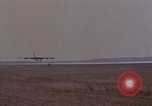
U.S. 306th and 91st Bomb Wing aircraft and personnel return to McCoy AFB, Florida and Glasgow AFB, Montana
U.S. Air Force (Strategic Air Command) B-52 bombers land back in the U.S. after 6 months deployment in Southeast Asia, during the Vietnam War. United States 306th Bomb Wing planes and crews return back to McCoy Air Force Base in Florida, and those of the 91st Bomb Wing return to Glasgow Air Force Base, in Montana. Both units had been operating out of Andersen Air Force Base, in Guam. The commander of 306th, Colonel Earl L. Johnson steps from the last B-52 to return to McCoy AFB. He meets his daughter and wife. Men take pictures in the background. Officers stand in the a group. He shakes hand with local officials. Crewmen with their luggage. A KC-135 Stratotanker taxis as it brings home ground crews and other support personnel. Relatives of the crewmen wait to meet them. They step from the plane. A banner reads '306th Bomb Wing Reception Center Happy Day'. The airmen enter a hangar and go through customs. The airmen meet their relatives. The scene changes from Florida, to Montana, where the final U.S. Air Force B-52 Stratofortress of 91st Bomb wing arrives at Glasgow Air Force Base. "McNamara's Band," playing kazoos, pot, and other contrived instruments, greets the arrivals. Colonel George Phieffer Jr., Commander of 91st bomb Wing greets his wife and others. Ground crews and other support personnel also meet their families.
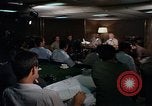
Newsmen take notes during a press conference aboard USS Ranger underway in the South China Sea.
Operations of U.S. Navy A-7A Corsair 2 aircraft aboard USS Ranger underway in the South China Sea during the Vietnam War. A press conference in progress by United States Navy Vice Admiral William F. Bringle. Several newsmen in the foreground. A newsman jots notes. Newsmen sitting at the tables in a wardroom listen to the briefing conference. Vice Admiral Bringle seated at a desk in the background. A news cameraman in the foreground takes movies. Many newsmen in the wardroom during the press conference.