


 Francais
 Deutsch
 Italiano
Refine Your Search
+"Virginia United States USA" +1945 stock footage and images
- Showing 1 to 6 of 6 results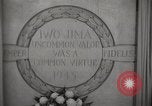
Dedication of Marine Corps War Memorial at Quantico Virginia, and sculptor Felix de Weldon working on sculpture for Arlington location.
The U.S. Marine Corps War Memorial original statue during its unveiling ceremony at the Marine Corps base in Quantico, Virginia on November 10, 1951 (This is after the statue had been moved from its original Constitution Avenue location in Washington DC in 1947, and subsequently renovated under sculptor de Weldon's supervision while it was in Quantico.). A sign on the memorial reads "Uncommon valor was a common virtue, 1945." Next scenes show sculptor Felix de Weldon as he works to build the larger Marine Corps War Memorial in Arlington, Virginia, which was dedicated in November 1954. Felix de Weldon measuring a model of the flag raising on Iwo Jima made by him. de Weldon and others on his team work to carve the large war memorial in plaster before it is cast in bronze. Views of the sculpted faces of the six Marines who raised the flag on Iwo Jima: Faces of John Bradley, Rene Gagnon, Ira Hayes, Franklin Sousley, Harlon Block and Michael Strank. Brief glimpse of the original flag raising scene on Mount Suribachi in February 1945. Next scene, circa 1954 or 1955, shows the completed Marine Corps War Memorial in bronze, in Arlington Virginia, with Washington Monument and Lincoln Memorial landmarks of Washington DC in the background. Close-up views of faces of a young boy, an elderly woman, and a middle aged man who removes his hat. American flag fluttering in the breeze atop the war memorial.
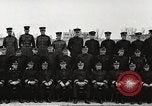
Naval officers photographed at The Naval Operating Base, Hampton Roads, Virginia in 1925.
The Naval Operating Base, Hampton Roads, in 1925 (re-designated "U.S. Naval Station Norfolk," in 1945). Opening scene shows Senior Naval officers (mostly captains plus a couple of rear admirals) seated in front row, and two rows of others officers standing behind them. At one point, they all remove their caps. Behind them is a concrete wall. But tops of some some buildings can be seen behind in the background. Closeup of a seated young rear admiral flanked by captains. In change of scene, all the officers are seen standing at attention, side-by-side on a gravel waterfront area, with a river and numerous buildings on the opposite shore visible in background. The camera pans across the assembled officers. Next, officers are seen on the waterfront, marching in white hats and carrying swords. (In these scenes, the motion is too fast, due to lack of compensation for low hand cranking speed of source camera.) The officers stop and stand in formation, and then march away.
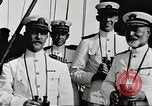
Chief of Naval Operation, Vice Admiral Edward W. Eberle at The Naval Operating Base, Hampton Roads, Virginia in 1925.
Vice Admiral Edward W. Eberle at Naval Operating Base, Hampton Roads in 1925. (The base was re-designated "U.S. Naval Station Norfolk," in 1945). Opening scene shows Admiral Eberle, Chief of Naval Operation, standing on deck of a ship with a captain, a Commander, and a Lieutenant Commander. They are pointing and peering through binoculars at objects (likely aircraft) passing overhead. Next, a Navy launch is seen entering a channel and moving toward the camera. It arrives at a dock is made secure by sailors. Vice Admiral Eberle then steps to the dock, followed by a Captain, a Commander, and several other naval officers, who line up on the dock They exchange salutes with the Admiral, who then ascends stairs followed by his retinue. The last scene is reconstituted and re-filmed. This time, naval staff officers are lined up beside the launch. They salute as Admiral Eberle steps from the launch, followed only by a staff Lieutenant Commander. The admiral then proceeds up steps, followed by officers on his staff. Another scene shows Admiral Eberle, standing on the dock with senior members of his staff behind him.
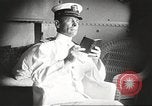
Scenes of Naval Operating Base, Hampton Roads, Virginia in 1925
Naval Operating Base, Hampton Roads, Virginia (renamed U.S. Naval Station Norfolk, in 1945 ). U.S. Navy Commander seated in a chair aboard a ship. A large group of civilian businessmen and officials pose on board a ship with several American Navy officers and one British Naval officer, for a photograph. Some of them stand and some are seated. One civilian stands in front of the group and poses with an American Navy Captain. Change of scene shows Admiral Way on the Navy Base, containing mansions and other structures from the 1907 Jamestown Exposition. It is a very windy day and several civilians are seen on a sidewalk and entering a large building on Admiral Way. Numerous Navy personnel in uniform are seen in the area, including a number of Naval officers entering that building and others heading there along a sidewalk. Residential mansions are seen in the vicinity along Admiral Way.
U.S. President Truman and party return from the Potsdam Conference aboard the USS Augusta
President Truman and members of his party gathering informally aboard the U. S. S. Augusta as the ship entered Chesapeake Bay, returning President Truman from the Potsdam Conference in Germany. Camera pans from right to left, over the group,assembled on deck, under one of shrouded triple 8 in (203 mm)/55 caliber guns of the Augusta. Fleet Admiral William Daniel Leahy stands to the left of President Truman. To the President's right, are Secretary of State, James Byrnes, Press Secretary, Charles Ross, and Naval Aide Captain James K. Vardaman. Next, as the Aurusta enters Hampton Roads, she passes close to a Brooklyn Class Light Cruiser, with her ship's company standing at attention on deck in dress whites. Closeup of the ship and crew as the Augusta passes to starboard. Wide view of Hampton Roads in the vicinity of the Naval Operating Base (Norfolk). A commercial ferry boat, spewing heavy black smoke from her stack, passes close to port. A barge decked out in patriotic bunting is seen as the Augusta approaches her berth. Glimpse of welcoming officers as the Augusta moves into position, docking, at Newport News, Virginia. Ship's mascot,dog, Scottie, standing on deck next to a sailor handling a line.
The U.S. Army Ninth Armored Division arrives in Camp Patrick Henry, Virginia, to be deactivated following World War II
Troops coming home to America at the end of World War 2. An Army Sergeant just returned from Europe, at the end of World War 2, stands on a pier, beside the troop ship USS General J. C. Breckinridge (AP-176). With him is a woman who wearing a jacket emblazoned with many emblems of U.S. military units. The sergeant places the insignia of the 10th Armored Division on her back. They hug and laugh. Scene shifts completely to 9th Armored Division soldiers at Camp Patrick Henry, Newport News, Virginia, holding the large sign originally placed on the Ludendorff bridge in Germany, by C Company of the 9th Armored Engineer Battalion during the war. It reads:"Cross the Rhine with dry feet, courtesy of 9th Arm'd Div." The soldiers carry the sign past a wooden building at the camp. Change of scene shows Ninth Armored Division troops arriving by train at Camp Patrick Henry. They march in loose order on train platform, with troop transport railroad train pulled into station. The happy soldiers march through a Victory Arch bearing words, "Welcome Home" at an entrance to the camp. More views of the troops marching into Camp Patrick Henry, where the 9th Division is to be deactivated. In the camp grounds, Sergeant reaches into his dufflebag and takes out a small puppy. ( Note: Vehicles: seen in this clip include: MB GPW, and CCKW)