


 Francais
 Deutsch
 Italiano
Refine Your Search
+"Warsaw Poland" +1939 stock footage and images
- Showing 19 to 24 of 28 results
Warsaw capitulates after two days of German shelling during invasion of Poland in World War II.
Invasion of Poland by Germany during World War II. Warsaw capitulates after two days of shelling. German troops fire heavy artillery , field artillery and mortars against targets in Warsaw, Poland. Smoke rises from shell fire in the background. Aerial views of destruction from German Stuka dive bombers.
General Tadeusz Kutrzeba, deputy commander of Warsaw, negotiates a cease fire with Germans during invasion of Poland, WWII.
Polish General Tadeusz Kutrzeba, deputy commander of forces in Warsaw, Poland, walks to a bus in which Nazi German officers await to negotiate a cease fire. They discuss disposition of forces using a map. General Kutrzeba then leaves, returns salute of German officer and returns to his soldier garrison. (World War 2.)
German Chancellor Adolf Hitler reviews the victory parade in Warsaw after the German invasion of Poland during World War 2
Victory parade of German troops in Warsaw, Poland after German invasion of Poland during World War II. German Chancellor Adolf Hitler and other German officers review the German troops as they parade through Warsaw.
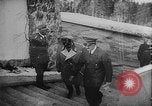
Events leading to World War II in Europe and German attack on Poland in 1939
Adolf Hitler and Hermann Goering walk together up the steps of Hitler's Berghof residence in Berchtesgaden, Bavaria, Germany. Inside the two walk about and converse. Views of them in several different rooms of the building. Hitler and Goering silhouetted against the large windows in one room, containing a long table and a world globe. Change of scene showing Nazi foreign minister, Joachim von Ribbentrop, being greeted by Soviet Union Minister of Foreign affairs, Vyacheslav Molotov, in Moscow, Russia, where they negotiated the signing of the German–Soviet non-aggression pact (also called the Molotov–Ribbentrop Pact) in August 1939. Von Ribbentrop is seen seated with Soviet negotiators. Various newspapers reflect mixed world wide views. Some question whether war or peace is ahead. Another notes that the Reichstag supports the diplomatic initiative. Another suggests that England and France must decide. One headline says Chamberlain will want war. Next, Polish forces are seen on parade being reviewed by General Władysław Bortnowski. Among forces parading are mounted cavalry, marching infantry, a formation of PZL P.11 fighter planes, Tk-3 tankettes (Tankietka), 120 mm wz. field guns, CP7 Ursus artillery tractors pulling wagons, antiaircraft guns mounted on trucks, and army trucks carrying soldiers. Scene shifts to German airmen loading bombs on aircraft; arming machine guns; refueling; and testing functionality of aircraft elements, such as turrets. Pilot in cockpit as engines start on a Dornier Do 17 bomber. Ground crew pull chocks and aircraft taxis out. A Heinkel He 111 bomber taxiing. Two of them take off. A Do 17 takes off, followed by more He 111s. Closeup of one flying low over the camera on takeoff. A mixed formation of German aircraft aloft, including several fighters flying top cover; nine Dornier Do 17s; and other bombers. Aerial closeup of a Do 17 seen from adjacent wingman. Closeup of several He 111s in formation. Closeup of gunner in turret. View from above of three camouflaged Do 17s flying far below. Closeup of pilot in cockpit of He 111 with wingman off to left side. More views of Do 17s flying over patchwork of farmlands. Gunner preparing in his turret. Clouds from antiaircraft fire seen from plane cockpit. Bombs falling and exploding on city below. Succession of bomb craters in a line across a flat area of land. View from aircraft of damaged Polish aircraft on an airfield. Scenes of devastation on the ground including destroyed buildings and Polish aircraft. Waves of German Junkers Ju 87 (Stuka) dive bombers taking off; in formation; and peeling off to dive on targets. View from cockpit of one, through rotating propeller, as it dives to bomb a railroad marshaling yard, and view back as it pulls out, showing clouds of smoke rising in its wake. Several German officers peruse damage at rail site. Destroyed Bridge and shipyard. The German battleship, Schleswig-Holstein bombarding the Polish base at Danzig's Westerplatte on September 1st, 1939. German artillery firing in Poland. Formation of Do 17 bombers overhead. Damaged and abandoned wooden wagons at side of road traveled by Polish civilians evacuating in a horse-drawn wagon and herding their cattle to safety. Destroyed Polish artillery and equipment and horses during German invasion. Men dig graves and bury dead Polish soldiers. Vies from air of bombed out part of Warsaw. Polish citizens gathered in places seeking assistance. German forces on parade in Warsaw, including German soldiers goosestepping. Closeups of Adolf Hitler reviewing them.
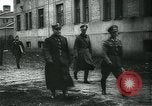
The fall of Warsaw to German forces in 1939, during World War II
Polish General Tadeusz Kutrzeba, deputy commander of Warsaw, is seen accompanied by German officers, as he proceeds toward a military bus where he will sign a ceasefire agreement incident to the capitulation of Warsaw defenders in World War 2. Views of the city in ruins, after the ceasefire. Thousands of Polish citizens gathered in an open square, damaged buildings in background. Polish children being escorted by teachers away from the gathering. Aerial views of the bombed out city, with smoke still rising in places. Unknown locations might include the Warsaw Ghetto. View of Polish General Kutrzeba, inside, the bus, where he signed capitulation agreements. He is reviewing local maps with German officers. He exits the bus and is escorted away (taken as a prisoner of war).
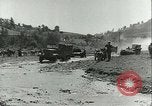
German forces invade through rural areas of Poland and enter Warsaw (WW2)
Invading German advancing into rural Polish regions in 1939. Trucks, motorcycles and infantry follow along the path of a shallow riverbed and ford it over rocks near the remains of a wooden bridge. German troops riding in an Sd.Kfz. 11 special motorized vehicle (Sonderkraftfahrzeug) towing an artillery piece, make their way through shallow water. Another military vehicle moves across remains of a destroyed steel bridge in the background. Closeup of smiling German soldier and his comrades, all shouldering M42 machine guns, as they enter the city of Warsaw on October 1, 1939. German infantry march into the city through smoke and debris to parade for Adolf Hitler on October 5, 1939 (not seen). In the background the twin towers of All Saints Church (plac Grzybowski 3/5, 00-115 Warszawa, Poland) dominate Grzybowski Square. Mounted officers lead marching infantry along a street in Warsaw. Views of German soldiers receiving newspapers as they proceed deeper into Poland. They read them as they march informally. Closeups of German infantry making their way in the company of horse-drawn wagons carrying troops, supplies, and towing artillery pieces. Staff cars, trucks, and motorcycles move over dirt roads near piles of debris.