


 Francais
 Deutsch
 Italiano
Refine Your Search
+"Warsaw Poland" +1944 stock footage and images
- Showing 7 to 11 of 11 results
Nuremberg Trials reveal the Nazi enslavement of people in occupied countries and atrocities against Jewish people during World War II.
Opening scene, in 1946, is the courtroom where Nazi officials are being tried for war crimes at the Palace of Justice in Nuremberg, Germany, where the procecutor has completed charges 3 and 4, concluding the indictment against them. Sitting in first row of the dock are Hermann Göring (or Goering) (hidden behind soldier), Rudolf Hess, Joachim Von Ribbentrop, and William Keitel. The camera focuses on Fritz Sauckel, as he is identified as the Nazi slave labor chief. Supporting documents are shown. Film footage scenes of slave workers being rounded up and working on shipping docks, emptying rail cars, repairing railroads, and digging in open pit mines, under Nazi military guard. Next are shown views of Hermann Goering walking in an occupied village in 1942, overseeing the confiscation of all of the livestock. German soldiers releasing and rounding-up cattle, sheep, and pigs that had belonged to citizens of an occupied village. Dr. Wilhelm Frick is shown. He is charged with eliminating elderly, insane, or uncurable sick Germans, considered "Useless Eaters" and subject to Nazi euthanasia programs. Several frail and sick or mentally disabled persons are shown. Crosses are shown marking burial places of these persons outside the institutions in which they died. Next, several German Jewish men in civilian clothes are seen rushing to a work site where they are put to work as slave labor digging with shovels under direction of a Nazi military officer. Scene shifts to Nazi Storm Troopers (Sturmabteilung) harrassing German Jewish shopkeepers, writing anti Jewish messages on the windows, encouraging boycott, and preventing their businesses from operating. More views of Nazi Storm Troopers causing trouble in the streets. Next scene is Hermann Goering reading some dictates as Hitler and Hess, along with other Nazi officials, sit in attendance. The so called "blood purity" rules or blood purity laws of the Nuremberg Laws define German citizens narrowly and prohibit marriage between "German Citizens" and Jews. An unseen audience roars its approval. Jewish people are next seen being rounded up and beaten, mistreated, harassed, and evicted from home. Back at the trial, the prosecutor speaks of Nazi SS Brigadier General Jürgen Stroop cleaning out the Warsaw Ghetto, in Warsaw, Poland, in utter ruthlessness in 1943. Scenes of Polish Jews people being driven and dragged out by SS and Gestapo forces, many unclothed, and the entire place being dynamited afterward. View of a detonation system, and then a huge explosion and walls of the Warsaw ghetto in Poland area are seen crumbling to the ground. Buildings burning and people leaving with injured on a stretcher. Scenes of Nazi agents, Gestapo, and Wehrmacht Army chasing Jews from sewers using tear gas and driving them from buildings using light tanks and armored vehicles. Jews are rounded up, beaten with clubs, and dragged by Nazi German SS and Gestapo authorities who capture them. Back in the courtroom, Rudolf Hess is seen describing how Nazi doctors would screen arrested Jews as they entered concentration camps. Views of crowds of Jews entering a concentration camp near a railroad train depot. A large group of Jewish children at a camp. Children hold up their arms and the boys and girls reveal tattoo numbers on their arms. More views of women and children moving through outside paths of a concentration camp, surrounded in barbed wire and fencing. Views of so-called camp shower baths in which prisoners were killed by poison gas. Clothing of prisoners hanging outside the gas chambers, which the prisoners were told were delousing chambers. Views of the gas chamber shower heads and gas output vents. Views of naked prisoners, some seated and some laying down, inside a gas chamber. View of dead, naked prisoner bodies stacked up in a room. View of bags filled with gold from rings and teeth of the dead. Canvas bags and chests containing the teeth and gold jewelry, held in the Reichs Bank. Closeup of corpses. Bodies being loaded and unloaded from flatbed trucks and being dragged by camp inmates and German soldiers, and thrown into mass graves.
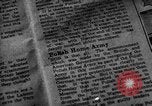
Warsaw bombed by Germans in retaliation to 1944 uprising, various scenes of Warsaw before WW2
Newspapers around the world reporting on the bombing of Warsaw by Nazi Germany as retaliation for the Warsaw Uprising during World War 2. Newspaper headlines read, "Poles Fighting Inside Warsaw," and "Warsaw Being Razed by Hitler's Order," and "Warsaw's Plight" and "Warsaw Poles Fight Tanks in Streets." Scenes of Warsaw in flames as buildings are being bombed by German forces. Montage depicting Warsaw on fire. Scenes of Warsaw before WWII, including scenes such as the Warsaw Old Town Market Square (rynek Starego Miasta, 00-279 Warszawa, Poland), the column of Sigismund III Vasa (plac Zamkowy, 00-001 Warszawa, Poland), the Royal Palace (plac Zamkowy 4, 00-277 Warszawa, Poland) and the Lazienki Park, before World War 2. Statue of King Jan III Sobieski in Lazienki Park. Men strolling near a palace. Baroque gates in park.
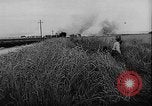
German Ju 87 aircraft dive bombing on suburb area of Warsaw in Poland during Warsaw Uprising.
German Luftwaffe Junkers Ju 87 aircraft bombing suburbs of Warsaw in Poland during 1944 Warsaw Uprising of World War 2. German soldier looks at bombing raid from a bunker. Formation of German Ju 87 aircraft attack large buildings in suburbs of Warsaw. Explosions on two buildings targeted. Aerial closeup view of Ju 87 dive bombing intended target building. Massive explosion as building blows up. Fire and smoke and debris in the air.
Soviet advance and liberation of Warsaw and Poznan during drive toward Berlin in World War 2
Russian attacks on Warsaw and Poznan in World War II in late 1944 and early 1945. Soviet army using tanks, heavy artillery, machine guns and grenades advance forward. Marshal Zhukov and Marshal Rosokofskey inspecting Russian cossacks advancing on horses. A Soviet soldier is shot by a sniper while running through street intersection. A Russian machine gunner firing a Soviet DP-28 light machine gun shoots at building to take out a sniper's nest. Dead bodies of German snipers in rooms next to windows. Views of ruined city of Poznan. Liberated concentration camp victims, including a woman who has been blinded in one eye. Interior of a room in Poznan Prison loaded with torture equipment, including a guillotine. Piles of bodies of persons mass executed during German retreat. Women crying over bodies in coffins of three Polish men that were found hanging in the liberated prison. German Generalmajor Ernst Mattern and his fellow officers seen after surrendering Fort Winiary Citadel (Poznan Citadel). Soviet soldiers. Liberated civilians in Poznan hit and beat German soldier prisoners of war as they are marched under Soviet guard. Scenes of ruined Warsaw include a sign that reads, 'Adolf Hitler Platz.' A wrecked trolley or street car with signs on it that read, ''Wierzeno' and 'Ein u. Ausstieg nur fur Deutsche' which translates to English as, 'On and off exit points only for Germans' The ruined home of Frederic Chopin in Warsaw. The Polish flag flying again after battle.
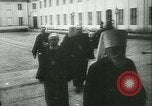
Bishops of the Ukrainian Orthodox Church present a plaque to Dr. Ludwig Fischer in Warsaw.
Bishops of the Ukrainian Orthodox Church assemble in Warsaw. Bishops enter the venue. They are greeted and welcomed by Nazi German politician Ludwig Fischer and other officers. The Bishops read from a plaque. Lit candles in the room. The Bishops present the plaque to Ludwig Fischer, and he accepts.