


 Francais
 Deutsch
 Italiano
Refine Your Search
+"Washington DC USA" +1924 stock footage and images
- Showing 1 to 6 of 13 results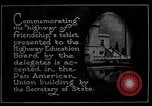
Pan American Highway Commission presents a commemorative plaque at the Pan American Union in Washington DC
Delegates of the Pan American Highway Commission present a gift after a month-long tour of the United States in 1924. Ceremony at the Pan American Union in Washington DC. Tablet is unveiled inscribed with the title 'Highway of Friendship', and presented as a gift to the Highway Education Board. The first line of the tablet reads, "Commemorative of the Official visit of the Pan American Highway Commission to the District of Columbia and the states of North Carolina, Kentucky, Illinois, Minnesota, Wisconsin, Michigan, Ohio, Pennsylvania and New Jersey June 2 to July 3, 1924. The happiness and prosperity of the people of the United States have been greatly enhanced by your definite program of Highway education...." U.S. Secretary of State Frank B. Kellogg accepts the tablet and speaks to those gathered.
Flight testing of a bi-wing Berliner Helicopter in Washington DC.
Test flight of a Berliner helicopter by Henry Berliner. A hybrid airplane helicopter built by Emile Berliner and his son Henry Berliner is shown during a Washington DC test flight. It rises and move forward in short hops. The lighter weight design and high incidence large camber lower wing indicates it was likely built in 1924 or 1925 as one of the last Berliner models, following after a triplane version that was test flown in February 1924.
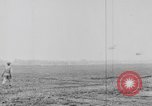
President Coolidge welcomes the U.S. Army Air Service round-the-world fliers in Washington DC, United States.
Two Douglas World Cruiser airplanes land at Bolling Field, Washington, DC, to be welcomed by U.S. President Calvin Coolidge, in recognition of their round-the-world flight completed on September 28, 1924, at Seattle, Washington. Major General Mason M. Patrick, Chief of the Army Air Service, signals with his arm to guide them to a parking place, as they taxi in after landing. The two aircraft park next to one another. Next, a welcoming committee is seen standing, with the President (dressed in a rain slicker). Secretary of War, John W. Weeks stands to the President's left. To Coolidge's right, are 1st Lieutenant Leigh P. Wade (pilot);1st Lieutenant Leslie P. Arnold (co-pilot); 1st Lieutenant Lowell H. Smith (pilot, and flight commander); and SSgt. Henry H. Ogden (flight mechanic). Closeup of President Coolidge with Lieutenant Smith in front of one of the aircraft. Scene shifts back again to the larger group, with Lieutenant Wade and Coolidge shaking hands with the four flyers, starting with Lieutenant Wade. Secretary Weeks shakes hands with General Patrick, who has donned a flying coverall. Then Weeks shakes the hands of the flyers and they proceed away from the gathering. Change of scene shows Lieutenant Smith perched on the wing of his aircraft, the "Chicago,"conversing with the President and Secretary Weeks. He gets down and continues his conversation with Coolidge, who touches a propeller blade at one point. Final scene shows a two seater DH-4 airplane taking off from Bolling field.
U.S. Air Service promotional activities during the 1920s.
1924: A crowd gathered at Boston Harbor to welcome the first 'Round the world flyers. Dignitaries seated. Air Service Douglas World Cruiser biwing float planes land in the harbor. United States Army Air Service flyers, led by Lieutenant Lowell Smith, arrive in boat at harbor. The six intrepid Lieutenants: Harding, Nelson, L.P. Arnold, Wade, Ogden and Smith, pose with General Patrick, Chief of the Air Service , along with several young women. View of the Barling Bomber at Wright Field in Ohio. Crew members: Lieutenants Harris and Muir Fairchild together with designer Walter Barling and engineer Culver, pose together and then climb aboard the airplane. The aircraft commander stands in open cockpit and orders flight engineer to start the 6 Liberty engines. The Barling Bomber taxis out and takes off. Commander waves from open front cockpit as aircraft climbs after takeoff. Views of the Barling Bomber in flight. President Calvin Coolidge stands, awaiting the arrival of the Pan American Goodwill flyers, at Bolling Field, Washington, DC. Crew of the Loening OA-1A amphibian, "New York": Major Herbert Dargue, and Lieutenant Ennis Whitehead, are greeted as they climb down from their aircraft. President Coolidge, presents all of the flyers with Distinguished Service Cross Certificates.
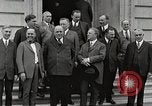
Congress adapts Japanese Exclusion Act and congressmen pose on the steps on a building in Washington DC.
The U.S. Congress adapts Japanese Exclusion Act of 1924. Congressmen pose on the steps of a building in Washington DC. A close view of officials standing on the steps. A Japanese official.
United States Army Air Force footage of Berliner helicopter 1925 variant being tested in Washington D.C.
United States Army Air Force footage of a helicopter designed by Emile Berliner and Henry Berliner being tested in Washington D.C.,United States. This was one of the final Berliner models built, if not the final, constructed after the triplane model 5 variant that had been demonstrated in February of 1924. This variant had a biplane configuration and was lighter to improve the thrust to weight ratio. The lower wing generated lift from the rotor downwash due to a high angle of incidence and large camber. The helicopter repeatedly lifts off, hovers, does some forward movement, and then touches the ground.