


 Francais
 Deutsch
 Italiano
Refine Your Search
+"Washington DC USA" +1928 stock footage and images
- Showing 1 to 6 of 16 results
Bishop James Cannon Jr. being tried on charges of mishandling Presidential Campaign funds
Photographers take pictures, as Bishop Cannon, of the Southern Methodist Church, emerges from courthouse. Cannon, founder of the Virginia Anti-Smith Campaign, was on trial along with campaign treasurer Ada L. Burroughs, accused of mishandling Presidential campaign funds in 1928. Bishop Cannon walks slowly down steps using a cane and makes his way to a coupe automobile awaiting him at the curb.
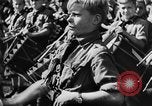
Fascism growth despite pre-World War 2 disarmament efforts including Washington Disarmament Conference, Nine-power treaty.
The background of World War II. German Hitler Youth children march with rifles, flags and a band beneath a camp entrance named Nordmark Lager 1935. Flag with Nazi symbol. Japanese flag and Japanese youth march in military exercises, followed by teenage Japanese forces. Italian fascist troops in uniform march in Torino Italy led by a band. Views of various German and Nazi forces parade and goose step in various cities. Units include brownshirts, goosestepping Storm Troopers, Wehrmacht. Civilians give a salute. Mostly sad looking men women and children watch the parades. The world globe. U.S. Capitol Building in Washington DC. French, Japanese and United States dignitaries attend the Washington Disarmament Conference or Washington Naval Conference at Memorial Continental Hall in Washington DC in 1921. View of the Washington Naval Treaty naval fleet reduction treaty book with signatures on it. Officials sign the Nine-Power Treaty that guarantees the integrity of China (per the John Hay "Open Door Policy"). Japanese delegation is shown at signing ceremony for the Nine-Power Treaty. Next scene shows 1928 signing ceremony in Paris of the Kellogg-Briand Pact renouncing war as a means of settling international disputes. French Foreign Minister Aristide Briand is seen speaking, and American Secretary of State Frank Kellogg is also seen at the treaty signing which was signed by 47 nations including Germany and Japan. In a 1930 scene, U.S. Secretary of State, Henry Stimson hands the London Naval Treaty to President Herbert Hoover. Scene of a U.S. Navy ship being blown up and scrapped in accordance with the treaty terms. View of American citizens in small town parades with floats marching as anti-war and isolationist groups.
Charles Lindbergh greeted by military officers, government officials, Rear Admiral Byrd and his mother in Washington DC.
Aviator Charles Linbergh returns to the U.S. after his trans-Atlantic flight. Lindbergh aboard the Cruiser, USS Memphis, as it makes its way over the Potomac to Washington DC. As it passes Mount Vernon, the USS Memphis fires a gun salute. Aerial view of the ship at the Washington Navy Yard. Military officers and government officials wave to welcome Lindbergh. Sailors with the U.S. flag. Naval officers including Rear Admiral Richard Evelyn Byrd escort his mother Evangeline Lindbergh aboard the ship.
Charles Lindbergh received by his mother Evangeline Lindbergh, Rear Admiral Byrd and Proctor Dougherty in Washington DC.
Aviator Charles Lindbergh returns to the U.S. after his trans-Atlantic flight. Rear Admiral Richard Byrd escorts Lindbergh off the USS Memphis in Washington DC. A large crowd greets Lindbergh. Byrd, Lindbergh, Evangeline Lindbergh and President of the Board of Commissioners Proctor L Dougherty get into a car and leave. The car driven through the city.

A parade down Pennsylvania Avenue in honor of Charles Lindbergh, Washington DC.
Aviator Charles Lindbergh honored in Washington DC. View from above of parade down Pennsylvania Avenue in Lindbergh's honor. The Avenue leading to the U.S. Capitol. A horse cavalry follows Lindbergh's car. Riding with him are Rear Admiral Richard Byrd, President of the Board of Commissioners Proctor L Dougherty and his Lindberg's mother ,Evangeline Lindbergh. Soldiers march during the parade. Crowds on either side of the street.
President Coolidge welcomes Lindbergh in Washington DC after his trans-Atlantic flight.
Aviator Charles Linbergh returns to the United States after his trans-Atlantic flight. The President of the Unites States Calvin Coolidge receives him at a ceremony. A decorated stage at the venue. Sailors, soldiers and government officials greet Lindbergh. A large crowd gathered for the ceremony. The U.S. flag sways in the breeze.