


 Francais
 Deutsch
 Italiano
Refine Your Search
+"Washington DC USA" +1934 stock footage and images
- Showing 1 to 6 of 22 results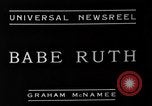
Babe Ruth honored before his final baseball game with New York Yankees, 1934
Brief newsreel clip covering Babe Ruth's final game with the New York Yankees at the Griffith Stadium (Present day Howard University Hospital, 2041 Georgia Ave NW, Washington, DC 20060, United States) in Washington DC, USA. Players, photographers, and dignitaries honor Ruth before the game with ceremony around home plate. Man presents Ruth, wearing the New York Yankees road uniform, with an award. Ruth accepts it and talks briefly, standing next to his wife Claire, seen at right. Brief shot of Washington Senators pitcher Orville Armbrust throwing. (Armbrust would get the only win of his major league career in this game.) Ruth, pictured in a different game and in home uniform, steps into batter's box. Scene of Ruth hitting a home run from earlier in his career.
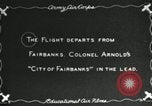
YB-10s of the U.S. Army Air Corps 1934 Alaska Flight return to Bolling Field in Washington, DC after flying more than 7000 miles.
The U.S. Army Air Corps (USAAC) Alaska Flight of 1934 departing Fairbanks Alaska on flight back to Washington, DC. Their YB-10 aircraft are seen in a line on the airfield. Spectators are at the edge of the field to see them off. Next, the aircraft are seen taxiing out for takeoff, with their Commander, Lieutenant Colonel Henry Arnold, piloting the lead aircraft, the "City of Fairbanks." Other aircraft follow in succession. Colonel Arnold's airplane takes off and proceeds in a shallow climb. Slate tells first leg is 640 miles to Juneau in 3 hours and 55 minutes. Map shows North America with outbound course to Alaska from Washington, DC, traversing the Great Lakes, Edmonton, Prince George, and White Horse, to Fairbanks. But a moving arrow shows return route via Juneau. Snow-covered mountains seen from a YB-10 on this return leg. Aerial shots of several YB-10s in formation. Slate announces next leg as 940 miles and 5 hours and 40 minutes to Seattle, Washington State. Aircraft and crews of the returning Alaska Flight, seen on a grass field in Seattle. Lieutenant Colonel Henry Arnold, expedition commander, leads his fliers across the field. Slate states remaining distance to Washington, DC, as 2700 miles and 14 hours. More shots of YB-10s in formation aloft. Shot of a YB-10 with farmland below. Ten YB-10s seen in formation, and the animated map completes the journey to Washington, DC. Aerial view from above of several YB-10s below, flying over the Potomac River, in Washington, DC, with the Lincoln Memorial, and Arlington Memorial bridge visible below. The formation of 10 planes barely visible above the Capitol building. The YB-10 named Juneau, taxiing across Bolling Field, after landing. (This segment of film is reversed, so the name and Alaska Flight logo are mirror-reversed.) The last of the 10 aircraft pulls into position on the flightline. Lieutenant Colonel Henry (Hap) Arnold stands in front of his fliers who hold a large totem pole souvenir. Secretary of War, George H. Dern, greets the returning aviators and poses next to Colonel Arnold.
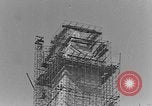
Washington Monument covered in scaffolding during cleaning and replacement of lightning rods, Washington DC, United States.
Vertical panning views of the Washington Monument, completely enveloped by scaffolding, during cleaning and replacement of lightning rods, in 1934.
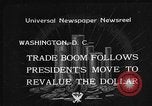
Gold Reserve Act revaluation of dollar by President Roosevelt causes influx of gold to United States and rise in prices of goods.
U.S. President Franklin Roosevelt's plan to readjust national currency via the Gold Reserve Act, conveyed at the Congress in Washington DC. The United States Congress meet at the Capitol in Washington DC. The officials seated in the hall inside the Capitol building. The House leadership and officials seated in the center during discussions related to the Gold Reserve Act of 1934. Secretary of the Treasury, Henry Morgenthau, Jr. seated at his desk signing documents. Crates of gold being unloaded from ships as overseas gold exporters sent gold to the United States where it commanded higher prices as proclaimed by the President. Two men stocking gold bars in a bank. Young African American farmers picking cotton in a cotton field. One smiles for the camera. Commodity traders busily trading commodities on on a mercantile exchange floor. Rise in prices, as a result of revaluation of dollar.
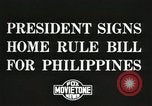
United States President Franklin Delano Roosevelt signs Constitution of the Philippines.
United States President Franklin Delano Roosevelt signs the Constitution of the Philippines, as permitted by the Tydings-McDuffie Act of 1934. View of the signed Philippine Constitution that had been produced by the Constitution Convention in the Philippines and approved there on February 8, 1935 before being presented to Roosevelt in Washington for his signature. (It was later ratified on May 14, 1935). President Roosevelt talks about the importance of document signed. Philippine President Manuel L Quezon stands up, shakes hands with President Roosevelt and thanks him on behalf of the Filipino people.
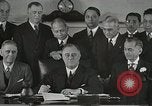
United States President Franklin Delano Roosevelt signs Philippine Constitution produced by Contitutional Convention
Pursuant to the terms of the Tydings-McDuffie Act of 1934, United States President Franklin Delano Roosevelt signs the Philippine Constitution presented to him by Philippine President Manuel Quezon, in Washington DC. View of the signed Philippine Constitution cover document. President Roosevelt signs one copy and hands it to one of the officials present. Then he signs another for President Manuel Quezon, who stands, shakes hands and thanks President Roosevelt, and then sits again. Audio of casual discussion during the signing ceremony is heard. President Roosevelt reads provisions of the act. President Manuel Quezon gives a brief speech to thank the United States.