


 Francais
 Deutsch
 Italiano
Refine Your Search
+"Washington DC USA" +1935 stock footage and images
- Showing 7 to 12 of 41 results
President Roosevelt authorizes Philippine Home Rule and congratulates Manuel Quezon in Washington DC, U.S.
U.S. President Franklin D. Roosevelt signs the recently formalized Philippine Constitution in Washington DC, United States. It had been formalized by a Constitutional Convention and approved in the Philippines on February 8, 1935. President Roosevelt at a desk as he signs the document, as required by the Tydings-McDuffie Act of 1934. Other officials stand behind the President. Philippine leader Manuel Quezon seated next to the President. President Roosevelt speaks from his desk. He congratulates the Filipino people for enacting a constitution for themselves. He says that after the ratification the people of the Philippines will have self government. Manuel Quezon shakes hands with the President and thanks him.
Commuters driving to work in Washington, DC, and people playing tennis at local park.
Commuters driving on Rock Creek Parkway near Washington, DC. (Among the many cars seen is a 1935 DeSoto Airflow automobile, at a traffic circle.) Views of commercial downtown section of Washington, DC, with businesses and offices along streets busy with automobile traffic and pedestrians. Young man and woman on telephone make a date to play tennis at a local park. View of tennis players on numerous park service tennis courts with U.S. Capitol building in background.
U.S. President Franklin Roosevelt addresses the nation and urges the people to support the relief fund drive in Washington DC.
U.S. President Franklin Delano Roosevelt addressing the nation from Washington DC, United States. The President seated at a desk. He urges people to support a relief fund drive. He talks about the aid from people in order to remove some of the relief burden from the government, during the 1935 Mobilization for Human Needs
President Franklin D. Roosevelt reviews a parade past the White House, following his 2nd inaugural in 1937.
President Franklin Roosevelt's mother, Sara Delano Roosevelt, is seen standing with her grandaughter, Anna Roosevelt Dall Boettiger, who holds the hand of her daughter, Anna Eleanor Roosevelt Dall. The President's son, Elliot Roosevelt and his wife, Ruth Josephine Googins Roosevelt, stand with them. Next, President Franklin D. Roosevelt and First Lady, Eleanor Roosevelt, holding a bouquet of flowers, are seen in an open car. Scene shifts to the White House porch, where a protected Presidential reviewing stand has been set up, along with chairs. View of President Roosevelt, in a top hat, receiving congratulations from officials. Admiral William Leahy, Chief of Naval Operations, and another admiral (possibly recently retired CNO, William Harrison Standley) are seen in full dress uniforms. The President's son, Elliot Roosevelt is also present, to assist FDR when necessary. Some mounted U.S. Army cavalry ride past the reviewing stand, saluting with swords. An automobile is seen driving along the wet street, accompanied by a formation of motorcycle police officers. President Roosevelt holding onto a built-in railing, reviews various elements and units in the inaugural parade, including several military marching bands. Army Chief of Staff, General Malin Craig, rides past on horseback, and renders a sabre salute to the President. He is followed by a contingent of U.S. Army mounted cavalry. One of the marching bands is seen from another camera location. An open top 1935 Duesenberg SJ Dual-Cowl Phaeton, with exposed exhaust tubes, is seen, displaying a small banner on its door, reading "Pennsylvania." Numerous closed sedans, carrying notables, drive along the wet street, past the President, who waves his hat and smiles at some. Vice President, John Nance Garner IV, shares the reviewing stand with FDR.
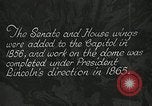
The U.S. Capitol building in Washington DC, and the Supreme Court chamber inside
View of the United States Capitol building (E Capitol St. & 1st St. NE Washington, DC 20004 United States) in Washington DC. View of the Senate, House wings and the Dome of the Capitol building. Congress in session at the Capitol building. The Old Senate Chamber inside the Capitol where the Supreme Court meets (before moving to the Supreme Court Building in 1935).
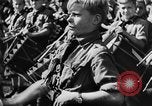
Fascism growth despite pre-World War 2 disarmament efforts including Washington Disarmament Conference, Nine-power treaty.
The background of World War II. German Hitler Youth children march with rifles, flags and a band beneath a camp entrance named Nordmark Lager 1935. Flag with Nazi symbol. Japanese flag and Japanese youth march in military exercises, followed by teenage Japanese forces. Italian fascist troops in uniform march in Torino Italy led by a band. Views of various German and Nazi forces parade and goose step in various cities. Units include brownshirts, goosestepping Storm Troopers, Wehrmacht. Civilians give a salute. Mostly sad looking men women and children watch the parades. The world globe. U.S. Capitol Building in Washington DC. French, Japanese and United States dignitaries attend the Washington Disarmament Conference or Washington Naval Conference at Memorial Continental Hall in Washington DC in 1921. View of the Washington Naval Treaty naval fleet reduction treaty book with signatures on it. Officials sign the Nine-Power Treaty that guarantees the integrity of China (per the John Hay "Open Door Policy"). Japanese delegation is shown at signing ceremony for the Nine-Power Treaty. Next scene shows 1928 signing ceremony in Paris of the Kellogg-Briand Pact renouncing war as a means of settling international disputes. French Foreign Minister Aristide Briand is seen speaking, and American Secretary of State Frank Kellogg is also seen at the treaty signing which was signed by 47 nations including Germany and Japan. In a 1930 scene, U.S. Secretary of State, Henry Stimson hands the London Naval Treaty to President Herbert Hoover. Scene of a U.S. Navy ship being blown up and scrapped in accordance with the treaty terms. View of American citizens in small town parades with floats marching as anti-war and isolationist groups.