


 Francais
 Deutsch
 Italiano
Refine Your Search
+"Washington DC USA" +1937 stock footage and images
- Showing 19 to 24 of 56 results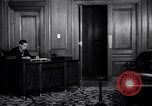
New York Mayor Fiorello H. LaGuardia proceeds for a meeting.
Mayor of New York Fiorello LaGuardia arrives with his subordinates for a meeting. He settles his subordinates outside and moves inwards to a room for meeting. 11 August 1937.
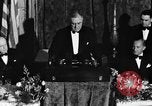
U.S. President Franklin D. Roosevelt speaking at Democratic Party Victory Dinner in Washington, D.C.
President Franklin D. Roosevelt stands at podium and speaks after Democratic Victory Dinner, in the Willard Hotel, Washington, DC, on March 4, 1937. He states that, "Democracy in many lands has failed, for the time being, to meet human needs." He speaks of people being so fed up with debate and party bickering that they surrender democratic principles and processes to get things done. He goes on to speak of history, and failure of dictatorship. He states that, "In the United States, Democracy has, not yet, failed, and does not need to fail." At that point the audience applauds. Roosevelt refers the the Agricultural Adjustment Act. He complains about the Supreme Court. He remarks with a smile that, as the lawyers themselves say, "In this fight, time is of the essence." The audience applauds. He speaks of meeting the needs of the peple, now.
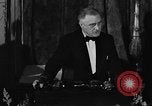
U.S.President Franklin D. Roosevelt castigates the Supreme Court at Democratic Party Victory Dinner in Washington, D.C.
President Franklin D. Roosevelt, standing at podium, speaking after Democratic Victory Dinner, in the Willard Hotel, Washington, DC, on March 4, 1937. He castigates the Supreme Court for issuing what he describes as a "pronunciamento," the Court's decision that neither the Federal Government nor the States may legally address issues of hours and wages. Roosevelt says it defines a "No man's land of final futility." The audience applauds. He goes on to speak to various problems with the Supreme Court. He speaks of freeing progressive actions of the Democratic Party from legal doubt. He calls for courage and wisdom. He notes that "here is one third of a nation, ill nourished;ill clad;ill housed." The President mentions farmers burdened by mortgage interest, and people laboring for inadequate wages. He decries the fact that thousands of children who should be in school, are, instead, working in mines and mills. The audience responds with enthusiastic applause.
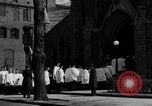
President Franklin D. and Mrs. (Eleanor) Roosevelt attend Easter Sunday worship services in Washington, DC.
Church choir members in white robes line the sidewalk and enter St. Thomas' Parish Episcopal Church, located at 1772 Church Street, NW, in the Dupont Circle area of Washington, D.C. The President and First Lady are seen arriving in the President's 1937 Packard seven-passenger parade touring car, accompanied by several Secret Service agents, walking beside the car and others riding in a car behind. People gather along the sidewalks to get a glimpse of President and Mrs. Roosevelt. Policemen maintain cordons in front of the sightseers. The Presidential motorcade drives up to an awning-covered side entrance of the stone church. Views of the building in the background. Following the worship service, President Roosevelt poses alongside two clergy from the church: Rev. Howard Sargent Wilkinson (Rector at St. Thomas as of 1936) and Rev. Allen O. Miller, Assistant. to the rector. Mrs. Roosevelt is seen behind in a fur coat. The President uses a cane to steady himself. Later the presidential open car departs (bearing license plate with number 101). It is followed by another car carrying Secret Service agents, bearing license plate reading: "USSS" for U.S. Secret Service. (Note: The Sanctuary building of St. Thomas' Parish Church was destroyed by fire, believed to be result of arson, in 1970.)
President Woodrow Wilson receives French Foreign Legion members at the White House.
President Woodrow Wilson receives French Foreign Legion members at the White House. Members of the French Foreign Legion on the lawn in front of the White House. Captain De Grey in command. The troops stand with their flags. American officials, dignitaries, and Frech troops march through a corridor. The troops exit the building led by officers.
Franklin Delano Roosevelt's Second Inauguration ceremony at White House in Washington DC; review of Inaugural parade.
Franklin Delano Roosevelt's Second Inauguration ceremony on a cold rainy day in Washington DC. Vehicles drive past on Pennsylvania Avenue. Troops with rifles; West Point Cadets; mounted cavalry and horse drawn artillery units parade. Several bands play, President Franklin Roosevelt is assisted by his son as he stands to review the parade. As a result of the bad weather not many spectators watch the activities.