


 Francais
 Deutsch
 Italiano
Refine Your Search
+"Washington DC USA" +1941 stock footage and images
- Showing 61 to 66 of 79 results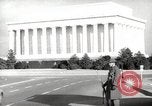
A soldier stands and walks on Arlington Memorial Bridge in Washington DC.
The Lincoln Memorial in Washington DC, United States. A soldier stands outside the building. Cars drive past along the street in front of the building. A soldier walks on Arlington Memorial Bridge, monitoring traffic entering the city early during World War 2. Buildings and trees in the background. The U.S. flags flying atop flag poles on a building.
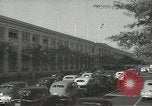
United States Secretary of Navy William Frank Knox and other officials at the U.S. Navy Department in Washington DC.
The U.S. Navy Department in Washington DC, United States. A number of vehicles drive past the U.S. Navy Department. The flag of the U.S. flutters from a pole on the building. United States Secretary of Navy William Frank Knox with U.S. Navy Admiral Harold Stark; Captain Beatty; Vice Admiral John Henry Towers and the Assistant Secretary of Navy ( Air) A. Gates. The officials discuss important issues during the meeting. William Frank Knox smokes a pipe while speaking to the group.
United States Navy Vice Admiral John H Towers with U.S. Captains at the U.S. Navy Department in Washington DC.
The U.S. Navy Department in Washington DC, United States. 'Secretary of the Navy' written on the door of an office. Vice Admiral John Henry Towers speaks to Captain Davison and Captain Ramsey in his office. Vice Admiral Towers explains about an aircraft with the help of a model aircraft.
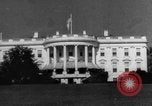
President Roosevelt and Cordell Hull in Washington DC; U.S. war production; German U-boat attack
Japanese newsreel during World War 2 shows United States President Franklin D Roosevelt signs the Lend Lease Act in Washington DC. A view of the White House. The United States flag flutters on the top of the building. United States Secretary of State Cordell Hull speaks. United States factories gear up for war production. War production workers busy with machines in a factory. A partially completed U.S. fighter aircraft on a factory floor. Men work on hand operated machines. President Roosevelt signs the Lend Lease Act. Supplies are loaded aboard ships. United States military tanks, trucks and ammunition carried by cranes onto the ships. A Red Cross van loaded aboard a ship. Scene changes to Atlantic Ocean and a convoy of ships at sea. A German submarine crew gets ready to submerge. German U-boat submerge. A convoy of ships underway at sea. Heavy seas and large waves as seen from deck of ship during rough seas. The ships are hit by German torpedoes. A ship sinks after being hit. Survivors of the Allied ship on a raft. Clip contains Japanese slates and Japanese narration.
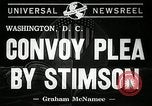
U.S. War Secretary Henry L Stimson speaks about the use of U.S. battleships to convoy war shipments to England, in Washington DC (WW2)
Convoy plea by U.S. Secretary of War Henry L. Stimson in Washington DC during World War II. U.S. Secretary of War Henry L. Stimson, seated at a desk, reads from a paper. War Secretary Stimson speaks about the use of U.S. battleships to convoy war shipments to England. Secretary Stimson also says that the U.S. fleet which is the first line of defense can best defend this country by guaranteeing delivery of goods to Britain.

Soviet Ambassador Constantine Oumansky addresses nation and presents his views on war in Washington D.C. (WW2)
Soviet Ambassador addresses nation in Washington D.C., United States, the day after the German invasion of the Soviet Union in Operation Barbarossa in World War II. View of the Embassy of the Union of Soviet Socialist Republics building. Soviet Union Ambassador Constantine Oumansky seated at office. He addresses nation and presents his views on Hitler's German invasion of the Soviet Union. He states that Hitler has miscalculated, and that Hitler's invasion will be smashed. Under Secretary of State, Benjamin Sumner Welles, addresses a press conference stating the administration's immediate aim is to stop Hitlerism (Nazism) and Fascism. Reporters note down the points. Photographers take pictures.