


 Francais
 Deutsch
 Italiano
Refine Your Search
+"Washington DC USA" +1941 stock footage and images
- Showing 7 to 12 of 79 results
President Franklin D. Roosevelt asks Congress to declare war, after Japanese attack on Pearl Harbor (WW2)
On December 8, 1941, U.S. President Franklin D. Roosevelt, addresses the Congress, calling for a declaration of War against Japan in World War II. He calls December 7, 1941 "a date which will live in infamy." Roosevelt notes the United States was at peace and in conversation with Japan's government and Emperor Hirohito, about maintaining peace in the Pacific. Japanese ambassador and statesmen are seen visiting State Department offices to meet with the U.S. Secretary of State. Photographers take pictures of the visiting Japanese statesmen. President Roosevelt asks Congress to affirm that a state of War exists between the United States and the Japanese Empire.
The Arcadia Conference in Washington, DC and Paratrooper Demonstration at Fort Jackson, South Carolina in World War II
The Arcadia Conference in Washington, DC, during World War 2, from December 22, 1941 to January 14, 1942. American President Franklin D. Roosevelt and British Prime Minister, Winston Churchill, are seated in chairs on a portico of the White House. ( Roosevelt wears a black arm band, in mourning for his mother, Sara Delano Roosevelt, who died on September 7, 1941.) Behind them stand representatives from various Allied nations. Scene shifts abruptly to Fort Jackson, South Carolina, June 24, 1942, where Prime Minister Churchill and U.S. Army Brigadier General William C. Lee, ride in back of an open white convertible car to inspect U.S. Army troops at attention in a massive formation. Next, the troops are seen marching. Churchill smoking a cigar is seated on a bench watching as the parade continues, to include soldiers in jeeps, and trucks. Closeup of U.S. Army chief of Staff, General George Marshall, conversing with Prime Minister Churchill. Next, Churchill, accompanied by General Lee, personally inspects Army paratroopers in their jump gear. Among others accompanying him is U.S. Secretary of War Henry L. Stimson, wearing a pith helmet. Churchill listens on a portable radio, as paratroop commanders in flight give orders for their paratroopers to jump. Formations of U.S. Army Air Forces C-47 aircraft are seen overhead, as hundreds of paratroopers jump from them and descend by parachutes. Churchill, seated on a chair, next to General Lee, watches the paratrooper demonstration. Secretary Stimson, sits behind him. British and American officers and soldiers stand behind and watch, as well. Closeup of Churchill with cigar in his mouth, shielding his eyes, with his hands as he watches the demonstration. The second person seated behind Churchill is British Field Marshal Sir John Dill, with his hand on an upright wood support. More views of parachutes floating down into an area of trees, and of more C-47s dropping paratroops from overhead.
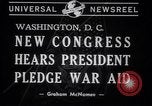
President Franklin Roosevelt at 77th Congress in Washington urges nation to enlarge weaponry and aid the Allies.
President Franklin Roosevelt along with Vice President Garner and other dignitaries gather for the 77th annual congress in Washington DC. President addresses nation in conference hall full of legislators ,reporters,and photographers. President says 'America must spent billions on weapons to aid the embattled democracies of world'. President promises to send in number, ships,tanks,planes and guns to their aid. All at conference applause President's noble notion. January 1941. (World War II period).
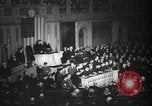
President Franklin D. Roosevelt addresses Congress at the U.S. Capitol in Washington DC, and declares war on Japan (WW2)
U.S. President Franklin D. Roosevelt at the U.S. Capitol in Washington DC. President Roosevelt at podium addressing Congress in World War II. He recounts events leading up to the Japanese attack and delivers his declaration of war against Japan. He describes the attack as "unprovoked and dastardly" and asks the Congress to affirm that since the attack on December 7, 1941, a State of War has existed between the United States and the Japanese Empire. He speaks about the war and states that the Americans will surely succeed in the war. The officials applaud at the President's statement.
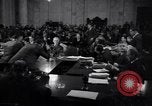
General George C. Marshall testifies before the Joint Congressional Committee on the investigation of the Pearl Harbor attack
General George C. Marshall and JCC members gathered in investigating the 1941 Pearl Harbor attack. General Marshall taking the oath and testifying before the Senators and Representatives. View of the committee members including the Chairman, Kentucky Senator Alben Barkley. The members of the meeting listen carefully to him. The press take notes of his address. (World War II period).
General Jonathan Mathew Wainwright returns back to the U.S. after World War II and receives the Congressional Medal of Honor.
U.S. Army General, Jonathan Mathew Wainwright, home from Bataan and Corregidor, and Japanese prisons, reviews a parade in San Francisco and Washington DC and receives the Congressional Medal of Honor from U.S. President Harry S. Truman. General Wainwright exits an airplane in San Francisco. A crowd stands on both sides of a road. The General is greeted by the western defense commander, and by his sister, Mrs. Frederick Mears. They ride in a convertible car and wave at a large parade crowd along Market Street in San Francisco, gathered to welcome him back to the United States. Next scene shows his arrival by airplane in Washington DC, where he meets his wife for the first time since she left the Philippines in 1941. A military motorcade with General Wainwright crosses Memorial Bridge from Arlington into Washington DC. Huge "Welcome" sign and bunting arches all the way across Memorial Bridge, with the Lincoln Memorial in the background. Posters on poles read "Welcome Home Skinny" (his nickname). Large crowd gathers at the Washington Monument to celebrate General Wainwright. Next, on the White House lawn, President Truman presents the Congressional Medal of Honor to the General in Washington DC.