


 Francais
 Deutsch
 Italiano
Refine Your Search
+"Washington DC USA" +1941 stock footage and images
- Showing 43 to 48 of 79 results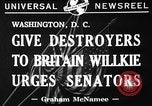
Wendell Willkie addresses senators in Washington DC and urges the passing of the Lend-Lease bill to help Britain.
Wendell Willkie, nominee of the Republican Party ( GOP ), addresses senators in Washington DC. People gather in a hall. Willkie addresses them and urges the passing of the Lend-Lease bill. He urges sending at least 10 destroyers per month to Britain. Cameramen records the event.
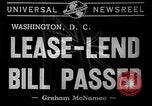
U.S. Senate passes H.R. 1776, Lend Lease Bill. Senate Majority Leader Alben W. Barkley telephones the news to the President.
View of Senate chamber in Washington DC, United States. Senate Majority Leader, Alben W. Barkley, hurries to private phone booth to telephone the news to President Roosevelt. A Senator emerges from the chamber waving newly signed documents passing H.R. 1776 to aid the United States war industry in World War II. Majority Leader, Barkley converses with other Senators. Senator Walter F. George, of Georgia speaking in praise of Lend-Lease, says "We are now ready to forge ahead and to cast the full strength of American industrial power into the struggle against aggression." Non-interventionist Senator Burton K. Wheeler, of Montana, who objects to the Roosevelt administration's lend lease bill, and to direct American involvement in World War 2 in Europe, speaks about continuing the fight to "keep American boys out of the holocaust of Europe's wars."

The Supreme Court Justices of the United States visit President Franklin Roosevelt at the White House in Washington DC.
The Supreme Court Judges of the United States visit the White House in Washington DC. Dignitaries arrive in cars. They arrive to visit President Franklin D. Roosevelt. They pose in front of the White House. Cameramen record the event.
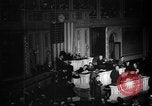
The declaration of the state of war between the United States and Japan is declared at the U.S. Capitol in Washington DC (WW2)
Officials of the United States Congress gather at the U.S. Capitol. A clerk reads the resolution following the Japanese attack on Pearl Harbor and it indicates that a state of war between the United States and Japan is declared in World War II. It further pledges all of the resources of the country to the war effort. Senators, Congressmen, and other dignitaries hear the resolution. Members cheer and applaud. The Speaker of the House, Samuel Rayburn, calls the House to order.
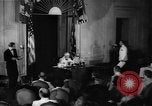
President Franklin D Roosevelt delivers fireside speech about the threat of war in Europe becoming a World War
President Franklin D Roosevelt delivers a fireside speech from inside the White House in Washington DC, United States. During the speech he expresses concern over the national emergency and the need to defend the freedom of American republics. He expresses concern over the European War turning into a World War (World War II) and the increasing threat to countries in the American hemisphere. He condemns Adolf Hitler's policies and stresses upon the need to check Nazi German expansion to the west. He says that the only way to stop Adolf Hitler is to prevent him from gaining control of the seas. Toward this end he stresses the need to speed up the ship building program.
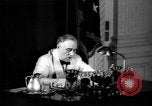
President Franklin D Roosevelt declares National Emergency during a speech in White House, Washington DC, United States (WW2)
President Franklin D Roosevelt during his speech at White House in Washington DC, United States declares America's decision to actively resist Adolf Hitler's expansion and to provide Britain full assistance to check Nazi German expansion. Excerpts from his "We choose human freedom" radio address as America nears direct involvement in World War 2. Roosevelt refuses to accept Adolf Hitler dominated world and promises to use armed forces to repel any attack on American republics. He upholds the freedom of all kind as their objective. President Roosevelt declares National Emergency and emphasizes on the need to strengthen their defense and asks all the Americans to cooperate towards the cause. Audiences clap in appreciation after the speech ends.