


 Francais
 Deutsch
 Italiano
Refine Your Search
+"Washington DC USA" +1955 stock footage and images
- Showing 1 to 6 of 21 results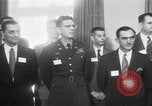
President Eisenhower distributes certificates of membership in the "Society of Remagen Bridge", which he instituted
Former commanders who were involved with the seizure of the Remagen Bridge, in Germany, March 7, 1955. On the tenth anniversary of that event, President Eisenhower presents them certificates of membership in the "Society of Remagen Bridge," which the President instituted, personally. The last to receive his certificate is Lieutenant General John W. Leonard, former Commanding General of the 9th Armored Division. Among others present are: Charles E. Wilson, Secretary of Defense; General Carl Spaatz, former commander of U.S. Strategic Air Force in Europe; and General Alfred M. Gruenther, Supreme Allied Commander, Europe. President Eisenhower, seated at a table, with General Carl Spaatz, at his left, poses for pictures surrounded by the recipients

Eisenhower is greeted by a crowd after his recovery and Paul Dudley White addresses a press conference in Washington DC.
U.S. President Dwight David Eisenhower in Washington DC after his recovery from his 1955 heart attack. The President followed by officials waves to people. The President enters a car. Paul Dudley White, American physician and cardiologist, addresses a press conference stating that the condition of the President is fit for another 5 to 10 years. The President and the First Lady of the United States Mamie Doud Eisenhower disembark from an aircraft at an airport. A crowd waves to the president. The car is driven on a road with the crowd gathered on either side to greet the President.
Presidential election debate in Washington DC. Richard Nixon, debating John F. Kennedy, speaks about the spread of Communism.
The second Kennedy-Nixon Presidential Debate in Washington DC, United States. Moderator Frank McGee introduces the candidates - Republican candidate U.S. Vice President Richard M. Nixon and Democratic candidate Senator John F Kennedy. The Moderator tells the rules to the candidates regarding questioning by the reporters. The reporters include Paul Niven, Edward P. Morgan, Alvin Spivak, and Harold R. Levy. Paul Niven asks Nixon to comment on whether Truman Administration was responsible for the loss of China to the Communists. Nixon answers and says that he disagrees with Senator Kennedy's statement that Cuba is lost and certainly China was lost because of Truman Administration. He talks about the decrease in the number of dictators in Southern and Central America in the past years. He speaks about Kennedy's book 'The Strategy for Peace' which prohibits the Americans from interfering in internal affairs of any other state. Kennedy presents his views and says that he never suggested that Cuba was lost. He criticized Nixon because in his press conference in Havana in 1955, he praised the competence and stability of the Batista dictatorship. He criticized the failure of the administration to use its great influence to persuade the Cuban government to hold free elections. He hopes that some day Cuba would rise if the U.S. changes its policies towards it.
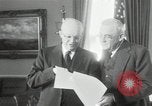
President Dwight D. Eisenhower conferring with Secretary of State John Foster Dulles, in the White House, Washington, DC.
President Eisenhower and Secretary of State, John Foster Dulles in the White House, Washington, DC. They discuss a working document.
Harry S Truman, Adlai Stevenson, William Averell attend the dinner given to Sam Rayburn of Texas in Washington DC.
Dinner for U.S. House Speaker Sam Rayburn in Washington DC. Dignitaries seated on table. Speaker Rayburn of Texas with former U.S. President Harry S Truman and Adlai Stevenson. Rayburn seated on a table. William Averell Harriman attends the dinner. Speaker Rayburn talks to dignitaries. Flags in the background. Dignitaries seated around a table applaud. Sam Rayburn waves at them. A flag of United States on the wall. Speaker Rayburn starts his dinner.
Dr. Jonas Salk, developer of the polio vaccine is presented with a citation by President Eisenhower in Washington DC.
Dr. Jonas Salk, developer of the polio vaccine in Washington DC. Dr. Jonas Salk and U.S. President Dwight D Eisenhower with other delegates on stage. Men take pictures. President Eisenhower speaks over the microphone and tells Dr. Salk, among other things, that he has no words adequate, to express the thanks of Americans and others throughout the world, who will benefit from Dr. Salk's contribution to the eradication of Poliomyelitis.