


 Francais
 Deutsch
 Italiano
Refine Your Search
+"Washington DC USA" +1969 stock footage and images
- Showing 7 to 12 of 103 results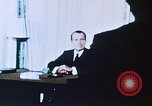
From the Oval Office in the White House, President Nixon talks to Apollo 11 astronauts after their landing on the moon.
Telephone conversation between U.S. President Richard Nixon and the astronauts of Apollo 11, while they are on the moon, July 20th, 1969. President Nixon seated at a desk in the Oval Office of the White House in Washington DC, United States. Technicians setting up video cameras. Nixon talks over a phone. Men setting up a monitor screen. Flickering moving images of the astronauts beside the Lunar Lander, on the surface of the moon. A camera focuses in on a document titled: DRAFT 'Talk to men on the moon' on the desk. The opening sentence reads: "This is an epic day in the history of man." A split image on the screen shows President Nixon talking and the astronauts on the moon. President Nixon talking to an astronaut on a phone at his desk in the Oval Office. Picture of "Earthrise" as seen from the moon, on wall in the Oval Office. NASA Astronaut, Frank Borman,who commanded the Apollo 8 mission,in 1968, comes before the cameras in the White House and makes speaks on behalf of NASA astronauts involved in the Apollo missions.
U.S. President Richard Nixon watches a college football game and celebrates with the victorious team in the U.S.
U.S. President Richard M. Nixon 1972 reelection promotional film. Nixon watches the "Game of the Century" football match in December 1969 between Texas and Arkansas, from among the spectators. He congratulates and then celebrates victory with the triumphant Texas players, and says a few words about their come-from-behind victory. Assistant Harry Dent speaks about positive changes brought about in himself during his tenure working as President Nixon's assistant during Nixon's first term as President.
U.S. President Richard Nixon watches a college football game and celebrates with the triumphant players; Harry Dent describes him.
Special Consultants, Counselors and assistants of U.S. President Richard Nixon speak about him as the President of United States. View of President Nixon on December 6, 1969 as he watches the college football "game of the century" between the University of Texas and the University of Arkansas, and then enjoys the victory among the triumphant Texas players, where he offers them congratulations on the win of Texas Longhorns over the Arkansas Razorbacks. White House assistant Harry S. Dent speaks about his own changes in perceptions after working for President Nixon.

President John Kennedy attends first baseball game played at DC Stadium, between Washington Senators and Detroit Tigers, in 1962.
U.S. President John Kennedy attends the first ballgame played at the new $20 million District of Columbia Stadium, or DC Stadium, in April 1962. 45,000 spectators in stands for the opening of the stadium and the Major League Baseball season. Glimpse of the new DC Stadium in Washington, DC, filled with baseball fans. President John F. Kennedy enters the ballpark, accompanied by David Francis Powers, and proceeds toward seats bearing the Presidential seal. Spectators in nearby seats stand to greet the President, and several shake his hand. Scene shifts to players and newsmen on the field all focused on President Kennedy. News photographers are busy photographing him. Camera shifts to President Kennedy making a long throw followed by the ballplayers scrambling for it on the ballfield. View of the President smiling after his throw, with Illinois Republican Senator Everett Dirksen standing to his left, and slightly behind him, and David Powers to his right. Senator George Smathers of Florida is laughing behind them. The President bends down momentarily revealing Senator Mike Mansfield of Montana, directly behind him and Special Assistant to the President Lawrence “Larry” O’Brien, at Mansfield's right. Associate Press Secretary Andrew Hatcher, wearing sun glasses is behind and to left of Dirksen. Closeup of Home plate umpire Charlie Berry shouting "Play Ball!" after brief rain delay. Lights are on during daytime as game is played. Washington Senators player hits single to left field. Senators go on to beat the visiting Detroit Tigers 4-1. (Note: The stadium was later renamed Robert F. Kennedy Stadium, or RFK Stadium, in 1969).

U.S. President Richard Nixon addresses people in the United States on withdrawal of remaining U.S. troops from Vietnam.
Television broadcast of U.S. President Richard Nixon's speech from the White House in Washington DC, United States on the withdrawal of remaining U.S. troops from Vietnam on 29th March 1973 during the Vietnam War. The White House. The Seal of the President of the United States. The President talks about that period of the Vietnam War when he joined the office and speaks about the program he initiated to end the war. He says American prisoners are on their way from Vietnam and people of South Vietnam are now free to choose their government. He says North Vietnam is not complying with few provisions of the Peace Agreement. He says that they should honor all those American soldiers who died during the Vietnam War. He refers to the difficult days of the war including the moratorium to end the war which was organized on October 15, 1969 when millions of Americans took day off from work and schools to participate in local demonstrations against the war. Nixon refers to the period of April 1971 when he ordered attacks on Communist bases in Cambodia. He talks about the period of May 1972 when he ordered air strikes in North Vietnam and the period of December 1972 when he ordered more air strikes.
President Nixon meets with former war correspondents before they travel to Europe for D-Day 25th anniversary
World War II war correspondents gather in Washington DC before returning to Europe for ceremonies commemorating the 25th anniversary of the Allied invasion of France. War correspondents walking on the streets of Washington DC. They pass a long painted mural wall depicting scenes from American life. They stop at guard station of a White House entrance gate and then enter gates at the White House grounds as a White House officer checks them in. President Richard Nixon meeting with the correspondents. The President and a correspondent hold a document and pose for a picture. The correspondents pose with President Nixon on the White House lawn. President Nixon poses with the document, as the correspondents stand near him. Nixon talks to the men and picks up and pets the White House dog named Pasha, who was Trish Nixon's Yorkshire terrier.