


 Francais
 Deutsch
 Italiano
Refine Your Search
+"Washington DC USA" +1973 stock footage and images
- Showing 1 to 6 of 125 results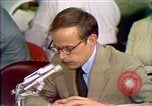
John Dean testifies about March 21, 1973 discussion with Nixon regarding Watergate as a "cancer" on the presidency
News reports about former White House Counsel John Dean's testimony in front of the Senate-Watergate Committee hearings in Washington DC. John Dean speaks about his phone conversation with President Nixon on the Watergate matter on March 20. He speaks about warnings given by him to President Nixon about the issue and the gravity of the Watergate issue. Also he reviews discussion between Haldeman and Dean about informing the president. He reviews the meeting with the President on March 21 where he laid out his understanding of the Watergate case, the idea of it as "a cancer on the presidency," and the serious implications of the case which Dean did not feel the President fully understood. Senate-Watergate Select Committee member Fred Thompson listens to his speech during the session.
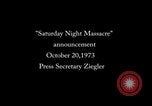
Ronald Ziegler reads a statement outlining events surrounding Nixon's 'Saturday Night Massacre'
White House Press Secretary Ronald Ziegler in a press room at the White House in Washington DC, United States reads a statement outlining dismissals of officials (known as Saturday Night Massacre) made by U.S. President Richard Nixon on October 20th , 1973. He says that President Nixon has taken action in which he has fired special prosecutor Archibald Cox in the Watergate Case. It was because of his refusal to comply with instructions given to him through U.S. Attorney General Elliot Richardson. He was not to seek to invoke the judicial process any further to compel production of recordings, notes, or memorandum regarding private Presidential conversations. He says that office of the Watergate Special Prosecution Forces has been abolished and its function will be transferred back to the Department of Justice. Ziegler says that President Nixon sought to avoid a constitutional confrontation by the action he announced on Friday October 19th, 1973 to give the courts the information from the tapes which the President had considered privileged. Further he says that President Nixon's action was accepted by responsible leaders in the Congress and in the country. But special prosecutor Cox's refusal to follow the President's instructions at a time of serious world crisis made it necessary for the President to discharge him. Ziegler says that before taking any action the President met with Richardson to instruct him to dismiss Cox, but Richardson refused to do so. After Richardson submitted his resignation, the President directed Deputy Attorney General William Ruckelshaus to dismiss Cox. When Ruckelshaus refused to carry out President's directive, he also was discharged. President Nixon then directed acting Attorney General Robert Bork to carry out the instructions and Bork fired Cox.
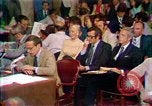
Counsel John Dean speaks about his meetings with President Richard Nixon before Senate-Watergate Committee, Washington DC.
Former White House Counsel John Dean testifies in front of the Senate-Watergate Committee hearings, Washington DC. Former Counsel Dean sitting in the court speaks about his meetings with President Richard Nixon regarding Watergate matters in February and March of 1973. He begins itemization of meetings with the President starting on February 27 and on that date the President told him to funnel all Watergate discussions directly through him rather than through Haldeman and Erlichman. Senate Watergate Committee members listen to his words during the hearings.
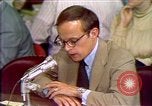
Counsel John Dean speaks before Senate-Watergate Committee about his meetings with President Richard Nixon, Washington DC.
Former White House Counsel John Dean testifies in front of the Senate-Watergate Committee hearings, Washington DC. Former Counsel Dean sitting in the court speaks about his meetings with President Richard Nixon on February 28, 1973 regarding Watergate matters, and the upcoming meetings with Senators Ervin and Baker. Senator Sam Ervin Junior and Senator Howard Baker of the Watergate Committee listen to his words during the hearings.
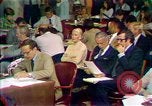
John Dean reports about meetings with President Nixon and other counsels before Senate-Watergate Committee, Washington DC.
News reports about former White House Counsel John Dean's testimony in front of the Senate-Watergate Committee hearings in Washington DC. John Dean speaks about his meeting with President Nixon about problems regarding the hearings beginning on March 17, 1973. Senate-Watergate Select Committee members listen to his speech during the session. He mentions subjects including the Gray Hearings and the upcoming Senate hearings. Also discussions of the letter drafted with Mr. Richard Moore. He discusses the extortion threats from Hunt that Hunt had communicated with Dean, and Dean, in turn, to Moore.

U.S. President Richard Nixon addresses people in the United States on withdrawal of remaining U.S. troops from Vietnam.
Television broadcast of U.S. President Richard Nixon's speech from the White House in Washington DC, United States on the withdrawal of remaining U.S. troops from Vietnam on 29th March 1973 during the Vietnam War. The White House. The Seal of the President of the United States. The President talks about that period of the Vietnam War when he joined the office and speaks about the program he initiated to end the war. He says American prisoners are on their way from Vietnam and people of South Vietnam are now free to choose their government. He says North Vietnam is not complying with few provisions of the Peace Agreement. He says that they should honor all those American soldiers who died during the Vietnam War. He refers to the difficult days of the war including the moratorium to end the war which was organized on October 15, 1969 when millions of Americans took day off from work and schools to participate in local demonstrations against the war. Nixon refers to the period of April 1971 when he ordered attacks on Communist bases in Cambodia. He talks about the period of May 1972 when he ordered air strikes in North Vietnam and the period of December 1972 when he ordered more air strikes.