


 Francais
 Deutsch
 Italiano
Refine Your Search
+"Western Europe" +1944 stock footage and images
- Showing 7 to 10 of 10 results more
more Hide
Hide
General Dwight D. Eisenhower introduces Joint British-American film, "The True Glory"; scenes of German forces massed for war
A film titled 'The True Glory' based on Allied invasion and conquest of Western Europe during World War II. Supreme Commander of Allied Expeditionary Force General Dwight D. Eisenhower introduces the film and speaks about Nazi defeat on Western Front in World War II. Animated map shows Germany and surroundings darkened on a world map. Nazi Fuhrer Adolf Hitler giving an impassioned and animated speech. Nazi Propaganda Minister Joseph Goebbels stands with other German officials. German troops parade. Massive columns of German soldiers marching in formation. German men beat drums. Barrel of a naval-type heavy gun firing. Huge explosion on the ground. Views of the German Atlantic Wall defenses including large fortifications and bunkers. German Field Marshal Wilhelm Keitel, Chief of Staff of the German High Command, inspecting the massive gun emplacements and coastal bunkers.
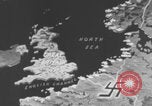
Germans building fortifications in the Maginot and Siegfried lines (WW2)
German fortifications in the Maginot and Siegfried Lines in World War 2. Illustrated map of Western Europe depicting Great Britain, Netherlands, Ireland, Scandinavia, Belgium and Germany during World War 2. The Swastika symbol is shown on the German-occupied side. German soldiers and slave labor workers digging ditches for fortifications along Atlantic Wall. Shadows of men digging ditches. Men building tank barriers and roadblocks. A man twists a wire in place. Men constructing a bunker. German troops marching on the beach under watch by soldiers with guns. German troops enter a bunker. German soldiers ducking to go through a fortification bunker door one by one. Nazi German soldiers push a field gun to a camouflaged underground bunker. German soldier puts down his telephone. A howitzer in a German fortification facing the coast. Gun turrets moving up. German soldiers with a Karl-Gerät siege mortar called “Thor” during the Battle of Sevastopol. Nazi German railgun “Schwerer Gustav” during the Battle of Sevastopol. German soldiers load a 7.1 ton shell to the “Schwerer Gustav” railgun. A German officer uses a telescope. Dragon’s teeth tank obstacles in the Siegfred Line fortification in Western Germany. Barbed wire fences in a battlefield.
United States Army 15th Corp and French soldiers in Strasbourg after Allied liberation (WW2)
A map of Western Europe showing the location of Strasbourg, France in World War II. The Raven Bridge or Pont du Corbeau over the Ill River in Strasbourg. A destroyed apartment with gaping hole in roof from damage. Two Allied soldiers read a Nazi German wall graffiti “Angloamerikaner und Bolschewisten bringen Chaos, Not, Hunger, Anarchie, Arbeitslosigkeit. Der Nationalsozialismus kampft bis zum Endsieg fur Freiheit und Brot unseres Volkes!” (“Anglo-Americans and Bolsheviks bring chaos, misery, hunger, anarchy, unemployment. National Socialism will fight to the final victory for the freedom and bread of our people!” in English). An M4 Sherman tank moves on the street, passing by the Oberlin Buchhandlung or Oberlin Bookstore (19 Rue des Francs-Bourgeois, 67000 Strasbourg, France) which is presently an LCL Bank building. Soldiers on top of the tank are seen. French troops and United States Army 15th Corp soldiers in Strasbourg after liberation from German forces. Slight damage on Strasbourg Cathedral (Pl. de la Cathédrale, 67000 Strasbourg, France). The Rose window and damaged clock of the Strasbourg Cathedral. Civilian German men, women, and children carry their belongings as they enter temporary prisoner of war stockade at Lycée Fustel-de-Coulanges ( 1 Pl. du Château, 67061 Strasbourg, France. )
Canadian troops occupy a German flying bomb launching site and describe launching apparatus in Flanders, France.
Canadian troops occupy a German flying bomb launching site in Flanders, France. Map of France. Long rocket launching ramp. View of pistons that propel buzz bomb during take off. Allied pilot takes photographs. Canadian troops inspect the ramp mounted with a 400 pound piston. Canadian troops carry V-2 bombs and load them on to piston. The operation of the V-2 and launching apparatus: Man operates remote control boxes for launching. Soldier handles jet nozzle assembly. Jet propulsion engine is used for fire piston set off explosives. Compressed air bottle supply power for gyro pilots. Servo motors moves radar and elevator. Unexploded head contains explosives for bomb. Diagram shows flying bomb and its parts. View of a bomb site. (World War II period).