


 Francais
 Deutsch
 Italiano
Refine Your Search
+"Wiesbaden Germany" +1945 stock footage and images
- Showing 1 to 6 of 27 results
Views of Wiesbaden and Mainz, Germany, at end of World War II in Europe. German soldiers being relocated.
Opening slate reads April 17, 1945, Wiesbaden, Germany. A brick building in Wiesbaden with large arrow pointing downstairs, labeled "LSR", meaning Luftschutzraum (Air-raid room). Signpost in front of a building with damaged roof reads, "Radfahr-weg" (bicycle path). Below it an American army sign reads "WP-Water Point." U.S. soldier directs military vehicles, carrying surrendered German soldiers, as they cross the Rhein (Rhine) river, from Wiesbaden to Mainz on a pontoon bridge. The dome of Christuskirche (Christ Church) across the river, dominates the skyline
German civilian Matthias Gierens is hung until death for murdering a downed American flier in Germany in World War 2.
German civilian Matthias Gierens, a 37 year old railroad worker, is hanged in Rheinbach Germany for the August 15, 1944 murder of a downed American flyer, who was later identified as U.S. Army Air Forces 2nd Lieutenant Lester E. Reuss, from Forsythe, Montana. Reuss was the navigator on U.S. Army B-17 bomber #42-31183 which was downed by German aircraft after it attacked the Airdrome at Wiesbaden, Germany. Gierens and three other German civilian men, Peter Kohn, Peter Back, and Matthias Krein, were convicted on June 2, 1945 in Ahrweiler, Germany, for the murder of the American airman after his parachute landing near Priest, Germany. The trial was the first Allied trial in Germany of civilians charged with a war crime. Military police are seen escorting Gierens toward the gallows in a prison yard in Rheinbach. A German Catholic priest performs the rites. U.S military officer reads charges as Gierens is readied for execution (the officer is possibly Lt. Col J.V. Roddy, of San Francisco, who was in charge of the hanging). Trap door opens and Gierens is hung. The U.S. Army executioners were Master Sgt. John C. Woods, a former Texas State executioner, and Staff Sgt. Thomas Robinson, of Bronx, New York. Witnesses present included seven U.S. Lieutenant Colonels and one British officer, a number of Military Police, news correspondents, and photographers.
Field Marshall Sir Bernard L Montgomery presents British awards to U.S. Army personnels in Wiesbaden, Germany.
Soldiers of 56th Armored Infantry Battalion in a ground in Wiesbaden, Germany. Some soldiers sitting, some marching, army band playing instruments. Field Marshal Montgomery and General Omar N Bradly troop the line of soldiers and presents awards. Motion picture photographers taking pictures. (World War II period).
German prisoners march in Wiesbaden, Germany
Allies take over Wiesbaden, Germany during World War II. Aerial view of German prisoners marching along a road in the country side. Lush green fields. A rail road bridge over a dried up river. German prisoners gathered in an area.
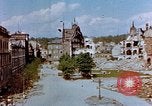
Destruction from Allied bombing still visible in Wiesbaden, Germany, ten years after World War II.
Bomb damage in Wiesbaden, Germany still evident 10 years after World War 2. View of the Destroyed Lyzeum (Lyceum) next to the Marktkirche (Market Church) at the Schlossplatz. (Its destruction was particularly tragic, because its basement had served as a bomb shelter during the war. It was never rebuilt.)
Group of displaced persons hold portrait of Stalin and Red flag on the VE Day celebration in Wiesbaden,Germany.
Victory in Europe Day celebrations in Wiesbaden, Germany after the end of World War II. Damaged buildings . Displaced person's camp buildings. Men decorate platform for a speech on the VE Day (Victory in Europe Day) celebration. Picture of Joseph Vissarionovich Stalin,Premiere of the Soviet Union and Russian banner on the platform. Portrait of Georgy Konstantinovich Zhukov,Soviet Military Commander and Russian banner. Group of DPs (displaced persons) as they hold a portrait of Stalin and Red flag. Parade begins. Men and girls stand in formation with Red banners and pictures of Stalin. Buildings in the background.