


 Francais
 Deutsch
 Italiano
Refine Your Search
+"Yugoslavia" +1944 stock footage and images
- Showing 19 to 24 of 27 results more
more Hide
Hide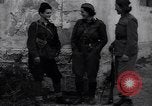
Yugoslav Partisan soldiers march on city streets during World War II
Opening scene shows three uniformed and armed Yugoslav women Partisan fighters conversing as they stand at the corner of a battle-damaged building in Drvar, Bosnia, Yugoslavia, during World War 2. Next are views from above of Yugoslavian Partisan men and women soldiers marching in loose formation, in the town. View of them from the front as they march toward the camera, under a steel pedestrian overpass bridge. Closeup from above as they proceed through a rail yard, and then a longer view as they continue along a town street. Closeup as they pass the camera carrying their weapons. Camera focuses on their marching feet well equipped in boots. Views from the rear of the marching Partisan fighters as they pass by buildings toward mountains in the background.
Yugoslav communist leader Josip Broz Tito, also known as Marshal Tito, talks with fellow officer at his mountain headquarters (WW2)
A female host wearing an U.S. army uniform, reads a letter from a sergeant asking to hear news about Marshal Tito, leader of the Yugoslav Partisan forces. Yugoslav communist revolutionary and President Josip Broz Tito, also known as Marshal Tito, with some of his fellow officers, meeting with Allied officers during World War II. Josip Broz Tito with his loyal partisans at his mountain headquarters in Yugoslavia. One of the few early footage segments of Josip Broz Tito. A cameraman walks away as Josip Tito talks with others.
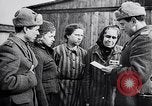
Russian soldiers rescue women and children prisoners and recover dead bodies at the Auschwitz Concentration camp in Poland.
Auschwitz Concentration camp of the Nazi Germans in Auschwitz, Poland during World War II. Russian soldiers note details of survivor women inmates from Yugoslavia. Inmates walk along with soldiers along barbed wire fencing. Male inmates carry a stretcher with dead body of a young woman. Pile of dead bodies taken out from a chamber. Horse carts draw lumps of dead bodies out of the camp. Young children released from experiment laboratories of the concentration camp, walk along paths guarded by barbed wire fencing. Clip is part of Nuremberg Trials prosecution exhibits 228, 229.
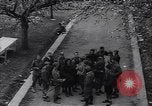
Yugoslav Partisan fighters in uniform are shown as they gather together during World War II
View from above of men and women Yugoslav Partisan fighters assembling for the camera.during World War 2. Closeup of them conversing with one woman, not in uniform, who is a 21-year old Montenegrin who left school to join the Partisans. Camera pans across some of the group. Next, a closeup shows a young boy in uniform with a rifle, at left of the group, as uniformed Partisans converse with the Montenegrin woman volunteer. Next scene shows her holding a short barrel submachine gun, as Partisan soldiers show her how to insert a clip of ammunition. Glimpse of the group from above, again.
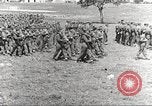
A battalion of uniformed Yugoslav Partisans march as a group during World War II
A battalion of uniformed Yugoslav partisan soldiers marches across uneven ground during a training exercise. They reform into a large square formation and parade across a smoother field. A number of women are included in their ranks. Next, all are seen marching, with some carrying Zastava M84 Medium Machine Guns, slung over their shoulders. They halt and stand at attention, and then resume marching. They break into two formations and march as the camera focuses on the space between them. The two formations pass on either side of the camera.
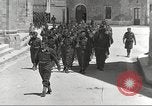
Uniformed Yugoslav Partisans march through a town and line up for mess in a field during World War II
A Battalion of uniformed, armed Yugoslav Partisans march through a town, past stone buildings, during World War 2. They proceed to an open field where form up in several lines, with their mess kits for a meal. Mess workers dole out cupfuls of food, from large caldrons, to each soldier. A number of women soldiers are seen in the Battalion