


 Francais
 Deutsch
 Italiano
Refine Your Search
"Bethlehem Pennsylvania USA" 1918 stock footage and images
- Showing 607 to 612 of 1835 results more
more Hide
Hide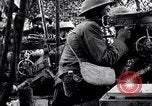
U.S. Army troops operating machine guns,in France, during World War I
U.S. soldiers in fortified dugout, operate a Hotchkiss Model 1914 heavy machine gun, during World War I. One gunner feeds strips of 8mm lebel ammunition into the gun, while the other fires it. (Each strip contains 24 rounds of 8mm Lebel ammunition.) Change of scene shows a lone machine gunner operating a Hotchkiss Model 1909 light machine gun as an antiaircraft weapon. He fires a 24-round strip and then obtains another one to rearm the gun himself. (World War 1. WWI. WW1)
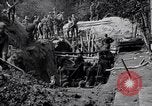
U.S. Army (AEF) troops establishing base camp North of Villers-Tournelle, during World War I
U.S. troops excavating for a deep dugout as part of their defenses North of Villers-Tournelle, during World War 1. Another scene shows troops in their bivouac area performing routine maintenance around their dugout shelters. Lines of wash are seen drying. Some prepare meals over camp fires. One soldier emerges from his dugout to scan the skies for enemy aircraft. An officer sits at a table and examines charts. Soldiers relax at entrance to a large dugout field kitchen, where a slab of meat sits on a butcher table. (WWI. WW1)
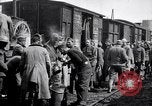
U.S. 1st Division troops (AEF) in Picardy, France, during World War I
U.S. 2nd Field Signal Battalion troops (AEF) getting their food in a chow line at an Army field kitchen alongside rail cars at Maron, France, during World War 1. They step aside as a steam locomotive arrives on the track next to them. Some soldiers sit on railroad equipment as they eat their meal. Several others cook over their own fire. Change of scene shows German prisoners of war being marched to the rear, and through a town near Catigny. A few are wounded, but ambulatory. One is carried on a litter, by his comrades.
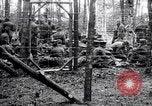
U.S. 1st Division troops process German prisoners following the Battle of Cantigny in World War I
German prisoners of war (POWs) held in an outdoor wire enclosure, by U.S. First Division troops behind the lines near Catigny, France, during World War 1. Closeups of two German prisoners, each with a U.S. Army interrogator. The second one is being spoken to by a U.S. Army lieutenant. View of several prisoners, including a German medical corpsman, attending a wounded on a litter. German prisoners being searched and processed by two French soldiers under supervision of a U.S. Army officer. U.S. troops in the background. U.S. General John J. Pershing, Commander of the American Expeditionary Forces (AEF) steps from a headquarters building, behind the lines near Catigny, France, accompanied by Major General Robert L. Bullard, Commander of the U.S. First Division, and staff. They proceed along pavement in front of several buildings. Next scene shows Pershing and Major General Bullard entering a wooded area, where U.S. troops line a path and several German prisoners are faced away from the path. The American generals look over some German officer prisoners drawn up in a small group on one side of the path. They continue past a wire enclosure containing German prisoners, on the other side of the path.
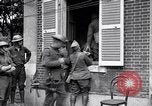
Wounded soldiers being treated behind the lines near Cantigny, France, in World War I
Wounded German soldier on a stretcher, is lifted from hospital set up behind the lines near Catigny, France, during World War 1. He is carefully placed in a military ambulance by U.S. Army soldiers. Closer to the front, medical corpsmen attend to a wounded soldier lying on a litter on the ground. They treat his wounds and apply a splint to his left leg. Troops in battle gear surround the corpsmen. The wounded man is placed in an ambulance.
U.S. Army First Division infantry deploying during World War I
Outdoor munitions depot in France, during World War 1. Stacks of heavy artillery shells are seen lined up in a field. American 1st Division troops prepare defenses near a road in the French countryside. They dig between a long trench and the road. Scene shifts to First Division troops drawing rations at a Quartermaster Supply Depot in Maron, France. The soldiers fill their arms with items set out for them. Change of scene shows 28th Infantry Regiment troops marching along a road between a river and a railroad, where they begin to board rail cars. Several soldiers receive hot beverages from two women volunteers. The troops wave from the cars as the train begins to pull out. (WWI. WW1)