


 Francais
 Deutsch
 Italiano
Refine Your Search
"Bethlehem Pennsylvania USA" 1918 stock footage and images
- Showing 1189 to 1194 of 1835 results more
more Hide
Hide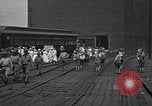
Red Cross Canteen Service serves U.S. soldiers in Midwest, before they go overseas in World War I
The tail end of a contingent of U.S. soldiers is seen marching away, along the tracks, after visiting a Red Cross canteen rail car during world war 1. Red Cross women volunteers in white dresses stand in front of a Wabash Railroad car marked with red crosses and a sign reading "Canteen Services." A U.S. Army brass band is playing in the center of the train yard. The Red cross workers step away from their rail car to wave goodbye to the departed troops. Scene shifts to a Red Cross woman handing out, what appear to be photographs, to U.S. soldiers standing in a line with their personal mess kit cups. A waterway is seen behind the line of soldiers. Afterwards, the soldiers assemble and drink their coffee. (Location is likely in the midwest USA.) (World War I; World War 1; WWI; WW1)
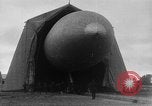
British and Italian blimps and airships of World War I
A blimp is towed out of a canvas tent hangar. One ground crewman ducks into trench between tracks as the blimp advances out of tent hangar. Scene shifts to distant wide view of a large semi-rigid airship fully emerged from its permanent hangar. It has a machine gunner nest on top. This appears to be an Italian made M.4, M.5, M.6, M.7, or M.8 semi-rigid, military use, single-gondola airship made by the Stabilimento Costruzioni Aeronautiche in Rome, and designed by Gaetano Crocco and Ottavio Ricaldoni. Next scene shows a medium wide shot of an airship, likely a SS Zero (SSZ) airship having just emerged from a hangar, and three other airships in the background. (This is possibly at Cranwell in the UK, and may be a ship of the British Royal Air Service or a US Navy airship, as the U.S. Navy was conducting airship training there with SSZ airships.) The SSZ were submarine scout aircraft used to spot German U-boats in World War 1. Next scene is an aerial view of gunner manning a machine gun atop an Italian M class airship, mounted on a pedestal surrounded by a circle of protective railing, on the top of the envelope. Next shot shows a view on the ground of a gondola for an airship Its fuel tanks, and various operating equipment are seen. Engine radiators and Blades of its twin propellers are partially seen at the top of the gondola. An officer walking within the framework of the gondola. Officer appears to be wearing an Italian Navy uniform cap.
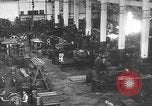
Manufacture and assembly of army trucks at war plant in Italy
Italian workers manufacture and assemble army trucks at a war plant in Italy. Heavy mechanical parts are moved with hoists in the assembly area. Women at sewing machines make canvas covers for army trucks Finished trucks line up and drive away from the plant. (World War I; World War 1; WWI; WW1)

Glass manufactured for military purpose in Italy during World War I
A man hammers a limestone piece to crush it to manufacture glass for military purpose in World War 1. Men work on circular glass sheets. Glass undergoes processing with the help of machines. Lenses inspected. Glass sheets grinded and polished. Glass used to manufacture products like mirror, searchlight and window glass. (World War I; World War 1; WWI; WW1)
Steel plates fabricated for use in ships, Italy
Steel plates fabricated for use in ships and submarines. Submarines are seen at dockside. A large ship is launched, not yet outfitted. Observers watch from small boat. A destroyer cruises by at high speed, smoke billowing from its stack. A heavy cruiser fires guns. (World War I; World War 1; WWI; WW1)
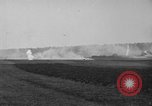
United States 328th Tank Battalion moves across a field in France
Infantry maneuvers in France during World War I. Smoke rises from a field as shells burst. United States 328th Tank Battalion moves across the field as shells burst in the background. Troops coordinate attack maneuvers with the tanks and fall to escape shell attacks and get up again to move ahead. Soldiers stand in a huge group, to observe maneuvers. (World War I; World War 1; WWI; WW1)