


 Francais
 Deutsch
 Italiano
Refine Your Search
"Bethlehem Pennsylvania USA" 1918 stock footage and images
- Showing 1741 to 1746 of 1835 results more
more Hide
Hide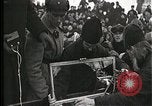
Bolshevik man displays bones of a Saint taken from a wooden box. Spectators show mixed emotions.
Perhaps as part of campaign to denigrate holy relics, and to question incorruptibility, a secular Bolshevik Russian man is seen on an outdoor stage holding an electric device with wires connected to it. He displays bones of a Saint to crowd of persons. Men on stage hold up various bones of the saint. Snow on ground. Crowd of soldiers and civilians shows mixed emotions during this anti-religious campaign of the Russian Civil War, following the Russian Revolution.
Numerous scenes showing evolution of mechanized warfare emphasizing World War I. but including footage as late as 1934
Montage of scenes illustrating development of mechanized warfare beginning with American Expeditionary Forces (AEF) engaged in World War I. U.S. Army infantry soldiers moving out of trenches going "over the top" into "no man's land" and advancing on battlefield. U.S. troops firing Browning M1917 machine gun,1903 Springfield rifles, and Stokes mortar from trench positions. Soldiers firing mortar are wearing gas masks. AEF trucks and other vehicles ostensibly an improvement over horses, but seen having difficulty in mud. A truck pulling a large artillery gun. A German 80cm K (E) rail gun (developed in 1934) shown at the Rugenwalde Test Range in Germany. It moves along curving rails and is elevated to its maximum elevation (65 degrees). Two World War 1 rail guns firing. An American World War I Naval 14-inch rail gun firing. Allied heavy howitzers firing in World War 1 (one with gun crew in gas masks). American gunners with a French 75 field piece and caisson. French soldier advancing in no-mans-land. The Wright brothers brought warfare into the air with their Wright Flyer airplane, seen being maneuvered on the ground by U.S. Army personnel at Fort Myer, Virginia in July 1909. A De Havilland DH-4 airplane taking off in World War I. A German Fokker D.VIII aircraft in flight. Three U.S. Army Air Service Curtiss P-1B Hawk pursuit aircraft in flight, circa 1926. Aerial dogfight scene including view from behind a pilot in open cockpit biplane (from feature film, circa 1927). Brief view of Renault FT tank maneuvering in World War I. Narrative and clips shift to historical perspective of warfare, showing use of horse and chariot, starting in ancient Assyria and use of elephants in later years by Hannibal. Pictures of mounted soldiers, in the middle ages, waging war in armor, and being transported in a wagon. Shift to World War I showing British Mark IV tanks maneuvering in a field.
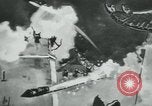
Troops used rockets to fight against enemies in foreign countries and during the U.S- British War of 1812 and the Mexican-American War.
Historic use of rockets in wars in foreign countries Sketches and pictures depict arrows and rockets used by Chinese people to fight against the enemies. British troops using rockets to fight against the Americans during the Anglo-American War of 1812. Rockets used during the Mexican-American War in the year 1846. View of Dr. Robert H Goddard, who launched the first liquid fueled rocket in U.S. experiments. He is seen in his working laboratory standing next to a rocket he was developing for possible use in World War 1 .
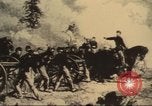
Union soldiers print the first issue of Stars and Stripes newspaper during the Civil War in the United States.
The history of the Stars and Stripes newspaper. Union soldiers print the first issue of Star and Stripes newspaper in a captured press in the U.S. on 9th November,1861 during the Civil War. World War I scenes show soldiers disembarking from a ship and advancing on a battlefield. Commanding Chief of the American Expeditionary Force John J. Pershing writes for the newspaper. Soldiers greet the Chief and wish him luck. After the end of World War I newspaper publication is ceased. During World War II the newspaper publication starts in London, England in 1942. Publication of the Pacific Stars and Stripes newspaper after the end of hostilities in Europe. Headlines in various editions of the Stars and Stripes.
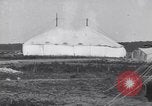
Wounded soldiers of U.S. 364th Infantry are unloaded on litters from a hospital train in Souilly, France during World War I.
An American Hospital Train in Souilly, France during World War I. The hospital train arrives at an evacuation hospital in Souilly. Tents set up at the evacuation hospital. Wounded soldiers of U.S. 364th Infantry on litters being unloaded from the train. The soldiers on the litters are carried into a tent.
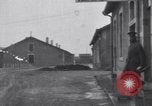
An American Expeditionary Force hospital train waiting for wounded soldiers in Toul, France during World War I.
An American Hospital Train in Toul, France during World War I. Two U.S. officers leave an evacuation hospital and get into a car. The car pulls away. Wounded soldiers on litters are placed in ambulances. An AEF (American Expeditionary Force) hospital train in Toul.