


 Francais
 Deutsch
 Italiano
Refine Your Search
"Bethlehem Pennsylvania USA" 1918 stock footage and images
- Showing 199 to 204 of 1835 results more
more Hide
Hide
An anti-aircraft gun used in World War I and a gun crew fires a 105 mm anti-aircraft gun in Maryland.
United States anti-aircraft guns used in Maryland during World War I. The guns are manned by 61st C.A.C. (Coastal Artillery Corps). An anti-aircraft gun which was used in the defense of Paris in 1918. Various views of the gun. A 105mm anti-aircraft gun with muzzle velocity 3000ft. and vertical range of 7 miles. The gun crew fires the gun.
Mining and transportation of iron ore to a steel plant in Italy; Coke manufacture in WWI
'Italian munitions 1914-1918 ' Men mine iron ore at a hilly region in Italy during World War 1. Iron ore transported in trolleys and then shipped. Trolleys carrying iron ore unloaded at a port in Italy and placed on trailers with a crane. Coking ovens are emptied and blast furnace charged with the ore and coke. Furnace is tapped and molten steel poured giving a fiery flare.
Newly drafted American Army soldiers undergo medical examination in United States.
Draft and mobilization activities for U.S. Army soldiers during World War I in 1917-1918. American World War 1 military recruits take a shower and undergo medical examination. Recruits lined up as doctors with stethoscopes perform physical examination. Those who pass the examination are injected by doctors "with 6 million germs" and their finger prints taken. Men and women at Adjutant General's office maintain the records of the recruits. Recruits in new uniforms lined up as officers go through their records to make registration card, qualification card and various other documents. (World War I; World War 1; WWI; WW1)
American military recruits for World War I undergo psychological tests in United States.
Draft and mobilization activities for U.S. Army soldiers of World War 1 in 1917-1918. American military recruits undergo psychological and mental acuity tests to determine their intelligence and ability to serve as soldiers. They undergo attention and observation tests. Figures drawn on a board as an instructor guides them, and Army recruits write on papers. Recruits must rapidly pick up their pencils on cue in a test of alertness. Rejected recruits discharged with payment and a discharge letter. The discharged soldiers stand in line at pay window. Close-up view of U.S. Army honorable discharge certificate. Slates indicate that most soldiers participated in the life insurance plan that was offered. Scene of soldiers seated at tables as they write letters home.
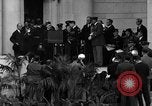
In an Armistice Day speech in 1935, President Roosevelt reflects upon World War I and the perils still threatening world peace
President Roosevelt delivers a speech reflecting the failure of World War 1 to be the "war to end war." He addresses a crowd at the Arlington National Cemetery Amphitheater in Arlington, Virginia, gathered for Armistice Day, commemorating the 1918 armistice ending World War I. Roosevelt reflects upon the role of United States in the world (as seeds of World War 2 are being sown). He upholds the ideals of peace and importance of being a good neighbor. He declares that the aim must be to avoid war and to remove the causes of war.
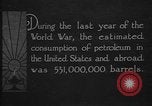
Water flows over the Niagara Falls and a globe with nine circular parallel lines along the equator rotates in the U.S.
The total consumption of petroleum of the U.S. and the world outside of the United States for the year 1918 is compared. Animation is used for this. Per capita consumption is also compared. Water flows over the Niagara Falls. A globe with nine circular parallel lines along the equator rotates. The 9 circular lines denote that if the per capita consumption of petroleum had increased as rapidly abroad as in the U.S. the world's petroleum requirement in 1922 would have been 10 times the actual requirement and if this volume had been loaded into tank cars of the capacity of 10,000 gallons each it would have made a solid train extending around the world at the equator 9 times.