


 Francais
 Deutsch
 Italiano
Refine Your Search
"Bethlehem Pennsylvania USA" 1918 stock footage and images
- Showing 235 to 240 of 1835 results more
more Hide
Hide
United States Army and Red Cross volunteers prepare Camp Kilmer in New Jersey for arrival of Hungarian refugees from the Hungarian Revolution
View of the Statue of Liberty. View of New York City and the Statue of Liberty. Sign saying “Camp Kilmer named in honor of Sgt. Joyce Kilmer Soldier Poet. Born December 6, 1886, New Brunswick, N.J. Killed in action World War I in France June 30, 1918”. A United States military jeep approaches the entrance of Camp Kilmer. Soldier at Camp Kilmer entrance allows Jeep to enter. Soldiers march and then sprint inside Camp Kilmer. Using crane attached to truck, soldiers unload crates containing furniture for incoming Hungarian refugees who will stay in Camp Kilmer. Soldiers carry mattresses into the barracks. Two soldiers carry a crate to a barrack. Soldiers carry a cabinet to the barracks. Inside the Camp Kilmer paint shop, soldiers prepare signs in Hungarian such as “Varás és asztalos munka (sic.)” (“Sewing and Carpentry”) and “fö üzlet” (“main shop”). Camp Kilmer dentists disinfect clinic. Camp Kilmer pharmacists prepare medicine for incoming refugees. An army pharmacist pour medicine into a bottle using a funnel. An army pharmacist grounds with using mortar and pestle. Pharmacists stack medicine such as aspirin in shelves. Army nurse making hospital bed with freshly laundered white bed sheets. Red cross volunteers filling comfort bags containing toiletries for refugees. Soldiers unload piles of second-hand clothes donated by Americans through the Red Cross. Red Cross volunteers organize second-hand clothes by type and size. African American woman Camp Kilmer staff enter the Recreation Center, with sign in English and Hungarian. African American staff at Camp Kilmer hang paintings and arrange furniture in the Recreation Center.
United States Army Infantry troops attack in Beffe, Belgium in winter snow during the Battle of the Bulge (WW2)
United States Army Infantry engage in attack against German snipers in Beffe, Belgium during the Battle of the Bulge (World War II). A platoon of the 200th Infantry, 4th Cavalry Reconnaissance Squadron advances along snow covered field in attempt to wipe out German snipers during winter. Soldiers with M-1 rifles assume prone position in the snow. A soldier shoots with a M1918 Browning Automatic Rifle (BAR). Soldiers shoot with their M-1 rifles before crouching. A soldier aims and shoots with his rifle. View of soldiers shooting with their rifles (one of them is holding a .45 caliber Thompson submachine gun) from a distance. Some crouch shortly to reload their rifles. Some soldiers carefully sneak up in the snow while holding shells and rocket launcher. Soldiers advance in the snow against enemy fire. A soldier firing with rifle from behind barbed wire fences. A wounded soldier crawls back to safety. The mustached soldier smiles upon his return. Two soldiers fire bazooka (2.46 rocket launcher) near barbed fence. Two soldiers crawl in the snow, attempting to rescue another wounded soldier. The soldiers are forced to withdraw because of German sniper action.
Tsar Boris III and King Alexander I pay their respects in front of a war memorial and meet in Belgrade
State visit of Bulgarian Tsar Boris III in Belgrade, Yugoslavia. King Alexander I (Aleksandar I) of Yugoslavia meets Tsar Boris III of Bulgaria. Tsar Boris III and King Alexander I and other officials walk in the snow together. The two monarchs salute in front of a monument and lay a wreath at the base of the memorial. (Based on text descriptions, this is possibly the original, smaller memorial to the Unknown Serbian Soldier, which was later replaced by the Monument to the Unknown Hero that was built atop the demolished Žrnov and completed in 1934. The original memorial, near Žrnov at the Avala mountain, was completed in June 1922. It reportedly had a plaque that read, "To the fallen heroes in the wars for liberation and unification 1912-1918, this monument is erected by the thankful people of the Vračar District. Consecrated on 1 June 1922." Another inscription read: "Unknown Serbian soldier confirmed by the commission on 29 November 1921". The text descriptions of the form and size of the 1922 memorial appear to match the memorial seen in this footage.) Honor guard of Yugoslavian soldiers depart the snow covered memorial area carrying a flag bearing the greater coast of arms of Yugoslavia. In next scene, Tsaritsa Giovanna of Italy, wife of Tsar Boris III, and Queen Maria of Yugoslavia leaving the royal residence in Belgrade. Final scenes show a car arriving in front of the royal residence and officers emerge. Another car arrives and women emerge to enter the residence. A brief frame or two of the film around timecode 02:29 shows four young children posing for the camera. The one on the far left, in the wide brim hat, is possibly Peter II Karađorđević, later King Peter II of Yugoslavia. Final scenes show the officials royalty emerging from the residence again and posing on the front steps.
President Woodrow Wilson inspects a British Handley Page bomber at Bolling Field during World War I.
Group of military officers from U.S., Britain, and France, pose for photographs during First World War. President Woodrow Wilson inspects a British Handley Page 0/400 twin engine bomber at Bolling Field. A Thomas Morse S4C airplane parked in front is dwarfed by the larger Handley Page machine. The President with General March and Mrs. Wilson inspect the British bomber. The British military pilot of the plane poses and smiles. The plane takes off and is seen in flight over the Washington Monument.
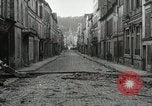
Destroyed buildings, smoke due to mortar shelling and 9th Machine Gun Battalion march in Chateau Thierry, France.
U.S. Army 9th Machine Gun Battalion in Chateau Thierry, France, during World War I. Ruins of destroyed buildings on the street. Smoke due to mortar shelling. 9th Machine Gun Battalion march with rifles on their shoulders. World War 1 (WWI).
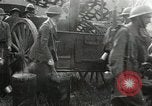
U.S. 6th Engineer Battalion receive hot chocolate from the Y.M.C.A before entering the St. Eugene in Chateau Thierry, France.
United States 6th Engineer Battalion in Chateau Thierry, France during World War I.. The 6th Engineer Battalion receives hot chocolate from the Young Men Christian Association (Y.M.C.A) before entering St. Eugene. A cart in the background. A woman pours chocolate in the mugs of the troops. The troops with rifles on their shoulders. A man puts the hot chocolate in a container which is kept on the cart. The troops move in a foxhole carrying rifles and mugs in their hands.