


 Francais
 Deutsch
 Italiano
Refine Your Search
"Bethlehem Pennsylvania USA" 1918 stock footage and images
- Showing 301 to 306 of 1835 results more
more Hide
Hide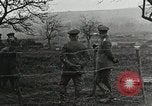
German prisoners of war including two officers at a camp in France during World War I.
German prisoners of war in France during World War I. The first group of German prisoners captured by the Americans at a prison camp. The twenty one soldiers and two officers in a barbed wire enclosure. The haggard looking young soldiers. Two German officers with their backs towards the camera. U.S. officers talk to the German prisoners. Cars and soldiers on the road in the background.
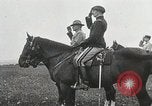
General John Pershing, President Raymond Poincare, and former PM Paul Painleve review French and U.S. troops in France in WWI
United States officials and officers in France during World War I. American Expeditionary Force (AEF) Commander General John Pershing and President Raymond Poincare review cavalry and infantry troops of the American and French forces. Also standing with them is former Prime Minister Paul Painleve and other American and French military leaders. U.S. and French cavalry and infantry march past in review. Soldiers carry the U.S. and French flags. Soldiers salute as they pass the leaders.
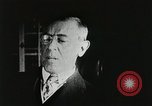
U.S. President Woodrow Wilson seated during an interview
U.S. President Woodrow Wilson in the United States during World War I. President Wilson seated in his office, talking. An map is shown with smoke rising from parts of the land masses. An overlay of a U.S. flag then is superimposed over the map. A U.S. military flag symbol with an eagle atop.
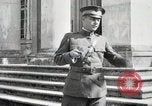
General Roy Hoffman and aides at Division headquarters, Maffrecourt, France.
U.S. Army Major General Roy Hoffman, Commander, U.S. 93rd Infantry Division, with staff officers at Division headquarters in Maffrecourt, France during World War 1. They discuss a document, and pose. for a photograph.
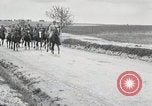
African American soldiers of 369th Infantry, 93rd Division, U.S. Army marching on road in Maffrecourt, France, during World War I
African American soldiers of the 369th Infantry Regiment, 93rd Division ("Harlem Hellfighters"), United States Army, march in formation along a road in Maffrecourt, France, in World War 1. They are led by mounted officers, and a brass band (likely under the direction of band leader Lt. James Reese Europe). Unit leaders salute as they pass the camera. Mules pull several artillery pieces and caissons. Several medics march with stretchers. The U.S. flag is the only one carried by the color guard. No unit colors are seen. The 369th Infantry soldiers wear French helmets because they were assigned to the French Army during the war, as the U.S. Army (American Expeditionary Forces) did not permit African Soldiers in combat.
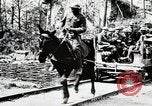
369th Infantry, 93rd Division United States Army African American soldiers occupy trenches and fire at Maffrecourt, France.
369th Infantry Regiment, 93rd Division United States Army African American soldiers occupy trenches near Maffrecourt, France during World War 1. They were also nicknamed the Harlem Hellfighters. Troops fire from trenches. Though American, the 369th Infantry soldiers are wearing French helmets because the U.S. Army (American Expeditionary Forces) did not permit African Soldiers in combat, so the unit was assigned to the French Army during the war. In one scene the African American soldiers are seen putting on gas masks during a gas attack drill. Soldier shows a document to Colonel. He ties a message to the carrier pigeon and releases it. African American soldiers rush from a trench toward the front with their rifles.