


 Francais
 Deutsch
 Italiano
Refine Your Search
-Cebu,-Philippines stock footage and images
- Showing 6355 to 6360 of 58885 results more
more Hide
Hide
Wilbur H. Durborough, America's famous Press photographer, goes to Germany during World war I
Closeup scenes show Wilbur H. Durborough-America's famous press photographer, seated behind the steering wheel of a 1911 Alto touring car parked on a street in Chicago, Illinois, getting ready to depart for Germany, during World War 1. Sitting behind him is his assistant cameraman, Irving G. Ries. Both have goggles pushed back on their foreheads. and both smoke cigars. Some spare tires are seen behind Mr. Ries. As camera moves back, they are seen surrounded by numerous friends and well-wishers as they prepare to depart from Chicago. Next, Durborough is seen standing on the bridge of the Holland-America steamship, S.S. Nieuw Amsterdam, with ship's Captain Jan Baron, who is on lookout for mines and submarines. Captain Baron passes his binoculars to Mr. Durborough. Captain Baron and Mr. Durborough stand on the deck looking at some documents. Lifeboats on davits behind them are ready for emergency. Durborough drives his car from the ship terminal onto a street in Rotterdam, with Captain Baron standing on a running board. The car is loaded down with luggage and equipment. He drives away as the Captain and others wave goodbye. Displaying an American flag on the hood, Durborough arrives at the German border. Dutch officials examine the car's contents, including a look into the engine compartment. Next, Durborough is stopped by German border guards, who examine his passport and greet him in a friendly manner. Durborough is seen in the offices of U.S.Ambassador James W.Gerard, as he describes his plans for visiting. He is honored by a visit from Prince of Reuss of German General Staff, Prince Max of Baden and Count Von Bernstorff- son of German Ambassador to the United States, who are seen chatting with him, before entering their car to depart.
German youth in Wandervogel organization march in a weekly drill during World War I
Members of the German youth group, Wandervogel, march to music provided by a brass band, during World War 1. They parade across a grass field accompanied by their adult advisors, who march beside them. A contingent of Wandervogel follow, walking their bicycles. The band falls in and marches behind the bicycle cadre.
Frau von Ihne, wife of the Emperor's architect, arranges an outing for blind and wounded German soldiers in World War I
Frau von Ihne, wife of Ernst von Ihne, architect to the German Emperor, escorts a blinded German soldier (likely from mustard gas attack) onto a bus for an outing during World War 1. More disabled, blinded soldiers are helped to board, by other soldiers. As they board the bus, and it drives away, German troops, with shouldered weapons, continuously march past on the street. Scene shifts to Frau von Ihne, tending to refreshments for the soldiers, in a large hall containing tables set with decorative table cloths. Assisted by another woman and a German soldier, she is cutting a cake. Next she is seen serving soldiers seated at a table. A young man assists her. Many soldiers are then seen sitting at tables as Frau von Ihne and several other women attend to them. (Note: Frau von Ihne founded a home for blinded soldiers on Bellevuestrasse, in Berlin. This may be where the bus was parked at the start of the film.)
Jane Addams, Alice Hamilton, and Aletta Jacobs in Berlin, during World War I
Three influential women in the early 20th century women's movements and suffrage are seen walking in front of the Brandenburg Gate, in Berlin, during World War 1. On the left is American, Jane Addams, co-founder of Hull House, in Chicago, and President of the newly formed Women's International League for Peace and Freedom (WILPF). In the middle is Alice Hamilton. She was a close associate of Addams in the Hull House project, and, in 1919, became the first woman professor at Harvard University. The third woman is Dutch pacifist, feminist and suffragist (sometimes called a suffragette) Aletta Jacobs, who was also involved with founding of the WILPF. Jacobs was also the first female University graduate in the Netherlands. (Medicine in 1877 and 1878). (Note: Film shot by photographer William H. Durborough.)
Jane Addams, of Chicago, U.S.A. watches Berliners raising funds for the Red Cross in Germany during World War I
A large wooden replica of the Iron Cross medal is set up outdoors, where persons may drive nails into it, to mark their contributions of from one to five marks to the Red Cross, during World War 1. An older man in military uniform taps several nails into the top of the cross. Visiting American, Jane Addams, co-founder of Hull House, in Chicago, and President of the newly formed Women's International League for Peace and Freedom (WILPF) stands nearby observing, as the man sets a nail into position at the center of the cross. He then lifts a small boy up, so he can finish hammering it in.
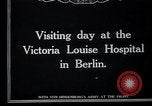
Visiting day at the Victoria Louise Hospital in Berlin, during World War I.
Relatives and friends visit wounded German soldiers at the Victoria Louise Hospital in Berlin, during World War 1. A large number of people are gathered outside the hospital. A young woman offers cigarettes to wounded soldiers who are outside in wheel chairs. A nurse passes out flowers to them. Another woman also seen walking along a line of wounded, giving them flowers. A civilian talking with several ambulatory wounded soldiers. He asks one about the wound to his head. Two recuperating soldiers watch as two others play chess. A group of recuperating soldiers pose as they gather around one who is bedridden. Some play cards on the lap of a soldier in a wheel chair. Scene shifts to inside the hospital. A bedridden soldier poses with nurse, for the camera. Some comrades stand behind his bed. She puts his military cap on his head. (Slate states that he died 20 minutes later.) More recuperating soldiers playing card games with those in beds in the ward. Doctor and nurses and staff seen in the ward. A soldier of short stature, with arm in a sling steps into the camera view as it pans along the ward, showing several of the recuperating soldiers. A hospital orderly wheels a patient towards the operating room.
CRITICALPAST.COM: About Us | Contact Us | FAQs - How to Order | License Agreement | My Account | My Lightboxes | Shopping Cart | Advanced Search | Featured Collections | Website Terms & Conditions | Privacy Policy ©2026 CriticalPast LLC.
License Agreement |
Terms & Conditions |
Privacy Policy
©2026 CriticalPast LLC.