


 Francais
 Deutsch
 Italiano
Refine Your Search
-Cebu,-Philippines stock footage and images
- Showing 6661 to 6666 of 58885 results more
more Hide
Hide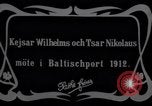
Kaiser Wilhelm II and Czar Nicholas II meet at a Baltic Seaport.
A launch bearing the Russian Imperial Navy ensign, rowed by sailors, transports Kaiser Wilhelm II and his party to a Russian ship at a Baltic Seaport. The Russian royal family, including Czarina Alexandra and her daughters are seen. There is much formal interaction with saluting and such. Russian troops pass in review on a parade ground. The visiting Kaiser and his party depart the Russian ship with fanfare and formality.
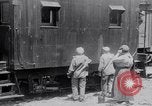
British women take on men's jobs on the homefront during World War I
Women in the industrial workforce on the homefront in Britain during World War 1. Opening scene shows several British women in working garb painting a railroad car. Other women perform manual labor alongside railroad box cars in a rail yard near a factory, as two women pass them pushing a small flatbed rail car loaded with steel rail parts. Change of scene to outdoors, where women are felling trees. Two in foreground are using a grinding wheel to sharpen an axe, while behind them, two push on a tree while two others use a long two-handled saw near its base. They jump clear as the tree falls. Women wielding axes to cut trees, elswehere in the woods. Two women with a two-handled saw, making final cuts on a standing tree, and stepping out of the way as it falls. A woman painter on a scaffold supported by block and tackle rigging four stories high on the side of a city building.
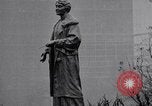
Brief montage of moving images from early 20th Century Women's suffrage and equal rights movement in Great Britain.
Scene opens showing the statue of British Women's suffrage movement leader, Emmeline Pankhurst, located in Victoria Tower Gardens next to the Houses of Parliament, Westminster. (This was erected in her memory, in 1930, two years after her death.) A World War 1 parade of women in clothing of religious orders; nurses; some military; and academics. One group carries a banner reading "Demonstrate-Trained Nurses." It also depicts What appears to be an Angel of Mercy and an appeal to buy war bonds. They are followed by women carrying a large British Union Jack, and by others, in academic garb, carrying banners of academic institutions. (This march was probably organized by the "Women's Party," the 1917 group founded by the Panghursts' to replace their "Women's Social and Political Union." The new party emphasized support for the British war effort.) Scene shifts to suffragist Emmeline Pankhurst (sometimes called a suffragette) viewed from camera behind her right shoulder as she addresses a large crowd. She is standing on a roofed platform in a park-like setting. The audience is mostly civilian, but a soldier is seen here or there. Several London Bobbies are in the audience, close to the speaker's stand. The next scene shows pedestrians gathered near Buckingham Palace, in London. A number of Bobbies (London policemen) are present, some on foot and some on horseback. The Queen Victoria monument is visible in the background. A horse-drawn carriage passes in front of the camera. Next, a woman is seen being arrested by two Bobbies, as passersby watch. An automobile passes and then the woman and police are seen approaching the camera as more officers become involved, keeping spectators away. In the final scene, in the 1920s, a man standing in front of a large group of women, congratulates one (probably Christabel Pankhurst). Closeup shows, from left to right, the man; a somewhat tired-looking Emmeline Pankhurst; and her daughter, Christabel.
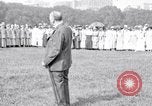
U.S. Navy Secretary Daniels, bids farewell to Navy female Yeomen(F) and female Marinettes of the U.S. Navy as they end their active duty after World War I
U.S. Navy Secretary Josephus Daniels stands in the center of a grassy field surrounded by contingents of women Navy Yeomen and Marine "Marinettes." He bids them farewell, as they are being officially released from active duty in accordance with the Naval Appropriations Act of 1919. Next, he dons his hat and steps forward to commence a final review of the women in formation. Among those accompanying him are: Assistant Navy Secretary, Franklin D. Roosevelt, Admiral William Sims (now President of the Naval War College), and Major General George Barnett, Commandant of the Marine Corps. They walk past a formation of Yeomen(F) commanded by a male Petty Officer sailor, and continue toward a contingent of women marines. Camera focuses,next, on Yeomen(F) marching in review. During the review, Assistant Secretary Roosevelt is seen speaking to Admiral Sims. Civilian spectators stand in the background. Next, the women marines march in review. The final scene shows Daniels and Roosevelt conversing as they pose with women Marinettes, a young Navy Admiral, and and a Yeomen(F) color guard. All relax and disburse as the ceremony ends.
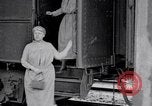
Women who had formerly served prison terms for their suffragist activities, arrive in San Francisco on "Prison Special" train.
Twenty four suffragist women (sometimes called suffragettes) arrive in San Francisco, California, on their 3-week tour across the country during February, 1919, in a last-ditch effort to urge passage of the 19th amendment, providing voting rights for women, which was being held up in the U.S. Senate. The women advocating women's suffrage are seen stepping from a railroad train coach, wearing uniforms like they wore when imprisoned at the Occoquan Workhouse (Run by the District of Columbia, the Workhouse, in Laurel Hill, Virginia, was later called Lorton Reformatory. Over 150 women suffragists were eventually incarcerated there.) (Note: The Senate later passed the 19th amendment which was ratified on August 18, 1920.)
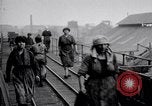
Women at work in a British industrial plant during World War I.
Women employed in a factory in Britain, during World War 1. Several women in grimy work clothes move what appears to be ore, in small open rail cars, atop a steel platform. Two women move one car to the end of the platform, where one pulls a long lever to tip it upside down and empty it. The next scene shows women pulling logs from symetrical stacks and placing them into open wooden rail cars. Two women move a log-filled car along the previously seen steel platform. Camera pans closeup of some of the women factory workers posing, with two men who appear to be supervisors. Closeup of two factory worker girls. They smile and laugh while posing.
CRITICALPAST.COM: About Us | Contact Us | FAQs - How to Order | License Agreement | My Account | My Lightboxes | Shopping Cart | Advanced Search | Featured Collections | Website Terms & Conditions | Privacy Policy ©2026 CriticalPast LLC.
License Agreement |
Terms & Conditions |
Privacy Policy
©2026 CriticalPast LLC.