


 Francais
 Deutsch
 Italiano
Refine Your Search
-Cebu,-Philippines stock footage and images
- Showing 667 to 672 of 58885 results more
more Hide
Hide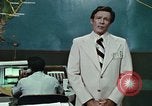
How the Civil Reserve Air Fleet, contract carriers, and U.S. Reserve and National Guard augment active U.S. military airlift capability.
Views of civilian airlines and examples of how they and U.S. Air Force Reserve and National Guard aircraft augment the active U.S. military airlift Command capability in time of emergency. Civilian narrator speaks from inside the U.S. Air Force Military Airlift Command (MAC) Headquarters Command Center, at Scott Air Force Base, Illinois. Next scene shows U.S. commercial airline passenger airplanes parked on a ramp. United Airlines, Delta Airlines, American Airlines, and Pan American aircraft are seen, some taxi, some parked, some taking off. A Boeing 727 jet taxis on the ramp. A Western Airlines 727 taxis behind a set of baggage carts being pulled by a tractor. The Narrator is discussing the Civil Reserve Air Fleet (CRAF) to which most U.S. airlines belong, and which can be activated by the Secretary of Defense, for airlift support in the event of a national defense emergency. The Western 727 aircraft takes off. A TWA 727 aircraft takes off. U.S. military personnel and dependent women and children are seen descending a stairway from a commercial airliner contracted by the Department of Defense. Military supplies are seen being offloaded by U.S. Airmen, onto a traveling cargo carrier, from a Flying Tigers Boeing 707 aircraft. Refugees from Southeast Asia are gathered and processed at an airport and then board an American Airlines Boeing 747 aircraft. Refugees from Vietnam and Cambodia boarding an Overseas National Airways Boeing 747. An American Airlines 747 taking off. A glimpse of the narrator in MAC headquarters, at Scott Air Force Base, is followed by a mix of private and military aircraft on a parking ramp, including a, presumably privately owned, Japanese Nakajima B5N Navy Type 97 Carrier Attack Bomber (Kate) with Japanese markings. U.S.Air National Guard C-130 and C-123 aircraft are seen taxiing, and taking off from this civilian airfield.
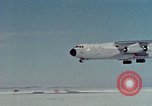
MAC C-141 aircraft transports shipments for the National Science Foundation as part of Operation Deep Freeze.
U.S. Air Force Military Airlift Command (MAC) aircraft lands in Antarctica for Operation Deep Freeze. A person enters a National Science Foundation Center. People disembark the plane. Unload the equipment. Numerous vehicles at the base. Plane takes off with the shipment to Point Mugu Naval Air Station in California. Scripps Institute of Oceanography conducts research for the National Science Foundation. Frank S Todd of the Hubbs Sea World Research Institute talks about the airlifting of penguins by C-141 used for behavioral studies.
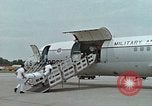
Medical technicians attend wounded in a MAC C-9 plane and Aero-medical evacuation during the war in South East Asia.
Responsibility of United States Air Force MAC during war time. People carry a wounded on stretcher into a Military Airlift Command (MAC) C-9 aircraft. Trained flight nurses and medical technicians board the plane. Men arrange stretchers inside the plane. MAC planes land and take off. View of Aero-medical evacuation during the Vietnam War in South East Asia. Soldiers carry injured United States Army soldier into a helicopter ambulance in the late 1960s or early 1970s.Medical personnel attend to the wounded on stretchers in a C-9 plane.
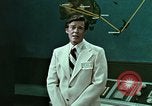
MAC aircraft transport and deliver relief material, bring back prisoners of war, and transport dignitaries
A man talks about American MAC medical missions from the MAC command headquarters. A map shows the path taken by a medically equipped C-141 from Irkutsk to Yokota Air Base hospital, Japan. Ground crewmen signal to a United States Air Force Military Airlift Command (MAC) aircraft. MAC planes deliver relief material to people during the floods in Pakistan. Men move towards the helicopter along with supplies. Supplies delivered during the famine and drought in North Central Africa. Men carry sacks of China rice. Destruction caused due to an earthquake in Guatemala. Cartons of clothes and other supplies loaded into a MAC plane. Plane taxis and takes off. Pilots talk on radio. U.S. prisoners of war brought back from Vietnam during Operation Home Coming. U.S. President Jimmy Carter exits a helicopter at Andrews Air Force Base and shakes the hand of a general. President Jimmy Carter climbs steps to Air Force One and enters the Boeing aircraft. Air Force One takes off from Andrews Air Force Base.
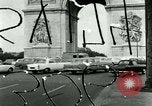
U.S. and Vietnamese officials arrive for first round of Paris Peace Talks in Paris, France.
Vehicle traffic in front of Arc De Triomphe in Paris. People at the Paris Airport. Military Airlift Command aircraft lands. People gather to welcome the dignitaries. U.S. delegation led by Ambassador at Large Averell Harriman disembarks the Military Airlift Command aircraft and they are welcomed by people of Paris. Sargent Shriver also seen with Harriman. Media persons on the airport. Soldiers receive the dignitaries. Harriman addresses group from microphone and talks about the peace talks. Police officers stand outside the Majestic Hotel. North Vietnamese delegation led by Xuan Thuy comes out of the hotel and enters a Citroen car. Media persons records the event. Officials arrive at discussions at the Centre de Conferences Internationales. Gathered for a photo opportunity, U.S. Secretary of State William Rogers and Xuan Thuy greet each other. Arrival of Averell Harriman's contingent at the talks in a Cadillac limousine. Averell Harriman and William Rogers together for photographers, and then exiting the building and reentering the limousine.
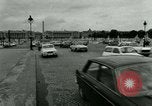
U.S. and Vietnamese leaders arrive for the Paris Peace Talks at Centre De Conferences Internationales in Paris.
Traffic at the Place de la Concorde. People of Paris buy the local newspaper. Headline of the Internation Herald Tribune refers to the first day of the Peace Talks. it reads, "Hanoi and U.S. Negotiators in Paris; Start of Peace Talks Set for Today." The picture shows Averell Harriman and Sargent Shriver along with a 3rd U.S. delegation member (Henry Cabot Lodge Jr. ?) Microphones on a table and other arrangements in the Centre De Conferences Internationales. Dignitaries enter the conference hall. Civilians and the press await the arrival of dignitaries oustside. The Vietnamese and the U.S. dignitaries arrive at the venue. Door closed as the Peace Talks begin. High view from a building patio of Paris with the Eiffel Tower in the background.
CRITICALPAST.COM: About Us | Contact Us | FAQs - How to Order | License Agreement | My Account | My Lightboxes | Shopping Cart | Advanced Search | Featured Collections | Website Terms & Conditions | Privacy Policy ©2026 CriticalPast LLC.
License Agreement |
Terms & Conditions |
Privacy Policy
©2026 CriticalPast LLC.