


 Francais
 Deutsch
 Italiano
Refine Your Search
-Cebu,-Philippines stock footage and images
- Showing 7381 to 7386 of 58885 results more
more Hide
Hide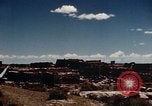
Lifestyle of Hopi Indian people at Oraibi, Arizona, and Navajo Indian people in Monument Valley area of Arizona
Native American Indian people of the Hopi people are shown living in Oraibi, Arizona in the late 1930s. Lifestyle of the Hope people. A woman climbs the stairs of a traditional Hopi dwelling, unchanged by modern civilization. Construction of houses is seen. Hopi women fashion pottery in an ancient village, while kneeling on a blanket on the ground. They shape bowls by hand. Completed Hopi bowls and vases, and ceremonial mats and baskets are shown. A man paints religious dolls known as Kachina dolls, each a replica of costumes worn during religious ceremonies. Children play with the dolls. Indian men work at a mining site, but they are constrasted with many Indian men who choose their traditional way of life. A Navajo American Indian man riding a horse passes near monuments and natural rock formations in the Monument Valley area of Arizona. A young navajo girl herds sheep and goats with Monument Valley rock formations in background, showing how children assist the tribe. Arid lands needing irrigation are shown, and narrator discusses need for irrigation to support growth of the Navajo nation. A Navajo brush shelter dwelling is shown, typical of those erected by the nomadic Navajo following their grazing animals from place to place. Navajo woman grinds corn in traditional manner by hand with a stone. Two Navajo boys watch her. A navajo woman wearing turquoise and silver jewelry. A navajo woman makes a rug by hand, using wool from Navajo sheep. The rug weaver follows no drawn pattern and uses her memory only to make the pattern. Prehistoric Native American Indian dwellings in the Canyon de Chelly are shown, protected as National Monuments, and originally home to ancient Navajo and Anasazi Pueblo people. An anthropologist or archaeologist participating in excavation at the Canyon de Chelly examines a piece of pottery. Scientists at a Canyon de Chelly ruin from end of 11th century AD extract a core sample from timber to determine the year of the dwelling construction by wood growth rate pattern.
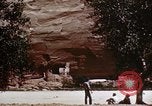
Native American Indian ruins, Oak Creek Canyon, Petrified Forests, and natural rock features and canyons in Arizona
Monuments ruins of native American Indian civilizations in Arizona, United States. People sit at the side of a waterway near a ruin. They view the ruined monuments. Canyons, ridges, rock formations and water streams in Oak Creek Canyon. A 1930s car on a road in Oak Creek Canyon. Tourists look at the ruins prehistoric trees turned to stone in the Petrified Forest National Park. Close-up views of trees in the petrified forest, and of various cross-sections cut and polished. Elevated view of colorful ridges in the Painted Desert on the Little Colorado River. View of Sunset Crater and dried rock of old lava flows from the volcano. Scenes of the Grand Canyon and a man and woman looking out over the Grand Canyon. Montage of scenes of farmers, American Indians, prospectors, and miners in Arizona. Mining operations and smoke rises from the chimney of a smelting factory. Saguaro cactus plants with the setting sun behind at dusk.

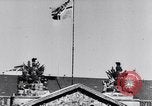
During World War II, Adolf Hitler and German High Command attend memorial ceremony for German war dead
Nazi War Ensign flying above the Zeughaus (old armory) museum building in Berlin on Heldengedenktag (Day of Commemoration of Heroes) in World War 2. Open car arrives carrying Adolf Hitler. Marshal Hermann Goering salutes with his baton as other German officers render Nazi salute. Hitler and Goering shake hands. Hitler then shakes hands with Marshal Wilhelm Keitel; Grand Admiral Karl Doenitz; SS leader Heinrich Himmler; Marshal Fedor von Bock; Marshal Erhard Milch and a local official. Hitler and Goering lead the group into the museum, past displays of war materiel and a large standing crowd of participants. Hitler and his military entourage are seated as the courtyard is filled by the music of Bruckner's Symphony No.7 in E major. Hitler seems enthralled. Other participants also listen quietly. While music continues, Hitler quietly steps to a podium decorated with the Naval ensign. A mass of flag bearers from units of all armed services stand behind him. He speaks softly about the struggle to defend Europe against the Bolsheviks. He mentions the Wehrmacht and those who have fallen in defense of homeland and people, who will be remembered always, by the nation.
Adolf Hitler and top military leaders pay homage on Heldengedenktag (Day of Commemoration of Heroes) in World War II
German war ensign flying over the Zeughaus (military museum) on Unter den Linden, in Berlin, Germany on Heldengedenktag (Day of Commemoration of Heroes) in World War 2. A military band outside plays the National Anthem, as Adolf Hitler walks out of the building, accompanied by General Paul von Hase, Commandant of Berlin. An honor guard of soldiers presents arms in salute. Hitler and Marshal Hermann Goering (Göring) lead members of the German High Command, including Marshal Wilhelm Keitel; Grand Admiral Karl Doenitz; SS leader Heinrich Himmler; Marshal Fedor von Bock; and Marshal Erhard Milch, as they walk along the street, reviewing troops in formation. Flag bearers dip 30 colors of the old German Kriegsmarine and 30 of the new German army, in salute, as the reviewers pass. Soldiers stand holding a large memorial wreath. Hitler and his entourage turn and walk towards the Neue Wache (New Guard) National War Memorial building. Scene shift to inside the memorial, as the wreath bearers enter, followed by Hitler and the Marshals. The strains of "ich hatt einen kameraden" war song are heard played as a dirge. Soldiers place the wreath, and all present salute. Many more flowers are seen on the memorial floor. View of the memorial black granite block topped by an oak wreath (designed by the sculptor Ludwig Gies) situated under an oculus. It is flanked by two guards. Flowers cover the entire floor in front of it. Meanwhile, outside, on Unter den Linden, all persons simultaneously salute, including military and civilians. As Hitler leaves the memorial building, accompanied by the Marshals, he stops to shake hands and converse with wounded German officers and soldiers in wheel chairs. He greets older veterans of earlier wars. A crowd including many young people hold up placards on poles.
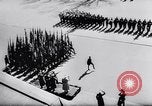
Military parade along Unter den Linden, Berlin, on Heldengedenktag (Day of Commemoration of Heroes) in World War II
German troops march along Unter den Linden, in Berlin, Germany, on Heldengedenktag (Day of Commemoration of Heroes) in World War 2. A military band (unseen) plays. The troops pass a reviewing party in front of the Neue Wache Memorial building, that includes Adolf Hitler, Marshal Hermann Goering; Marshal Wilhelm Keitel; Grand Admiral Karl Doenitz; SS leader Heinrich Himmler; Marshal Fedor von Bock; and Marshal Erhard Milch.
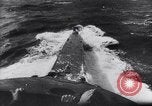
Sights and sounds aboard a German U-boat operating in the North Atlantic during World War II
German U-boat underway on the surface in stormy weather on the North Atlantic ocean during World War 2. The crew all wear foul weather gear. They search for British ships. Upon seeing one, they quickly descend and the boat rapidly submerges. View inside the submarine as sailors close all hatches and manipulate valves. Underwater view of periscope rising from a submerged U-boat. The boat's Captain looking through his periscope. He and the second officer look through the periscope and check book of known British ships to identify it. They fire a torpedo from tube number 4, start a stop watch, lower the periscope, and wait. Next, they hear an explosion and then the sounds from screws of a destroyer passing nearby. A depth charge from the destroyer explodes, knocking items in the boat to the floor. Lights go out in the U-boat and water leaks in places. Crew members inspect by flashlight and confirm minimal damage. With lights on again, the U-boat Captain looks through the periscope and then surfaces,to see a sinking ship
CRITICALPAST.COM: About Us | Contact Us | FAQs - How to Order | License Agreement | My Account | My Lightboxes | Shopping Cart | Advanced Search | Featured Collections | Website Terms & Conditions | Privacy Policy ©2026 CriticalPast LLC.
License Agreement |
Terms & Conditions |
Privacy Policy
©2026 CriticalPast LLC.