


 Francais
 Deutsch
 Italiano
Refine Your Search
-Cebu,-Philippines stock footage and images
- Showing 7585 to 7590 of 58885 results more
more Hide
Hide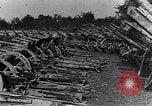
German artillery, shells and other weapons captured by Canadian troops are displayed on a field during World War I.
Huge numbers of German 7.7 cm artillery field pieces (Feldkanones) and other artillery of various kinds, captured by Canadian forces during a battle in World War 1. Camera pans over the guns, arranged in neat rows by type, in a large storage area. Shells for the artillery are also arranged in rows on the ground in front of the weapons. Also seen on the ground are rows of machine guns. A British officer steps amongst the captured military weapons.
Ruins of the Canal du Nord in France. French and British officials and Generals visit war torn sites
Opens with camera panning over debris filled Canal du Nord and then continuing along and up its concrete sides to the top. British troops walk along the high ground above the opposite side of the damaged canal. Next, Commander of British forces, Marshal Sir Douglas Haig, and French Premier, Georges Clemenceau, step from their respective automobiles, and walk together in a war torn area in France, during World War 1. Other officials and military officers join them. Closeup of British Field Marshal Sir Julian Byng, Commander of the Third Army, conversing with another General officer and then with a French priest Other officers stand behind him and a dog sits on the ground, nearby. Premier Clemenceau with a French General speaking to French women in a city. A civilian official (wearing a black mourning armband) joins them. Next, Haig and Clemenceau are seen walking together toward an honor guard of French soldiers, drawn up in formation along the roadside. The proceed to a contingent of British troops, including a military band, standing in formation. Haig and Clemenceau walk through the ranks inspecting the troops. They are next seen as Marshal Haig introduces British General Sir Herbert Plumer to Premier Clemenceau. French soldiers stand at attention in the background. Views of different officers and officials conversing, including Field Marshal Sir Julian Byng speaking with General Plumer. The statesmen and Generals then visit the damaged former German headquarters. Sign above the building reads:”Kommandantur.” The building is pockmarked by shell and bullet holes. Clemenceau leads the party exiting the building. Debris covers the front steps. Clemenceau and Haig return to the same car, saying farewell to others in the party. An officer places a carriage robe over the French Premier’s legs, and they drive away. Next scene is on the outskirts of Ypres, as the remains of a damaged hospital are demolished by British Forces after it was deemed dangerous and unusable due to German shelling.
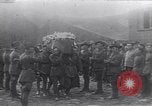
The burial of German Ace fighter pilot, Manfred Von Richthofen, in France.
Officers and men of the Australian Flying Corps, who controlled the combat area, in France, where he died, give Ace German pilot, Baron von Richthofen a funeral with full military honors. Six Captains, of their Squadron number 3, serve as pallbearers, and others participate as honor guards. Pallbearers place the flower covered coffin of Richthofen (also known as The Red Baron) on a vehicle for transport to a cemetery at the village of Bertangles, near Amiens, France. There a Priest officiates as the coffin is lowered into the grave. ANZAC (Australian and New Zealand Army Corps) troops assemble in formation and ceremonially position themselves with heads bowed. They then raise their rifles and fire several volleys into the air, in salute to the fallen German aviator. (Reportedly, memorial wreaths were received, for the funeral, from other Allied Flying Squadrons, including one with the words, "To Our Gallant and Worthy Foe"). This was the first of several burials of von Richthofen's remains. (World War I; World War 1; WWI; WW1)
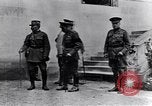
Britain’s King George V and Field Marshal Haig, meet with French Marshal Foch and Gerneral Petain just before the Armistice ending World War I.
Historic Meeting of Britain’s King George V with French Marshal Ferdinand Foch, British Field Marshal Douglas Haig, and French General Henri-Philippe Pétain, in France, on the eve of the Armistice, ending World War 1. King George V, wearing black mourning armband, begins to organize them to pose for photographs, at the foot of some stairs. They all do some shuffling to arrange themselves with due respect to rank, etc and end up with King George V in center of front row, with Haig and Petain to his left. To his right is Marshal Foch, French General Louis Franchet D'Esperey and British General Henry Rawlinson. Complete change of scene shows a clean shaven British military officer speaking with British Prime Minister David Lloyd George. The local city mayor is with them, dressed in ceremonial robes. A statesman, in top hat stands nearby. A uniformed man carries the Mayor’s maces. Next, Lloyd George and the British officer inspect troops, walking between flanks of British soldiers holding shouldered rifles.
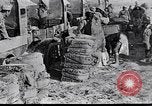
British military operations in Palestine during World War I
Palestinian workers loading bulk supplies onto British Army trucks, lined up, bumper to bumper, in the desert, during World War 1. A supervising British officer is seen briefly. Similarly, Palestinians loading British Army supplies into horse-drawn carts, at a British military encampment in the desert. As loaded carts begin to drive away, Stacked sandbags and tents can be seen in the background. A Brtish soldier appears briefly as carts leave. Next, a British soldier poses with his camel. He demonstrates how docile the animal is, by placing his arm into camel’s mouth. Palestinians are nest seen with camels at a watering hole, before they begin travel. Then, British Army soldiers are seen astride camels as they make their way in a column across the desert. A column of British Army Vauxhall 25hp motorcars moves along a desert road, of sorts, between rock outcroppings. (Preceding Slate states,” it takes a lot of gas to haul water for the men.”)
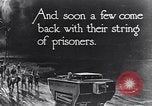
Soldiers on tanks and other vehicles pass on a field in France.
Soldiers walk along with prisoners of war at a field in France. Vehicles pass on the field. Soldiers move on tank. They rest in the field.
CRITICALPAST.COM: About Us | Contact Us | FAQs - How to Order | License Agreement | My Account | My Lightboxes | Shopping Cart | Advanced Search | Featured Collections | Website Terms & Conditions | Privacy Policy ©2026 CriticalPast LLC.
License Agreement |
Terms & Conditions |
Privacy Policy
©2026 CriticalPast LLC.