


 Francais
 Deutsch
 Italiano
Refine Your Search
-Cebu,-Philippines stock footage and images
- Showing 12979 to 12984 of 58885 results more
more Hide
Hide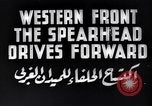
Allied bombers strafe enemy ground installations in France.
The Allied spearhead drives forward on the Western Front. British tanks move forward in France. Anti mine tanks move in front. Smoke in the distance. Allied bombers fly through flak to strafe and bomb ground installations. Allied planes bomb an enemy convoy off Helgoland, Germany (Heligoland). Enemy ships at fire. Allied spearhead advances forward. Half tracks and tanks move through a rubbled French town. The soldiers march. An Allied soldier picks and reads a leaflet. Allied tanks followed by soldiers. Soldiers aim and fire. A soldier marches a captured Nazi soldier. Allied planes bomb German supply vehicles. Explosion and fire as the bombs hit the targets. (World War II period).
The Battle of Shanghai and Chinese history, 1937.
The Battle of Shanghai, September 1937. Japanese planes in flight over Shanghai. Pilots in the cockpit. A hand dials a control to drop bombs on the underlying city. Explosions as bombs hit the target. The citizens flee. A plane drops bombs on a bridge as people are crossing it. The bridge collapses. Citizens in the streets. Vehicles on the streets of Shanghai. People in runner pulled rickshaws. Dead Chinese people on the streets. A cloud of smoke rises over the city. Gate to the Chinese Forbidden City opens to reveal the Temple of Heaven. A Ming Lion statue. A time line shows the advent of different civilizations-- A milestone with 1776 written on it indicates the time when Washington crossed the Delaware River. Another milestone shows 1492. A picture of Columbus's ship. Yet another milestone reads 476. Pictures of ancient Roman Empire. A milestone reads 1440 B.C. A statue of Moses. A milestone reads 1880 B.C. A scene of the pyramids depicts the Egyptian civilization. Another milestone reads 2200 B.C. Shows a road leading to Chinese civilization. . A man carrying two baskets on a pole walks by a statue of Confucius and a horse. Ancient Chinese temple in background. A wall shows Chinese statues of Buddha. An animated map of China. Laborers mining coal in Manchuria. Coal cars filled with coal. In the Gobi desert nomad tribes move with their camel caravan. Himalayan mountains in the Tibet region. Animated map of China shows rivers. Sampans in the Yangtze river. A Chinese farmer plows his field. Chinese soldiers in China. Montage shows the people of China against a crowd of Chinese people.
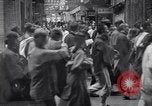
Fighting in China as Japan tries to conquer China during World War II.
Japanese aggression in China during the Second Sino-Japanese War and World War II. People in the streets of China. Animated pictures show one Chinese out of every 5 people in the world. A page showing Chinese writing. A mariners' compass. A Chinese man at an observatory. A porcelain cutlery set on a table. A Chinese man places porcelain into a furnace. A man puts gun powder in a bowl from a mortar. Explosion in the bowl. Firecrackers burst. Chinese people celebrating a festival. A book titled 'Analects of Confucius'. A saying of Confucius reads “What you do not want done to yourself, do not do to others”. Statues and pagodas in China. Scenes of fighting. Japanese artillery fires and cavalry advances. U.S. flag flutters beside the Chines flag. Chinese troops on horses. Animated map of China. A book titled 'The Tanaka Memorial Japan's dream of World Empire'. Japanese Foreign Minister Baron Nishi Tanaka. Excerpted line of the book. Japanese military officers. An animated map of Asia showing regions which Japan wanted to conquer. Animated map shows Germany and Russia. Animated map showing Japan and China contrasts Japanese unity with Chinese disunity. Animated map shows China breaking into pieces. A scene of the Japanese Army.
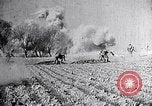
Chinese people demonstrate against the Japanese in China (WW2)
Japanese aggression during the Second Sino-Japanese War leads China to enter World War II. Fighting in and around Nanking (Nanjing), China. Japanese soldiers advance forward. Chinese soldiers behind a wall load and fire artillery. The Japanese invade the city. Japanese soldiers move through rubbles. They celebrate after conquering the city. Japanese tanks and troops advance. Japanese atrocities as they rape the woman and torture and kill the civilians. Dead civilians on the streets. Japanese Emperor Hirohito gets off a plane and salutes. A Chinese man carries a dead body. A lady wails. Injured civilians in the hospitals and on the streets. Chinese people holding banners protest and demonstrate against the Japanese. A saying of Chiang Kai-shek and other Chinese men demonstrating against Japanese imperialism.
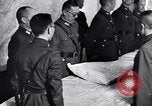
Chinese men, women and children mass migrate to the West in China, as they flee the invading Japanese.
Chinese emigrate to the West as they flee the invading Japanese. Chinese military officers and officials in a meeting. They develop strategies to fight the Japanese invasion. Maps and charts on the table. They confer on territory yield, military strategy and industrial power for production of rifles and guns. An officer talks as he points to a wall map. They decide to move West into the mountains. Chinese men blow up roads, scorch fields, and blow up factories before proceeding westward. Factories in flames. People begin to move towards the West. Men, women and children walk, ride in hand rickshaws. They cross bridges and cities in the process of mass migration. People carry their belongings and machinery. Libraries, schools and houses are dismantled and carted away. Machinery moved in trucks and carts. People wait for a train near a railroad. They board a train bound westward. men dismantle railway tracks to leave no route for the enemy. People seated on railway carriages. Overcrowded boats and barges in a river. Elderly people and children in the boats. People cross a river running through a mountain gorge. People walk on the banks and pull load and boats with ropes. People climb hills and move further into the mountains. (World War II period).
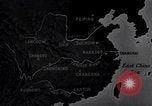
Bombing of Chungking (Chongqing), China, by Japan, in Second Sino-Japanese war
The Republic of China establishes its wartime capital at Chungking (Chongqing), China during the Second Sino-Japanese War. Animated map depicts areas of Japanese occupation and highlights cities including Lanchow (Lanzhou), Chengtu (Chengdu), and Kunming. It highlights Chungking (Chongqing) as the Nationalist Republic of China. Chiang Kai-Shek is seen leading a group of Chinese leaders as they walk through an arched gate in Chungking (Chongqing). A busy street with shops and apartment houses in a commercial district. Busy scene of pedestrians, cart traffic, and automobiles in the road center. Boats on the Yangtze River are seen below long steep steps leading up to the streets above. Houses along the cliffs. Chinese workers digging bomb shelters into the cliffs. View from inside a shelter being hollowed out of the rock. Back in the Japanese occupied area, a car brings a Japanese Air Force leader who addresses a large group of fliers at an airbase. Next, Japanese aviator crews are seen running to their aircraft from their camp on the airfield. They take off in Mitsubishi G3M bombers to attack Chungking (Chongqing). Nakajima Ki-27 airplanes take off from the field and join in large formations overhead. A formation of Chinese World War 1 era aircraft is seen in flight to engage incoming Japanese bombers. Japanese crew member in a bomber sees the Chinese fighters and gunners in the bombers get ready to fire on them. The Chinese fighter planes dive at the bombers but are intercepted by Nakajima Ki-27 airplanes flying cover. Dogfights ensue with Chinese aircraft being shot down, and the bombers continuing their way. Air raid sirens sound in Chungking (Chongqing) and people run to their shelters, including school children. Views of bomber crews at their stations and then of bombs falling with the Yangtze River below. Bombs exploding along the riverfront and inland, along the cliffs. View of machinery operating, and Chinese workers occupied in underground factories in Chungking (Chongqing). Fires burning throughout the city from the bombing, and Chinese fire fighters with hoses working to extinguish fires.
CRITICALPAST.COM: About Us | Contact Us | FAQs - How to Order | License Agreement | My Account | My Lightboxes | Shopping Cart | Advanced Search | Featured Collections | Website Terms & Conditions | Privacy Policy ©2026 CriticalPast LLC.
License Agreement |
Terms & Conditions |
Privacy Policy
©2026 CriticalPast LLC.