


 Francais
 Deutsch
 Italiano
Refine Your Search
-Cebu,-Philippines stock footage and images
- Showing 1309 to 1314 of 58885 results more
more Hide
Hide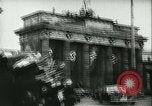
Fuhrer Adolf Hitler addresses the Reichstag in Berlin and German troops advance in the European Theater of World War II.
Adolf Hitler as Fuhrer of Nazi Germany. Hitler and other German officers in cars pass by through the Brandenburg Gate in Berlin as crowds line the streets with Nazi salutes. German Nazi flags on the Brandenburg Gate. Civilians greet the Fuhrer as his car passes by. Hitler greets Nazi officers in the Reichstag building and shakes hands with several German officials. Officers give the Nazi salute and Hitler salutes the group. Hitler addresses the Nazi gathering. The Parteiadler Nazi party symbol and the Swastika in the Reichstag hall. German troops gathered for the Nuremberg Rally at the Nazi Party grounds in Nuremberg. Montage of scenes featuring German soldiers and armament: Close up view of face of young German soldier; German soldiers march in formation and on roads. German tanks rolling and closeup of tank tread. During battle, German soldiersy take cover in trench and then advance using flame thrower during attack amidst shelling. Very large formation of German soldiers marching around Nazi flags during the Nuremberg Rally. Thousands of German soldiers. The German Nazi eagle symbol. German soldiers with hands raised in "Schwurhand" as they take an oath, possibly the Hitler Oath.
V-mail procedures including cutting, microfilming, transport, photographic enlargement, and processing during WWII.
The use of V-mail (Victory Mail) by the United States during World War II. V-mail procedures including cutting, microfilming, transport, photographic enlargement, and processing of V-mail letters and post. A poster promoting the use of V-mail. Women in a line at a post office. The post office staff at counter windows serves the customers. A woman collects a V-mail letter, writes her message and then addresses the letter. The preferred use of a softer pencil in V-mails. Cutting: Specially trained soldiers unpack the V-mails and use a cutting machine to open each mail. Processing: The experienced staff sorts mails into the respective destination groups at sorting tables. Soldiers open mails to photograph them. A soldier sorts mail that can't be photographed and are to be sent back. These mails include stamps, enclosures, snapshots and bad writing. The correct mails are then sorted into given numbers in bundles. Microfilming: Women use Airgraph machines to photograph each mail on 16mm films. 1600 mails on 100 feet of film. The complete reels are sent for developing. Women put in new reels of negatives into the cameras. Developers dry the film reels. Stacks of reels on a table containing images of thousands of letters. Soldiers packing and stacking many hundreds of sacks filled with V-mail letter microfilm images. A Boeing 314 Pan American Clipper flying boat sea plane (military designation C-98) is seen taking off to transport V-mail to major destination points. A bag of microfilm reels is delivered to an officer. He unpacks the reels and sends them to the printing room. Enlargement: Enlargement machines are used to enlarge the snapshots. Men and women operate the printing machines. Soldiers with the printed facsimiles on tables. Processing: Women slice the prints into separate letters. Machines used to insert facsimiles into V-mail envelopes and seal them. The mails are then sent to the exact destinations by ordinary post. Soldiers gather around as a comrade distributes mail at a U.S. military base in the combat area.
The Guadalcanal campaign in World War II
Major General Alexander Vandegrift, USMC, who, as Commanding General of the 1st Marine Division, also commanded other U.S. military units involved in the invasion of Guadalcanal in World War 2. He discusses those joint U.S. military operations. The U.S. Destroyer, USS Blue (DD-387) seen bombarding Guadalcanal.A B-17 bomber overhead. U.S. Marines decend rope net into landing craft of the attack transport, USS George Clymer (APA-27), later seen with the USS Harry Lee (APA-10) and numerous landing craft around them. A landing craft from the Harry Lee arriving and Marines jumping out. Many U.S. troops wading ashore from landing craft. Troops carrying supplies ashore. Officers salute as American flag is raised on rugged flag pole. Numerous Japanese prisoners of war marching and in outdoor confinement. Japanese prisoners being processed. Japanese soldier using shoe clamps to quickly climb a tall palm tree. Admiral William Frederick Halsey, Jr.decorating a flyer with the Distinguished Flying Cross. View of the medal.Halsey decorating marines, including Major General Alexander Vandegrift, USMC, seen wearing the Navy Cross. Sign on palm tree reading: "Hospital Station C-1-Med." Wounded inside hospital tent. Troops gathered for religious service. U.S. troops dug in and moving along jungle path. Fallen Japanese soldiers on shore of Guadalcanal.Smoke rising from Japanese bombing of Henderson Field and construction continuing with heavy equipment. A B-17 bomber landing on the field. Names on B-17s at the field, including: "Spook," "Leis-Lady,"and "Boomerang." A Douglas SBD Dauntless aircraft taking off from Henderson field. Film concludes with parade of warships and overflight of warplanes (including a biplane).
The invasion of Poland, Dunkirk evacuation, Second Armistice, and London Blitz during World War II.
'50 Years of Cinematography' depicts the role of military and news cameramen during World War II. Germany starts the War. Invasion of Poland in 1939: German Nazi Luftwaffe bombers in flight over Warsaw. Explosions due to the bombardment. Burning and damaged buildings in the war torn city. Civilians amidst rubble and ruins. Soldiers and civilians look at corpses on a sidewalk. A woman with her child cries. A man walks on a street. Dunkirk Evacuation in 1940: Allied troops evacuated from the Dunkirk coast. Allied troops on ships. Smoke rises from a ship under German attack. Soldiers wade through the water towards waiting ships. Burning ships. The Second Armistice at Compiegne after the German victory in the Battle of France, 1940: German troops stand at attention. German Fuhrer Adolf Hitler, President of the Reichstag Hermann Goering, German Field Marshal Wilhelm Keitel and other German officers arrive at the venue. The leaders and officers walk past the soldiers at attention. Hitler gives the Nazi salute. The Blitz, London in 1940-1941: Bomb damaged buildings. Cars and pedestrians amidst ruins and rubble on the streets. A train over a collapsed wall. Civilians in a horse cart. A wrecked bus in a damaged building. Rescue workers among the rubble. Clouds over the city.
British troops fight Italians in Libya; Germany opens Eastern Front Campaign during World War II.
Images taken by military and news cameramen during World War II. The North African Campaign, 1940: Convoy of British tanks, trucks, and infantry advance over the Libyan Desert. British soldiers fire artillery. Masses of Italian prisoners marched by British soldiers. Next shown is campaign on the Eastern Front, 1941, as Germany attacks Russia: Nazi tanks advance under Luftwaffe air cover into the Soviet Union. Aerial view of German Junker Ju 87 aircraft in flight. German tanks and armored vehicles rolling. Wide view of many German tanks rolling east. German soldiers leaping down from a hill with smoke all around as they battle in a Russian town. Russian Pe-2 bomber aircraft in flight. Interior view of pilot and crew in Soviet Pe-2 bomber while in flight. Soviet soldiers on tanks during a battle. Burning tanks. Soviet soldiers run toward battle front and pass a dead German soldier on the battlefield.
British Commandos raid Lofoten Islands, Spitsbergen Island, and Vaagso Island during World War II.
Pictures taken by military and news cameramen during World War II. Operation Claymore, March 1941: British Commandos raid Lofoten Islands in assault boats. They destroy a fish oil refinery off the coast of Norway. Soldiers and civilians on the docks. Burning refineries and buildings. Clouds of black smoke. 1941: British and Canadian troops on Spitsbergen Island. They destroy Soviet coal mines to prevent the Germans from occupying them. Black smoke clouds due to the explosions. Operation Archery on Vaagso Island, 1941: British Commandos raid the Island. Soldiers walk in the snow. Nazi prisoners surrender and marched by British soldiers. Battle ensues on the Island. Soldiers walk past a fence. Burning buildings in the background.
CRITICALPAST.COM: About Us | Contact Us | FAQs - How to Order | License Agreement | My Account | My Lightboxes | Shopping Cart | Advanced Search | Featured Collections | Website Terms & Conditions | Privacy Policy ©2026 CriticalPast LLC.
License Agreement |
Terms & Conditions |
Privacy Policy
©2026 CriticalPast LLC.