


 Francais
 Deutsch
 Italiano
Refine Your Search
-Cebu,-Philippines stock footage and images
- Showing 1435 to 1440 of 58885 results more
more Hide
Hide
Dramatization depicts production, black marketing of gas coupons and citizens' responsibilities in supporting World War 2 gas rationing.
'No Alternative' dramatizes citizens' responsibilities in supporting gas rationing in the United States. Dramatization: Group of men seated playing card game. Tom interrupts a poker game to lecture on rationing, after Bob offers an illegal gas coupon to Frank. He talks about the production of automotive gasoline, increasing price and limited production of crude oil. Uses of crude oil: U.S. airmen and soldiers use crude oil to fuel aircraft and tanks. A U.S. aircraft drops bombs made with the use of crude oil. Workers produce synthetic rubber from crude oil at a plant. U.S. Navy ships, merchant fleets, railroads and war industries use crude oil. Tom explains how "black market" coupons cause shortages that affect war industries and military activities. Dramatization depicts safe breakers breaking into a ration board and stealing gas coupons worth 11 million gallons. Gasoline used by farmers in tractors, to take produce to the markets, finished ammunition, guns and tanks to the railroad stations so that they can be sent to the front. Tom points out ways to make rationing work and save gasoline including: formation of car pools, scorning illegal coupons, identifying coupons with the user's license number.
U.S. Army Air Forces light Grasshopper aircraft on a reconnaissance mission on Bougainville during World War II.
U.S. and Japanese forces battle during the Bougainville Campaign of World War II. A U.S. Army Air Forces Grasshopper light aircraft takes off to conduct a reconnaissance mission against Japanase forces who hold part of Bougainville, New Guinea. The aircraft in flight over difficult terrain, flying slowly at tree-top height. The pilot spots Japanese positions and radios the ground forces. U.S. artillery is positioned and fired. They blast revealed Japanese positions. Infantry units land near the Jaba River and progress to clean up isolated Japanese troops. A Grasshopper in flight overhead.
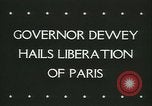
Speaking from the NY State Capitol, Governor Thomas Dewey hails the Liberation of Paris by the Allied forces in World War II.
New York Governor Thomas E. Dewey hails the Liberation of Paris by the Allied forces. The New York State Capitol building (State St. and, Washington Ave, Albany, NY 12224, United States) in Albany, New York. Governor Dewey addresses the nation regarding the Liberation of Paris in World War II. He states that the incident is an inspiration to others still under the Nazi German occupation. He talks about the contribution of Allied forces to the cause, America's war efforts and the goal to defeat Germany and Japan.
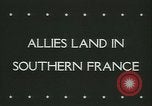
U.S. General Patch, U.S. Admiral Hewitt, and French Admiral Lemonnier lead the Allied fleet invasion of southern France.
Amphibious and airborne Allied forces land in southern France during World War II. (Operation Dragoon in August 1944). Map of France depicts Allied landings at Normandy on D-Day. Naples: An Allied naval force assembles, poised for landing in Southern France, 10 weeks after the Normandy D-Day invasion. Thousands of landing crafts, trucks, tanks, mobile cannons, military vehicles and equipment in the embarkation area. Barrages in flight overhead. Allied officers supervise as the vehicles are loaded into ships. US, French, British, Greek and Polish troops move up to their ships. The ships underway in the Mediterranean. U.S. Secretary of Navy James Forrestal, U.S. Army General Alexander Patch, French Admiral Andre Lemonnier and U.S. Navy Admiral Henry Hewitt (Chief of the Atlantic Invasion Fleet) aboard the flagship. Allied soldiers stitch sleeve patches. An animated map depicts the Allied invasion of southern France near Toulon in a combined amphibious and airborne assault. Hundreds of transport aircraft carry paratroop forces. The paratroopers get ready, jump, and descend to the ground. The amphibious forces near the French coast. German shore batteries fire at the approaching naval vessels. Explosions on ships and in water. Allied troops crouched in landing crafts. They hit the beach under shell fire and advance in land.
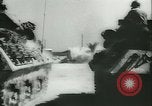
FFI soldiers and French civilians cheer and greet Allied forces as they advance in France during World War II.
The Allies advance after amphibious landings in France during World War II. Allied tanks blast a German pillbox. Nazi gun crews surrender. A nazi soldier with a white flag. The prisoners marched by the Allied soldiers. Allied soldiers search German prisoners and confiscate their belongings. FFI (French Forces of the Interior) soldiers greet and talk to Allied soldiers. The men with the FFI sleeve patches. Allies advance further inland. Citizens of the town of Frejus come out to welcome the Allied troops. They greet and cheer the soldiers. Soldiers on tanks greet the civilians.
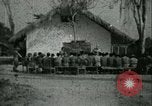
A U.S. OSS officer uses a black board to instruct Burmese students in Burma during World War if.
U.S. OSS (Office of Strategic Services) officers train Burmese recruits in Burma during World War II. An OSS officer instructs Burmese students on ambush and traps. Students seated on benches outside a hut. The instructor uses a black board. He explains the written matter and diagrams on the board. A Burmese instructor translates the information. A student stands up and asks a question. The instructor responds.
CRITICALPAST.COM: About Us | Contact Us | FAQs - How to Order | License Agreement | My Account | My Lightboxes | Shopping Cart | Advanced Search | Featured Collections | Website Terms & Conditions | Privacy Policy ©2026 CriticalPast LLC.
License Agreement |
Terms & Conditions |
Privacy Policy
©2026 CriticalPast LLC.