


 Francais
 Deutsch
 Italiano
Refine Your Search
-Cebu,-Philippines stock footage and images
- Showing 14527 to 14532 of 58885 results more
more Hide
Hide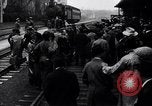
President Wilson visits his hometown to vote in the primaries during campaign in Princeton, New Jersey. He ceremoniously plants trees.
A large crowd gathered at the railroad train station and spilling onto the tracks, watches as a steam locomotive, pulls President Woodrow Wilson's special Pullman rail car (the "Superb") into Princeton, New Jersey. He is arriving on September 28, 1916, to vote in the Democratic Primary elections, during his 1916 presidential reelection campaign. Closeup of the President stepping from his train car and being escorted by National Guard soldiers and local officials. Next, he is seen walking along a sidewalk, accompanied by New Jersey Governor, James Fairman Fielder. After voting in the primary election (unseen) the President is seen standing with his wife, Edith Galt Wilson, and the Governor, on an outdoor platform, wrapped in patriotic bunting. President Wilson appears to hold some speaking notes. Closeup of people gathered below the platform, including a Boy Scout, and members of the New Jersey Federation of Women’s Clubs. The President steps down from the platform and is given a spade that he uses to plant some trees along the Lincoln Highway. Mrs. Wilson watches along with others in the background.
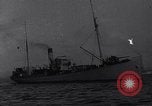
Armed French Trawlers (auxiliary cruisers) partrolling the North Sea in world War I
Opening scene shows a single funnel French trawler (auxiliary cruiser) armed with a deck gun. View from the trawler as she apprehends a small sailing vessel carrying cargo. Officer from the trawler aboard the smaller vessel, inspecting her papers and cargo. He converses with her Captain. View from another French auxiliary cruiser firing a large naval gun. Vvieww of French gun crew loading and firing a 5-inch deck gun.
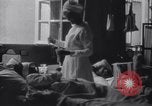
A nurse caring for wounded American soldiers in World War 1
A nurse on duty in a crowded ward of wounded American soldiers in World War I. She pours some water for one of the patients, whose head is bandaged. She converses with him. The nurse sitting with a wounded soldier on a bench in some gardens outside the hospital. The patient is smoking a cigarette. His left arm appears to be in a sling underneath his hospital coat.
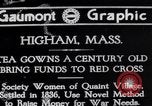
Women at a tea gown party wearing long gowns in a garden to raise money for war needs in Hingham, Massachusetts.
Women at tea gown party wearing long gowns in a garden to raise money for war needs in Hingham, Massachusetts, during World War 1. Women sit on chairs. More women come and join them. Women talk.
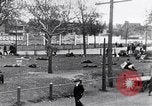
Homeless people and scenes of destruction after T. A. Gillespie Company Shell Loading Plant explosion
Displaced homeless people and refugees gather in grassy area near a railroad station, following explosion of the World War I shell loading facility. The T. A. Gillespie Company Shell Loading Plant explosion, sometimes called the Morgan Depot Explosion, occurred in October 4, 1918. The plant was one of the largest munitions facilities in the world at the time. Damage was extensive in the South Amboy and Sayreville area. Clip shows a refugee family posing together, sitting in the grass. Many billboard signs are on nearby fences and a grass and sidewalk area beside railroad tracks. The Perth Amboy Railroad Depot (train station) building on Smith Street is seen behind them (this building has since been moved to Lewis Street). With Martial Law imposed, the next scene shows a Coast Guard or Navy sailor on patrol to keep law and order and prevent looting in front of destroyed shopping area stores on Smith Street in Perth Amboy, including the Reynolds Brothers store (Reynolds Bros), at 134 Smith Street (also 136 Smith Street and 138 Smith Street), where the windows are blown out and debris are seen inside the store. The explosion of the Gillespie plant was one of three similar events in the New York-New Jersey area during World War 1: The Black Tom Explosion in 1916, the Kingsland Explosion in 1917, and then the Morgan Depot Explosion in 1918.
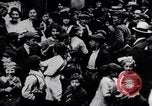
Samuel Gompers visits his boyhood home in London.
Labor and union leader Samuel Gompers visits his boyhood home in London, England. Samuel Gompers seen amid a large crowd. People gather to see him.
CRITICALPAST.COM: About Us | Contact Us | FAQs - How to Order | License Agreement | My Account | My Lightboxes | Shopping Cart | Advanced Search | Featured Collections | Website Terms & Conditions | Privacy Policy ©2026 CriticalPast LLC.
License Agreement |
Terms & Conditions |
Privacy Policy
©2026 CriticalPast LLC.