


 Francais
 Deutsch
 Italiano
Refine Your Search
-Cebu,-Philippines stock footage and images
- Showing 15871 to 15876 of 58885 results more
more Hide
Hide
Scenes of warfare using American technology, including submarines, aircraft bombing of London, atomic bomb use in Japan
Training regarding relief and rebuilding works in Germany and Japan by United States Army, after World War II. Narrator discussing adoption of American inventions during the war that were used against America and allies. Sketch of an early American submarine design, followed by view of German U-boats operating under sea, firing torpedoes and target ship is destroyed. Footage of Wright brothers with an early Wright Brothers airplane invention, as they prepare it for a flight. This is followed by a view of London burning after aerial blitz raids by German aircraft during World War 2. View of atomic bomb explosion over Japanese city of Nagasaki and mushroom cloud seen from the air. Also view of Trinity blast in New Mexico - the first U.S. atomic test. The atomic cloud rises high and vast in the sky. Narrator warning against the perils of a third world war.
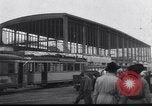
Markets and shops of Berlin busy with buyers and merchandise in morning after night time power cuts
Berlin during Berlin Airlift operations. Streetcars in Berlin enter tunnel. Pedestrians walk on streets. Roads of Berlin darkened during night hours due to power cuts. A Berlin Airlift "Raisin Bomber" airplane flying low over the city at dusk. Headlamps of vehicles on streets during night. People going to work walk up the stairs of a subway in morning hours. Counter girl sells bread and other bakery goods to customers in a bakery shop. Canned goods emptied from a can and weighed in a shop. Citizens gathered around a news stand. A busy market of Berlin. The partially bomb damaged Kaiser Wilhelm Memorial Church in Berlin, with a plan flying in the background.
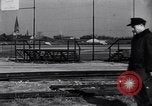
Pilot who was gifted a teddy bear by a German airfield worker, drops candies for children from a plane during Berlin airlift.
Berlin during Berlin airlift operations. A boy runs towards his father and gives him a teddy bear for one of the pilots. The father, an airfield worker gives the teddy to one of the pilots. Pilots approach snack bar on airfield. German labor presents teddy to a pilot who gifts him a pipe. Pilot reaches his home and meets his family. He gifts teddy to his children. A plane in its flight. Pilot walks to a porthole and drops candy by parachute. Children run to get the candies. The plane makes its landing. The airfield worker walk to the pilots and shows them newspaper headlines. Protest meets in Potsdammer Platz. A huge crowd of people assembled. An airplane ready for flight, Pilot observes the radarscope and talks on mike. The plane takes off.
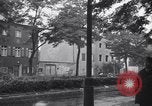
Plane crash and fighting firemen, children surround American pilots at Tempelhof field during Berlin Airlift.
Berlin during Berlin airlift operations. A United States military airplane crashes at Tempelhof during Berlin Airlift operations. Firemen try to control fire in the burning plane. View of the smoldering and destroyed plane. Military Air Transport Service (MATS) Planes parked at Tempelhof Airfield. Unloading of equipment from trucks. Sunderland flying boat lifts off a lake. A crowd of German children runs on the Tempelhof airfield tarmac towards American pilots and present them with bouquets and flowers. Door of a Berlin Airlift supply plane closed. View from runway as C-54 Skymaster airplane taxis, approaches gaining speed for take off, and then takes off.
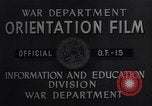
U.S. orientation film for Allied occupation forces, to provide background for understanding Japanese and their society
Background information for United States occupation forces in Japan after end of World War II. At start, the film shows sky filled with U.S. Navy airplanes flying in formations. They include Vought F4U Corsair aircraft, among others, and are seen overhead above the Battleship USS Missouri (BBB-63). Closeup of the USS Missouri with her crew in formation on deck wearing dress whites. Next, General Douglas MacArthur is seen and heard speaking from a podium on the Missouri's deck. He invites the representatives of the Emperor of Japan, and the Japanese Government, and the Japanese Imperial headquarters, to sign the instrument of surrender. The date is September 2, 1945, just after the end of World War 2. Closeups of the Japanese delegation, which includes envoys Foreign Minister Mamora Shigemitsu and General Yoshijiro Umezu, and of MacArthur. Japanese Foreign Minister Mamora Shigemitsu sits at a table. Closeups of him signing the surrender document. Change of scene to Japan, where camera pans over many thousands of Japanese people assembled to learn of their fate. Closeups of Japanese soldiers and family members, as Narrator asks how should the U.S. occupying force treat them. View of soldiers in plain non-military uniforms. Views of Japanese responding en masse to a leader, during World War 2. Views of child victims of the war. Closeup of Japanese soldier firing a short barrel light machine gun. Views of Japanese pedestrians including families, most in western dress. Japanese workers in an office. Film shows artists view of one worker's brain, and then many brains, as Narrator refers to need for reorienting Japanese thinking. View of learned wise Japanese leader at a podium. View of a Japanese soldier posed with his sword above the head of a war prisoner. Japanese mother feeding her baby. Closeups of Japanese babies. Closeups of Japanese school age children, in a group, and some doing things in school, and some at a playground. Group of uniformed Japanese students studying the art of Japanese calligraphy. Students doing artwork, studying nature outdoors, and paying attention to a teacher using a black board to explain how to calculate volumes of different shaped vessels. Students in classes of Geography and of geology. Japanese chemists, architects, and lawyers at work. Telephone switchboard operators at work. Electrified train moving on a track.
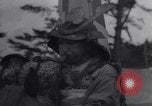
U.S. Army film showing history of Japanese militarism from the days of the Samurai to the 20th Century
Segment of U.S. film orientation film to help Allied Occupation Forces to understand background of Japanese traditions and rise of militarism prior to World War 2. Film begins showing a Japanese man dressed as a Trumpeter (kai yaku) in an army of the Feudal Period, blowing a conch shell horn. Japanese reenact Feudal period ceremonial exercises using pikes. Closeup of the way the pikes interlock as they wield them. Next young Japanese men are seen practicing Bōjutsu (the martial art of using a staff weapon called bō). A large formation of Japanese men practice in unison. A Japanese man dressed as a traditional Samurai warrior of history. Reenactment of Samurai engaged in war showing mounted Samurai warriors and foot soldiers carrying pikes. Image of the sun with Japanese sun flag gradually superimposed upon it. Slate intervenes reading: "The Sun Goddess Created the Japanese to Rule All the Other People of the Earth." Japanese people assembled near large building and tents in a park-like setting. A Japanese military officer addressing a large gathering. Japanese politicians, dressed formally, address a large gathering that includes many military officers. A crowd of Japanese people responding to a speaker by raising their arms in unison, several times. Japanese men in formation, bowing. Japanese women in formation, bowing. Large gatherings of Japanese people bowing en masse. Another politician addressing a gathering in an outdoor arena. Glimpse of Japanese school children being addressed by officials. A room full of banking officers being addressed by an official and farmers also being addressed. Young people and others marching in close order drills. A cadre of Japanese uniformed soldiers marching. A contingent of Japanese army troops marching with shouldered rifles displaying bayonets. More soldiers marching with high stepping gait. Film ends showing Japanese soldiers marching through Tori Gates at various places in Japan.
CRITICALPAST.COM: About Us | Contact Us | FAQs - How to Order | License Agreement | My Account | My Lightboxes | Shopping Cart | Advanced Search | Featured Collections | Website Terms & Conditions | Privacy Policy ©2026 CriticalPast LLC.
License Agreement |
Terms & Conditions |
Privacy Policy
©2026 CriticalPast LLC.